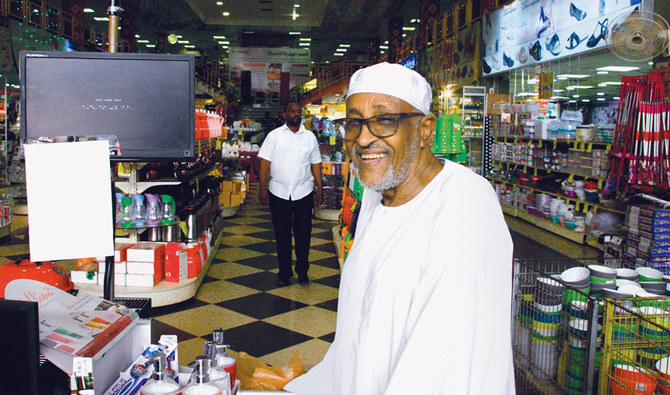

KHARTOUM: Sales have tumbled at Hashem Abul Fadel’s shopping centers in Sudan, where he and fellow business owners fear that months of political turmoil could bring on a full-scale economic collapse.
Sudan’s ruling generals and protesters inked a deal on Wednesday aimed at installing a civilian administration and breaking months of political deadlock.
But the country’s fragile economy has already been hard hit by months of mass protests which led to the military council’s toppling of longtime president Omar Al-Bashir in April.
Demonstrators have continued to demand a transition to civilian rule, keeping up their campaign despite a June 3 crackdown on a protest sit-in that left dozens dead.
Abul Fadel said the unrest had slashed his overall sales by 20-25 percent — or as much as 40 percent for some items.
“The government has yet to announce its economic policies, and as an investor, I can’t take any decisions in the current climate,” he said.
The millionaire businessman depends heavily on imports to stock his five Khartoum malls, but he said many firms have stopped bringing in goods due to the uncertainty.
Fellow entrepreneur Mohammad Hussein Madwi, who owns a string of agricultural and manufacturing firms, echoed his concerns.
“Sales are down by at least 30 percent because of the lack of demand and the collapse of the Sudanese pound,” Madwi said.
“The state of political uncertainty makes me hesitant to invest or import goods, so things have pretty much come to a standstill.”
Since the last devaluation of the pound in October by the then-Sudanese authorities, the currency has plunged by a further 70 percent against the dollar on the black market.
Inflation has meanwhile fallen from a high of 70 percent in December to below 50 percent, according to the country’s central statistics bureau.
Mother of seven Hanadi Mohammad, shopping at one of Abul Fadel’s malls in northern Khartoum, said the lack of liquidity was stopping her spending.
“I don’t know how long we can live like this,” she said, walking past household appliances which, despite heavy discounts, were sitting unsold on the shelves.
Economic concerns were among the initial sparks for the protests, which broke out in December when the government announced it would triple the price of bread.
Months later, the army and protest leaders have agreed on the form of the country’s governing institutions, but further talks will be needed to settle other contentious issues.
That means political uncertainty — and economic woes — are likely to haunt the country for some time to come.
Decades of US sanctions had already devastated Sudan’s economy before the protests broke out in December. The demonstrations quickly burgeoned into a nationwide movement against Bashir — and the resulting unrest, along with persistent power cuts, soon hit the economy.
“Trade activity has been at rock bottom since January,” said Khaled Al-Tijani, a prominent business journalist.
“The economy is suffering from a lack of confidence because of the lack of a government to oversee it.”
In April, Saudi Arabia and the UAE announced a joint $3-billion package of economic aid for Sudan, including a $500 million deposit in Khartoum’s central bank to strengthen the currency.
The remainder is allocated for food, medicine and petrochemicals purchases.
Agriculture is a major sector and a key source of income for most of Sudan’s 40 million inhabitants.
The latest crisis has hit farmers hard, particularly as the collapsing pound has stopped them importing agricultural chemicals.
On Sunday, Riyadh and Abu Dhabi sent Sudan an emergency batch of more than 50,000 tons of fertilizers and other agricultural supplies, according to the official Saudi Press Agency.
Faisal Mohammad, an importer of agricultural supplies, said the lack of foreign currency had hit imports hard.
“Even if they are available, we’re hit by the weakness of the pound and the rising price of goods, as well as a lack of confidence among buyers, all of which negatively impacts farming operations,” he said.
Tijani warned that damage to such a vital sector could harm Sudan’s economy more broadly — bad news for entrepreneurs like Abul Fadel.
“Everyone is alert and waiting,” Abul Fadel said. “If this state of tension and uncertainty continues, the economy will collapse.”
For the tycoon, there is only one way forward.
“A political deal between the military council and (protest leaders) is the only way out of the current economic situation,” he said.