

PM Khan ‘appreciates’ ICJ decision not to acquit Indian convicted of spying

1 / 2
Attorney-General for Pakistan Anwar Mansoor, Foreign Office spokesperson Mohammad Faisal and Shujjat Ali Rathore, Ambassador of Pakistan in the Netherlands, seen before a verdict in the case of Indian national Kulbhushan Jadhav by International Court of Justice, in The Hague, Netherlands, India, July 17, 2019. (REUTERS)
2 / 2
In this file photo, Prime Minister Imran Khan gestures to his supporters during a campaign meeting ahead of general elections in Islamabad, Pakistan, July 21, 2018. (REUTERS)
Updated 18 July 2019
Follow

PM Khan ‘appreciates’ ICJ decision not to acquit Indian convicted of spying

  • Says Kulbhushan Jadhav “guilty of crimes against the people of Pakistan”
  • Army spokesman calls Wednesday’s verdict a victory, foreign office says Pakistan will now proceed as per law

ISLAMABAD: Pakistani Prime Minister Imran Khan on Thursday hailed the decision of the International Court of Justice (ICJ) not to acquit and release former Indian navy commander Kulbhushan Sudhir Jadhav who was convicted of being a spy in 2016.

On Wednesday, the ICJ, the United Nations’ top legal body for hearing disputes between states, ordered Pakistan to review a 2017 military court verdict to execute Jadhav and asked that Islamabad give India consular access to him but did not order his release, as pleaded by India.
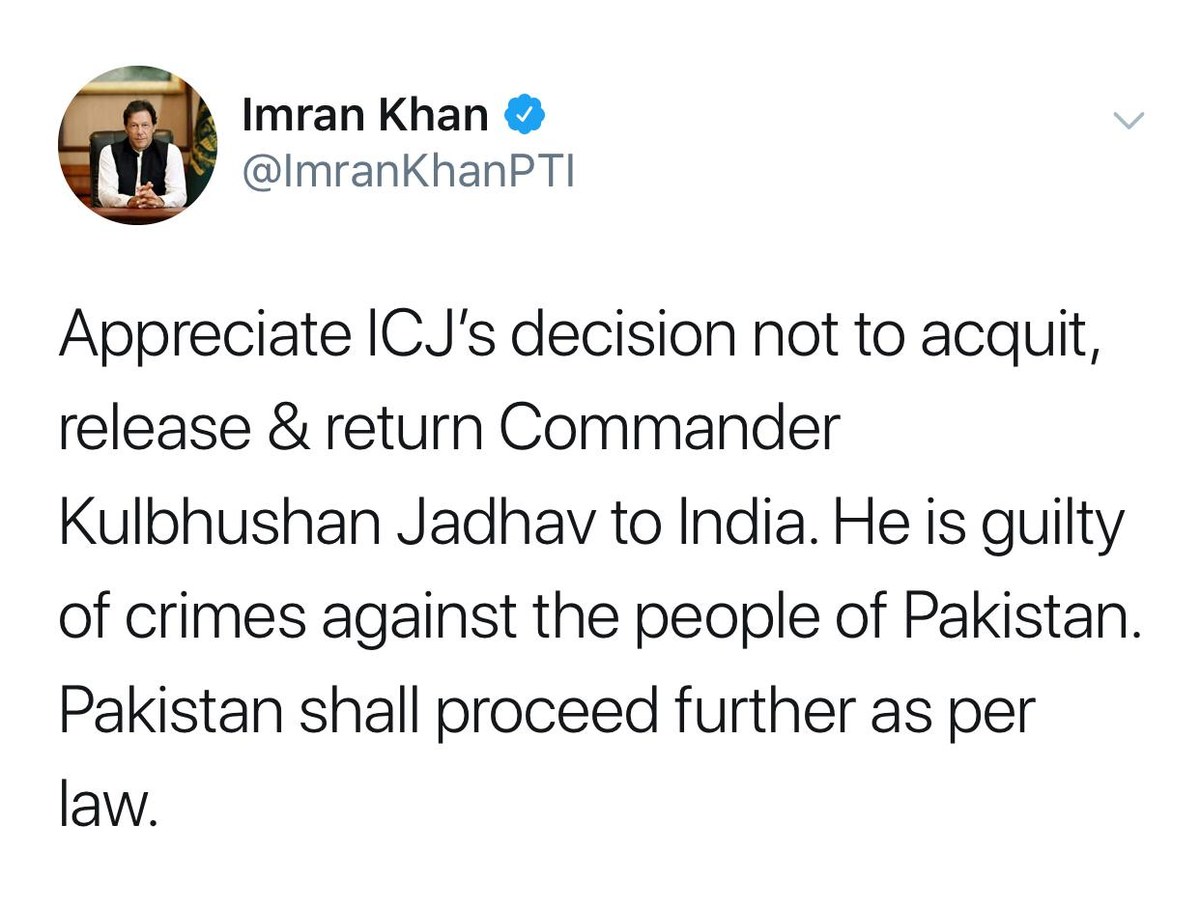
“Appreciate ICJ’s decision not to acquit, release & return Commander Kulbhushan Jadhav to India,” Khan said in a tweet. “He is guilty of crimes against the people of Pakistan. Pakistan shall proceed further as per law.”
Pakistan has maintained that the ICJ need not intervene in the case as the Vienna convention on consular relations did not apply to “spies and terrorists,” and also that a 2008 bilateral treaty with India, that Pakistan says supersedes the Vienna pact, allowed the right to consular access to be waived where “national security” was at risk.
On Wednesday, the ICJ rejected both these arguments, saying Pakistan had breached the Vienna convention by not allowing Indian diplomats to visit Jadhav in jail or assist him during his trial at a military court. The 16-judge panel also said Pakistan had to provide an “effective review” of the case and a “continued stay of execution” of Jadhav was needed for that to happen.
It was unclear from the ruling what exactly would constitute an effective review of Jadhav’s sentence though legal experts say the Pakistani high courts or supreme court would be the most effective forums. The ICJ has no means to enforce its rulings which are final and without appeal.
In an interview with a private Pakistani TV channel, Pakistan’s military spokesman Major General Asif Ghafoor also called the ICJ’s verdict a victory for Pakistan, saying the court had not only rejected India’s plea seeking the release of Jadhav but also not annulled the military court’s judgment awarding him the death penalty, as pleaded by India.
“So this was the best possible (verdict) that we could expect,” the general said.
Sherry Rehman, a former Pakistani ambassador to the United States and a member of the opposition Pakistan People’s Party, said the ICJ had denied most of India’s major demands.
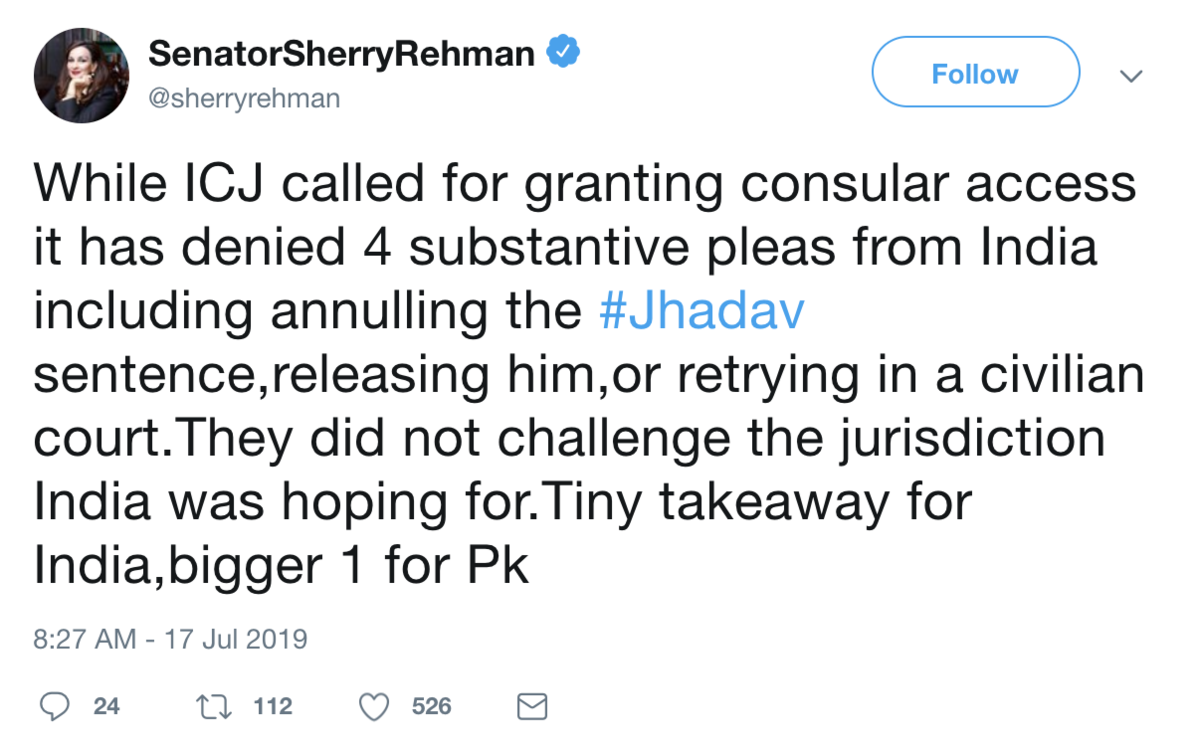
“While ICJ called for granting consular access, it has denied 4 substantive pleas from India including annulling the #Jhadav sentence, releasing him, or retrying in a civilian court,” Rehman said. “They did not challenge the jurisdiction India was hoping for. Tiny takeaway for India, bigger 1 for Pk.”
In a statement released on Wednesday night, the Pakistani Foreign Office said that as a responsible member of the International community, Pakistan had upheld its commitment to rule of law from the very beginning of the case by appearing before the World Court for the provisional measures’ hearing despite very short notice.
“Having heard the judgment, Pakistan will now proceed as per law,” a spokesman for the FO said.
Pakistan has repeatedly described India’s decision to take its case to the UN court as “political theater.”
The Vienna Convention has been a frequent subject of disputes at the ICJ, often in cases involving the United States. The ICJ’s rulings are binding though occasionally flouted, such as in 1999 when US authorities ignored an ICJ injunction and executed a German national.


Pakistan says ensuring interfaith harmony key priority as nation marks Christmas

Updated 25 December 2025
Follow

Pakistan says ensuring interfaith harmony key priority as nation marks Christmas

  • Pakistan is home to over 3 million Christians, making it the third-largest religion in the country
  • PM Sharif economic well-being, equal opportunities for all in message to nation on Christmas

ISLAMABAD: Prime Minister Shehbaz Sharif on Thursday identified ensuring interfaith harmony and freedom of rights for all citizens, especially minorities, as his government’s key priorities as the nation marks Christmas today. 

Millions of Christians worldwide celebrate Dec. 25 as the birth of Jesus Christ, marking the day with religious and cultural festivities. The Christian community in Pakistan marks the religious festival every year by distributing gifts, decorating Christmas trees, singing carols and inviting each other to lavish feasts. 

Christianity is the third-largest religion in Pakistan, with results from the 2023 census recording over three million Christians, or 1.3 percent of the total population in the country. 

However, Christians have faced institutionalized discrimination in Pakistan, including being targeted for blasphemy accusations, suffering abductions and forced conversions to Islam. Christians have also complained frequently of being reserved for jobs considered by the masses of low status, such as sewage workers or brick kiln workers. 

“It remains a key priority of the Government of Pakistan to ensure interfaith harmony, protection of rights and freedoms, economic well-being, and equal opportunities for professional growth for all citizens without discrimination of religion, race, or ethnicity,” Sharif said in a statement issued by the Prime Minister’s Office (PMO). 

The Pakistani premier said Christmas was not only a religious festival but also a “universal message of love, peace, tolerance, and goodwill” for all humanity. 

Sharif noted the Christian community’s contributions to Pakistan’s socio-economic development were immense.

“Their significant services in the fields of education, health care, and other walks of life have greatly contributed to the promotion of social harmony,” the Pakistani prime minister said. 

Despite the government’s assurances of protection to minorities, the Christian community has endured episodes of violence over the past couple of years. 

In May 2024, at least 10 members of a minority Christian community were rescued by police after a Muslim crowd attacked their settlement over a blasphemy accusation in eastern Pakistan.

In August 2023, an enraged mob attacked the Christian community in the eastern city of Jaranwala after accusing two Christian residents of desecrating the Qur’an, setting Churches and homes of Christians on fire. 

In 2017, two suicide bombers stormed a packed church in southwestern Pakistan just days before Christmas, killing at least nine people and wounding up to 56. 

An Easter Day attack in a public park in 2016 killed more than 70 people in the eastern city of Lahore. In 2015, suicide attacks on two churches in Lahore killed at least 16 people, while a pair of suicide bombers blew themselves up outside a 130-year-old Anglican church in the northwestern city of Peshawar after Sunday Mass in 2013. 

The Peshawar blast killed at least 78 people in the deadliest attack on Christians in the predominantly Muslim country.