Facing Olympic hotel shortage, Tokyo looks offshore

1 / 3
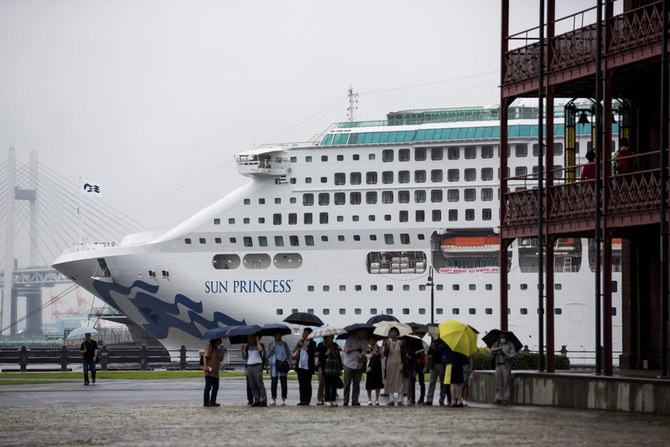
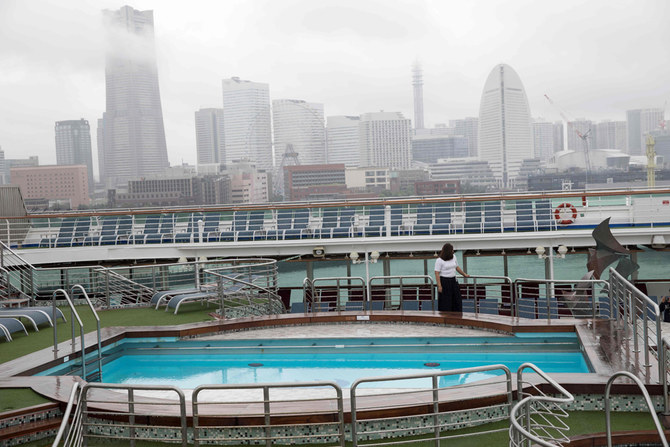
This picture taken on July 16, 2019 shows Sun Princess cruise ship, docked in the port of Yokohama. (AFP / Behrouz Mehri)
2 / 3
This picture taken on July 16, 2019 shows Sun Princess cruise ship, docked in the port of Yokohama. (AFP / Behrouz Mehri)
3 / 3
This picture taken on July 16, 2019 shows Sun Princess cruise ship, docked in the port of Yokohama. (AFP / Behrouz Mehri)
Updated 18 July 2019
Follow

Facing Olympic hotel shortage, Tokyo looks offshore

  • Tokyo could be short as many as 14,000 rooms given an expected surge of Olympics-related tourism
  • Japan’s largest travel agency JTB has chartered the 1,011-cabin Sun Princess for the Olympic period

YOKOHAMA, Japan: Tokyo is facing a shortage of accommodation when Olympic fans pour into the Japanese capital for next year’s Games so officials are looking offshore — to moored cruise ships operating as floating hotels.
Despite a construction boom, Tokyo could be short as many as 14,000 rooms given an expected surge of Olympics-related tourism, according to researchers.
Local officials think one solution could be to put people up in giant ships temporarily docked off Tokyo and nearby Yokohama during the Games.
Among those on board with the idea is Japan’s largest travel agency JTB, which has chartered the 1,011-cabin Sun Princess for the Olympic period, complete with everything from jacuzzis to a theater.
The agency is offering packages that combine rooms with Olympic event tickets, but they don’t come cheap.
Two nights in a room with a balcony combined with tickets to an Olympic football match will run 200,000 yen ($1,850), while two nights in a 50-square-meter suite combined with baseball tickets will go for 724,000 yen ($6,700).
The agency said it was confident about demand, partly because “we will have a shortage of hotels of a certain standard,” said Minoru Kuge, head of JTB’s Tokyo2020 Project Office.
“Although we can’t disclose the actual numbers, we have received an excellent reaction from our customers,” he told AFP on a tour of the luxury ship.
And Kuge said he expected the package to have a special draw — “a sense of unity” among customers who will all be cheering on Olympic athletes.
Elsewhere, plans have been negotiated for the 928-cabin Explorer Dream ship to dock in Kawasaki, in western Tokyo bay.
And both Tokyo’s local government and officials in Chiba prefecture, east of the capital, are looking into additional cruise ship possibilities.
Japan’s hotel business law bans rooms without a window, but the health ministry last year issued an ordinance that allows ships with windowless cabins to be used as hotels during major events.
But experts warn that a few cruise ships may not be enough.
“It is unclear if hotels ships in the Tokyo Bay will be able to cover hotel rooms shortage,” warned a report on the issue published in October by Mizuho Research Institute.
Even the number of tourists the capital can expect remains unclear because the increase in Olympic visitors may be balanced out by other tourists opting to stay away until the Games are done.
Regardless, Tokyo officials see the ships as a novel accommodation solution, and are also planning to open a new cruise ship terminal days before the Games began.
Officials and industry experts hope using docked ships for extra hotel space will become common in the country, as a way to cater to visitors during special events, or even help people displaced during disasters.
“If a provincial city wants to host an international convention or other big events but doesn’t have enough accommodation, hotel ships can be a solution,” said Yoshimi Tajima, JTB’s senior official at the corporate business department.


Congress taking first votes on Iran war as debate rages about US goals

Updated 6 sec ago
Follow

Congress taking first votes on Iran war as debate rages about US goals

  • The US Senate is headed toward a vote on President Donald Trump’s decision to embark on a war against Iran
  • It’s an extraordinary test in Congress for a conflict that has rapidly spread across the Middle East with no clear US exit strategy
WASHINGTON: The US Senate is headed toward a vote Wednesday on President Donald Trump’s decision to embark on a war against Iran, an extraordinary test in Congress for a conflict that has rapidly spread across the Middle East with no clear US exit strategy.
The legislation, known as a war powers resolution, gives lawmakers an opportunity to demand congressional approval before any further attacks are carried out. The Senate resolution and a similar bill being voted on in the House later this week face unlikely paths through the Republican-controlled Congress and would almost certainly be vetoed by Trump even if they were to pass.
Nonetheless, the votes marked a weighty moment for lawmakers. Their decisions on the five-day-old war — which Trump entered without congressional approval — could determine the fates of US military members, countless other lives and the future of the region.
“Wars without clear objectives do not remain small. They get bigger, bloodier, longer and more expensive,” said Senate Democratic leader Chuck Schumer at a news conference Tuesday. “This is not a necessary war. It’s a war of choice.”
Trump administration scrambles for congressional support
After launching a surprise attack against Iran on Saturday, Trump has scrambled to win support for a conflict that Americans of all political persuasions were already wary of entering. Trump administration officials have been a frequent presence on Capitol Hill this week as they try to reassure lawmakers that they have the situation under control.
“We are not going to put American troops in harm’s way,” Secretary of State Marco Rubio told reporters in a raucous news conference at the Capitol Tuesday.
But six US military members were killed over the weekend in a drone strike in Kuwait.
Trump has also not ruled out deploying US ground troops. He has said he is hoping to end the bombing campaign within a few weeks, but his goals for the war have shifted from regime change to stopping Iran from developing nuclear capabilities to crippling its navy and missile programs.
“I think they are achieving great success with what they’ve done so far,” Senate Majority Leader John Thune said Tuesday, adding that what happens next in the country will be “largely up to the Iranian people.”
Almost all Republican senators were readying to vote Wednesday against the war powers resolution to halt military action, but a number still expressed hesitation at the idea of deploying troops on the ground in Iran.
“I don’t think the American people want to see troops on the ground,” said Sen. Bill Cassidy, R-Louisiana, as he exited a classified briefing Tuesday. He added that Trump administration officials “left open that possibility,” but it wasn’t an option they were emphasizing.
Lawmakers to go on record
The votes in Congress this week represented potentially consequential markers of just where lawmakers stand on the war as they look ahead to midterm elections and the consequences of the conflict.
“Nobody gets to hide and give the president an easy pass or an end-run around the Constitution,” said Sen. Tim Kaine, the Virginia Democrat leading the war powers resolution. “Everybody’s got to declare whether they’re for this war or against it.”
Republican leaders have successfully, though narrowly, defeated a series of war powers resolutions pertaining to several other conflicts that Trump has entered or threatened to enter. This one, however, is different.
Unlike Trump’s military campaigns against alleged drug boats or even Venezuelan leader Nicolás Maduro, the attack on Iran represents an open-ended conflict that is already ricocheting across the region. For Republicans who are used to operating in a political party dominated by Trump and his promises of keeping the US out of foreign entanglements, the moment represented a bit of whiplash.
“War is ugly, it always has been ugly, but we’re taking out a regime that has been trying to attack us for quite some time,” said Sen. Markwayne Mullin, an Oklahoma Republican.
Meanwhile, Sen. Lindsey Graham, a South Carolina Republican who has long pushed Trump to engage overseas, argued that the widening conflict represented an opportunity for Arab and European countries to join in the fight against Iran and the militant groups it supports.
“I don’t mind people being on record as to whether or not they think this is a good idea,” he told reporters, but also argued that too much power over the military was ceded to Congress in the War Powers Act, which mandates that presidents must withdraw troops from a conflict within 90 days if there is no congressional authorization.
House vote looms
On the other side of the Capitol, House leaders were also readying for an intense debate over the war followed by a vote Thursday.
“I do believe we have the votes to defeat it, I certainly hope we do,” House Speaker Mike Johnson said after an all-member briefing on Tuesday night.
Meanwhile, House Democratic leader Hakeem Jeffries said he expected a strong showing from Democrats in favor of the war powers resolution.
As lawmakers emerged from a closed-door briefing Tuesday night, Rep. Gregory Meeks, the top Democrat on the House Foreign Affairs Committee, implored the Trump administration to “come to Congress” and speak directly to the American people about the rationale for the war.
His voice filled with emotion as he said, “Our young men and women’s lives are on the line.”