TOKYO: Tokyo’s new National Stadium is 90 percent completed with the opening of the Olympics just over a year away.
Media were given a glimpse inside the $1.25 billion stadium on Wednesday. It is located in central Tokyo and will be the scene of the opening ceremony on July 24, 2020. It will also be the venue for track and field and some soccer.
Organizers say they are planning events in December to inaugurate the new stadium, which was designed by Japanese architect Kengo Kuma.
The new stadium design was first awarded to British architect Zaha Hadid, but eventually the futuristic design was scrapped by the government as the cost soared toward $2 billion.
Organizers say about 45,000 of the 60,000 permanent seats have been installed, and the grass surface should be down by the end of the month. The all-weather track will be installed in August and September.
Including the stadium, Tokyo is building eight new venues for the Olympics. The other 35 venues for the games are defined as “temporary” or older buildings that are being reused, which Tokyo organizers say has saved billions. The other centerpiece for the games will be the Olympic Village for more than 10,000 athletes being built on the edge of Tokyo Bay.
The Summer Olympics don’t come cheaply, and even existing venues need extensive renovation when the Games come to town. Exact costs — what are, and are not Olympic expenses — are difficult to sort out. But Tokyo is spending at least $20 billion to get ready, 70 percent of which is taxpayers’ money.

Tokyo Olympic stadium 90% complete; opening set for December
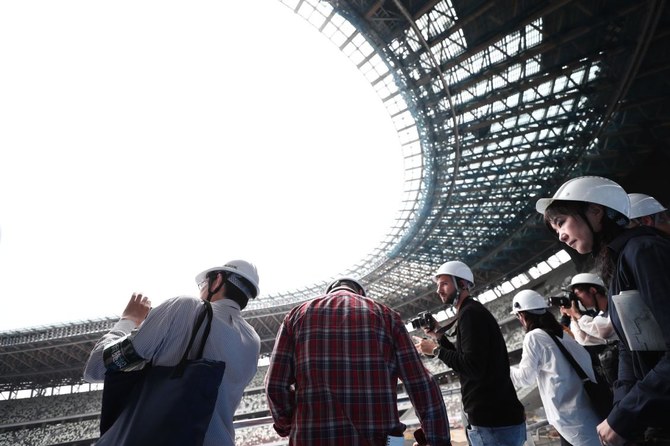
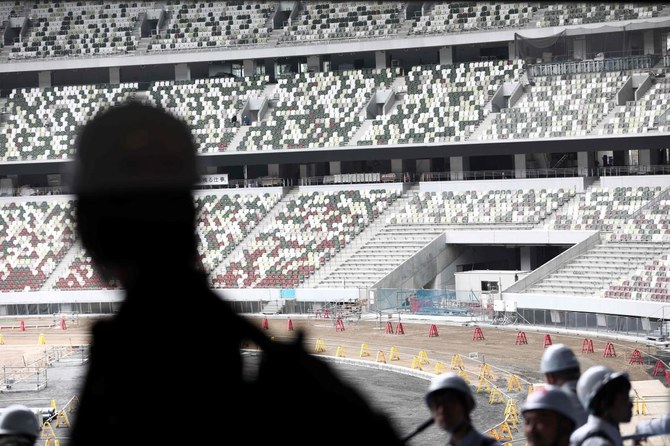
- Organizers say they are planning events in December to inaugurate the new stadium
- Tokyo is spending at least $20 billion to get ready, 70 percent of which is taxpayers’ money
Home hero Piastri edges Antonelli in second Australian GP practice
- McLaren’s Oscar Piastri powered to the fastest time ahead of Mercedes’ Kimi Antonelli in second practice for the season-opening Australian Grand Prix on Friday
MELBOURNE: McLaren’s Oscar Piastri powered to the fastest time ahead of Mercedes’ Kimi Antonelli in second practice for the season-opening Australian Grand Prix on Friday as drivers grappled with sweeping new engine changes.
The Australian sent 125,000 fans at his home track into a frenzy by blasting round Albert Park in one minute 19.729secs, 0.214 clear of Antonelli.
Antonelli’s teammate, pre-season favorite George Russell, came third, a fraction clear of Ferrari’s seven-time world champion Lewis Hamilton.
“A lot of learnings but overall a reasonably good day,” said Piastri, who won seven times last year but could only finish the championship in third.
“FP2 ran smoothly and we were able to find a bit more consistency and the car behaved more as we expected, which was good.”
After a dismal debut season with Ferrari last year, an upbeat Hamilton was encouraged by what had been achieved so far by the Scuderia.
“It was challenging at times on track, but we maximized our laps and executed to the best of our ability, getting some good information,” he said.
“Lots of work to do but I’m looking forward to getting back in the car tomorrow.”
Charles Leclerc, in the other Ferrari, was fifth with four-time world champion Max Verstappen sixth after spending half the session in the garage having stalled his Red Bull.
McLaren world champion Lando Norris clawed his way to seventh, more than one second off the pace, after managing only seven laps in first practice due to gearbox issues.
“We’ve got some good bits of data to go over from the second half of FP2 and there’s plenty we can learn from what our competitors have been doing,” said Norris, while admitting to “a tricky first day.”
Racing Bulls’ impressive rookie Arvid Lindblad banked an eye-opening eighth, a place ahead of Isack Hadjar — the man he replaced and who is now Verstappen’s teammate.
F1 begins new era
It was the first proper test of far-reaching new engine and chassis rules with the hybrid power units now 50 percent traditional combustion and 50 percent electric.
With a finite amount of energy available, drivers had to carefully manage their batteries on each lap, working out when to deploy while building it up back through braking.
The challenge of Albert Park is its long sweeping straights, which deplete batteries, and relatively few twisty turns to brake and charge it up again.
There have also been changes to the aerodynamics of the cars, which are lighter and smaller.
On a perfect Melbourne afternoon, Nico Hulkenberg led them out, but it was Hamilton who set the opening time.
Verstappen had an inauspicious start, stalling in the pit lane, while Russell clipped Lindblad on his way out and needed a new nose.
Verstappen’s car was wheeled back into the garage, apparently stuck in gear, where he stayed for almost half an hour.
The drivers started on a mix of medium and hard tires and Russell soon upstaged Hamilton as they jockeyed for places.
At the halfway mark it was Italy’s Antonelli, Russell, Hamilton and Piastri.
Russell locked up and hit the gravel at Turn 3 as he pushed hard, as did Hamilton, but they both kept enough momentum to get back on track.
Piastri blasted to the top of the timesheets on soft tires with 25 minutes left as Verstappen began climbing the leaderboard.
But the Dutchman was trying too hard and careered into the gravel at Turn 10 with debris flying off his car, ending his day early.
Fernando Alonso clocked 18 laps and Lance Stroll 13 as the troubled Aston Martins battle extreme vibration caused by the new Honda power unit.
Newcomers Cadillac — the 11th team on the grid — also struggled with Valtteri Bottas 19th and Sergio Perez last.
In first practice, Leclerc outpaced Hamilton with Verstappen and Hadjar third and fourth.


