Vietnam, China embroiled in South China Sea standoff

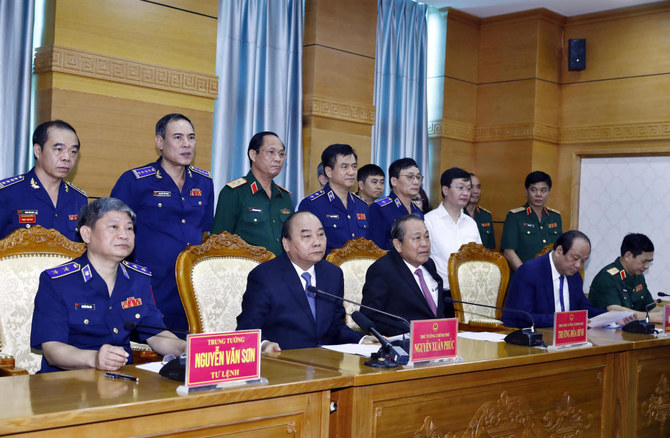
Vietnam’s Prime Minister Nguyen Xuan Phuc, second left, front, and Deputy Prime Minister Truong Hoa Binh, second right, front, speak with deployed Coast Guard Force sailors via video call on July 11, 2019. (VNA via Reuters)
Updated 17 July 2019
Follow

Vietnam, China embroiled in South China Sea standoff

  • China’s U-shaped ‘nine-dash line’ marks a vast expanse of the South China Sea that it claims
  • It includes large swathes of Vietnam’s continental shelf where it has awarded oil concessions

HANOI: Vietnamese and Chinese ships have been embroiled in a weeks-long standoff near an offshore oil block in disputed waters of the South China Sea, which fall within Vietnam’s exclusive economic zone, two Washington-based think-tanks said on Wednesday.
China’s U-shaped “nine-dash line” marks a vast expanse of the South China Sea that it claims, including large swathes of Vietnam’s continental shelf where it has awarded oil concessions.
The Haiyang Dizhi 8, a ship operated by the China Geological Survey, on Monday completed a 12-day survey of waters near the disputed Spratly Islands, according to separate reports by the Center for Strategic and International Studies (CSIS) and the Center for Advanced Defense Studies (C4ADS)
One of the oil blocks it surveyed is licensed by Vietnam to Spanish energy firm Repsol, which was forced last year and in 2017 to cease operations in Vietnamese waters because of pressure from China.
As the Haiyang Dizhi 8 conducted its survey, nine Vietnamese vessels closely followed it. The Chinese ship was escorted by three China Coast Guard vessels, according to data from Winward Maritime, compiled by C4ADS.
In a separate incident days earlier, the China Coast Guard ship Haijing 35111 maneuvered in what CSIS described as a “threatening manner” toward Vietnamese vessels servicing a Japanese-owned oil rig, the Hakuryu-5, leased by Russian state oil firm Rosneft in Vietnam’s Block 06.1, 370 km (230 miles) southeast of Vietnam.
That block is within the area outlined by China’s “nine-dash line.” A series of dashes on Chinese maps, the line is not continuous, making China’s claims often ambiguous.
Last year, Reuters exclusively reported that Rosneft Vietnam BV, a unit of Rosneft, was concerned that its drilling in Block 06.1 would upset China.
“On July 2 the vessels were leaving the Hakuryu-5 when the 35111 maneuvered between them at high speed, passing within 100 meters of each ship and less than half a nautical mile from the rig,” CSIS said in its report.
It was not clear on Wednesday if any Chinese ships were still challenging the Rosneft rig.
In 2014, tension between Vietnam and China rose to its highest levels in decades when a Chinese oil rig started drilling in Vietnamese waters. The incident triggered boat rammings by both sides and anti-China riots in Vietnam.
In response to reports of this month’s standoff, which first emerged on social media, Chinese foreign ministry spokesman Geng Shuang said on July 12 that China’s position on the South China Sea was “clear and consistent.”
“China resolutely safeguards its sovereignty in the South China Sea and maritime rights, and at the same time upholds controlling disputes with relevant countries via negotiations and consultations,” Geng said, without elaborating.
On Tuesday, Vietnam’s foreign ministry released a statement in response to unspecified “recent developments” in the South China Sea.
“Without Vietnam’s permission, all actions undertaken by foreign parties in Vietnamese waters have no legal effect, and constitute encroachments in Vietnamese waters, and violations of international law,” foreign ministry spokeswoman Le Thi Thu Hang said.
Neither statements confirmed or elaborated on the standoff.
Neither Rosneft nor Repsol immediately responded to an emailed request from Reuters for comment.
In a new statement on Wednesday, China’s foreign ministry spokesman Geng acknowledged that there had been an incident with Vietnam.
“We hope the Vietnam side can earnestly respect China’s sovereignty, rights, and jurisdiction over the relevant waters, and not take any actions that could complicate the situation,” Geng told a regular news conference.
On July 11, as China was conducting its survey of the blocks, Vietnam’s prime minister, Nguyen Xuan Phuc, visited the headquarters of the Vietnam Coast Guard in Hanoi.
State media did not mention the incident, but showed Phuc speaking to sailors on board vessels via a video link.
Phuc told the sailors to “stay vigilant and ready to fight” and to be aware of “unpredictable developments,” the Vietnam Coast Guard said in a statement on its website.
On the same day, Vietnam’s national assembly chairwoman, Nguyen Thi Kim Ngan, met her Chinese counterpart, Li Zhanshu, in Beijing, China’s Xinhua news agency reported.
The two officials agreed to “jointly safeguard peace and stability at sea,” Xinhua said.


Britain’s Starmer ends China trip aimed at reset despite Trump warning

Updated 1 sec ago
Follow

Britain’s Starmer ends China trip aimed at reset despite Trump warning

  • Keir Starmer’s visit was the first to China by a British prime minister in eight years
  • Leaders from France, Canada and Finland have flocked to Beijing in recent weeks
SHANGHAI: British Prime Minister Keir Starmer wrapped up a four-day trip to China on Saturday, after his bid to forge closer ties prompted warnings from US President Donald Trump.
Starmer’s visit was the first to China by a British prime minister in eight years, following in the footsteps of other Western leaders looking to counter an increasingly volatile United States.
Leaders from France, Canada and Finland have flocked to Beijing in recent weeks, recoiling from Trump’s bid to seize Greenland and tariff threats against NATO allies.
Trump warned on Thursday it was “very dangerous” for Britain to be dealing with China.
Starmer brushed off those comments on Friday, noting that Trump was also expected to visit China in the months ahead.
“The US and the UK are very close allies, and that’s why we discussed the visit with his team before we came,” Starmer said in an interview with UK television.
“I don’t think it is wise for the UK to stick its head in the sand. China is the second-largest economy in the world,” he said.
Asked about Trump’s comments on Friday, Beijing’s foreign ministry said “China is willing to strengthen cooperation with all countries in the spirit of mutual benefit and win-win results.”
Starmer met top Chinese leaders, including President Xi Jinping and Premier Li Qiang, on Thursday, with both sides highlighting the need for closer ties.
He told business representatives from Britain and China on Friday that both sides had “warmly engaged” and “made some real progress.”
“The UK has got a huge amount to offer,” he said in a short speech at the UK-China Business Forum at the Bank of China.
He signed a series of agreements on Thursday, with Downing Street announcing Beijing had agreed to visa-free travel for British citizens visiting China for under 30 days, although Starmer acknowledged there was no start date for the arrangement yet.
The Chinese foreign ministry said only that it was “actively considering” the visa deal and would “make it public at an appropriate time upon completing the necessary procedures.”
He also said Beijing had lifted sanctions on UK lawmakers targeted since 2021 for their criticism of alleged human rights abuses against China’s Muslim Uyghur minority.
“President Xi said to me that that means all parliamentarians are welcome,” Starmer said in an interview with UK television.
He traveled from Beijing to economic powerhouse Shanghai, where he spoke with Chinese students at the Shanghai International College of Fashion and Innovation, a joint institute between Donghua University and the University of Edinburgh.
On Saturday, Starmer visited a design institute and met with performing arts students alongside British actress Rosamund Pike, who spoke of her children’s experience learning Mandarin.
Later on Saturday, Starmer will arrive in Tokyo for a meeting with Japanese counterpart Sanae Takaichi.
Visas and whisky
The visa deal could bring Britain in line with about 50 other countries granted visa-free travel, including France, Germany, Australia and Japan, and follows a similar agreement made between China and Canada this month.
The agreements signed included cooperation on targeting supply chains used by migrant smugglers, as well as on British exports to China, health and strengthening a bilateral trade commission.
China also agreed to halve tariffs on British whisky to five percent, according to Downing Street.
British companies sealed £2.2 billion ($3 billion) in export deals and around £2.3 billion in “market access wins” over five years, and “hundreds of millions worth of investments,” Starmer’s government said in a statement.
Xi told Starmer on Thursday that their countries should strengthen dialogue and cooperation in the context of a “complex and intertwined” international situation.
Relations between China and Britain deteriorated from 2020 when Beijing imposed a national security law on Hong Kong and cracked down on pro-democracy activists in the former British colony.
However, China remains Britain’s third-largest trading partner, and Starmer is hoping deals with Beijing will help fulfil his primary goal of boosting UK economic growth.
British pharmaceutical group AstraZeneca said on Thursday it would invest $15 billion in China through 2030 to expand its medicines manufacturing and research.
And China’s Pop Mart, makers of the wildly popular Labubu dolls, said it would set up a regional hub in London and open 27 stores across Europe in the coming year, including up to seven in Britain.