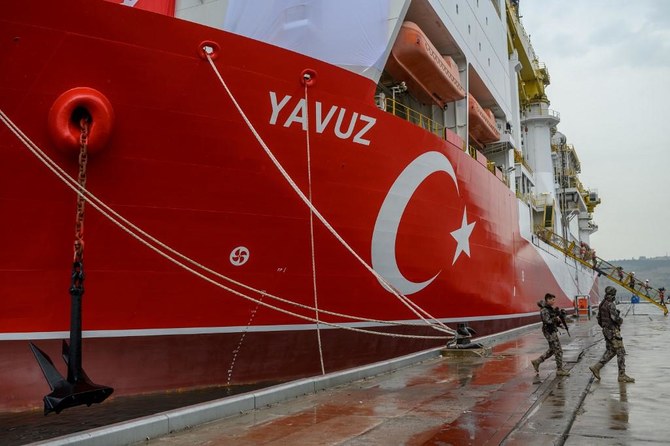
ANKARA: Turkey on Tuesday rejected as “worthless” an initial set of sanctions approved by the European Union against Ankara, and vowed to send a new vessel to the eastern Mediterranean to reinforce its efforts to drill for hydrocarbons off the island of Cyprus.
EU foreign ministers on Monday approved sanctions against Turkey over its drilling for gas in waters where EU member Cyprus has exclusive economic rights. They said they were suspending talks on an air transport agreement, as well as high-level Turkey-EU dialogues, and would call on the European Investment Bank to review its lending to the country.
They also backed a proposal by the EU’s executive branch to reduce financial assistance to Turkey for next year. The ministers warned that additional “targeted measures” were being worked on to penalize Turkey, which started negotiations to join the EU in 2005.
Speaking at a news conference in Macedonia, Turkish Foreign Minister Mevlut Cavusoglu said the sanctions aimed to “appease” Cyprus and were of “no importance.”
“The EU needs us concerning the migration issue or other issues,” he said. “They will come to us and hold contacts; there is no escaping that.”
“They know that the decisions they took cannot be applied,” he said. “They were forced to take the worthless decisions under pressure from the Greek Cypriots and Greece.”
Cavusoglu added: “If you take such decisions against Turkey, we will increase our activities. We have three ships in the eastern Mediterranean, will with send a fourth.”
Earlier, the Turkish Foreign Ministry criticized the EU for ignoring the rights of Turkish Cypriots and accused the 28-nation bloc of “prejudice and bias.”
It added that Turkey was determined to protect its rights and the rights of Turkish Cypriots.
Two Turkish vessels escorted by warships are drilling for gas on either end of ethnically divided Cyprus. A third Turkish exploration ship is also in the area. Turkey insists that it has rights over certain offshore zones and that Turkish Cypriots have rights over others.
Cyprus was split along ethnic lines in 1974 when Turkey invaded in the wake of a coup by supporters of union with Greece. A Turkish Cypriot declaration of independence is recognized only by Turkey, which keeps more than 35,000 troops in the breakaway north. Cyprus joined the EU in 2004, but only the internationally recognized south enjoys full membership benefits.
Cypriot officials accuse Turkey of using the minority Turkish Cypriots in order to pursue its goal of exerting control over the eastern Mediterranean region.
The Cypriot government says it will take legal action against any oil and gas companies supporting Turkish vessels in any repeat attempt to drill for gas. Cyprus has already issued around 20 international arrest warrants against three international companies assisting one of the two Turkish vessels now drilling 68 kilometers off the island’s west coast.


![]()

Turkey: EU sanctions over gas drilling ‘worthless’
Turkey: EU sanctions over gas drilling ‘worthless’
- EU foreign ministers said they are suspending talks with Turkey over air transport agreement
- They backed EU’s proposal to decrease financial assistance to Turkey


Latest updates





© 2026 SAUDI RESEARCH & PUBLISHING COMPANY, All Rights Reserved And subject to Terms of Use Agreement.