

Emirati artist Farah Al-Qasimi’s first solo US show set to open

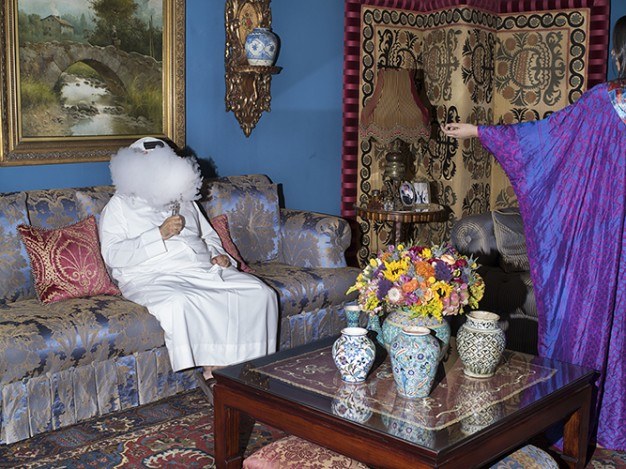
Farah Al-Qasimi’s ‘Living Room Vape’ (2017). (Supplied)
Updated 16 July 2019
Follow

Emirati artist Farah Al-Qasimi’s first solo US show set to open

DUBAI: Emirati artist Farah Al-Qasimi’s first solo exhibition at a US institution is set to open on July 30 at the MIT List Visual Arts Center in Cambridge, Massachusetts.

Working in photography, video, and performance, Al-Qasimi’s work explores themes of gender, nationality and class. Her photographs subvert ingrained expectations of how images are constructed and understood and she is known for borrowing conventions from various sources, including documentary photography and Renaissance paintings.


Um Al Naar (Mother of Fire) (still), 2019. (Supplied)

Camouflage and concealment play a central role in the artist’s work. In a recent series of portraits, Al-Qasimi obscures the faces of her subjects while capturing intimate images, despite the lack of a clear, engaging face. Various compositional strategies hide identifying features — behind plumes of smoke, a well-placed hand, or sumptuously patterned textiles and drapery — while she still manages to accentuate the opulent interiors her subjects inhabit.

Alongside a group of recent photographs, the exhibition will include a screening of Al-Qasimi’s new film, “Um Al Naar (Mother of Fire)” (2019), which was recently unveiled at Art Basel Statements.


M Napping on Carpet, 2016. (Supplied)

The 40-minute video is structured like a television documentary following a jinn — a ghost-like entity in Islamic tradition. Delivering a confessional, reality TV-style monologue, the jinn appears on camera beneath a patterned sheet. The video interweaves her thoughts on centuries of Portuguese and British colonial meddling in the modern-day emirate of Ras Al-Khaimah in the UAE. The video also explores the influence of the European presence in the region and the use of Euro-centric practices for the display of historical artifacts.

Curated by Henriette Huldisch, the director of exhibitions at the MIT List Visual Arts Center, the exhibition marks the first time Al-Qasimi’s work has been shown in a solo exhibition in the US — it is set to wrap up on Oct. 20.  

The artist lives and works between New York and Dubai and has seen her work exhibited in The Third Line gallery in Dubai, Jameel Arts Centre in Dubai and the San Francisco Arts Commission, among other locations.

Al-Qasimi received her MFA from the Yale School of Art and has participated in residencies at the Delfina Foundation in London; the Skowhegan School of Painting and Sculpture in Maine; and is a recipient of the New York NADA Artadia Prize and the Aaron Siskind Individual Photographer’s Fellowship.


‘The Wild Within’ sees artists breathe new life into Mideast buildings

Updated 1 min 7 sec ago
Follow

‘The Wild Within’ sees artists breathe new life into Mideast buildings

DUBAI: Lens-based artist Ryan Koopmans and digital artist Alice Wexell are staging a showcase at Dubai’s Leila Heller Gallery that breathes new life into regional buildings.

The series of digital artworks is part of the exhibition “The Wild Within,” featuring images of old structures in Beirut, Istanbul, and Abu Dhabi filled with wild flowers.

Two of the largest works, “Heartbeats” and “The Wish,” are displayed using Ventana, a microLED architectural display surface created by visual technology company Megapixel.

'Around Us' by Ryan Koopmans and Alice Wexell. (Supplied) 

The former artwork depicts the entrance hall of Qasr Al-Watan, the UAE’s presidential palace in Abu Dhabi, while the latter reimagines the upper floors of the Emirates Palace Mandarin Oriental in Abu Dhabi.

“Each building we work with comes to us through a combination of research, travel, and intuition,” the artists told Arab News in a joint statement.

“We are drawn to structures that carry both emotional and historical resonance, often buildings that once embodied human ambition and now exist in a state of quiet transformation.”

Koopans and Wexell made sure to research the context of each building they choose to recreate, saying “an old villa in Jeddah or a former school in Sharjah each hold their own cultural memory, influencing everything from the lighting and atmosphere to the plants and flowers that we digitally sculpt and implement into the photographs.”

'Heart of Sharjah' by Ryan Koopmans and Alice Wexell. (Supplied) 

The hypnotic works depict the interior of buildings in the region, with digitally rendered flowers carpeting the floor in a bid to “(reimage) these spaces (and) explore the relationship between nature, place, and time, while celebrating each site as a unique work of architecture with its own spirit and story,” the artists said.

Koopmans is of dual Canadian and Dutch heritage, while Wexell is Swedish and based in Stockholm, so it is noteworthy that both artists chose to explore the Middle East for their latest project.

'Blossom of the Ancestors' by Ryan Koopmans and Alice Wexell. (Supplied) 

“In the Middle East especially, the architecture reflects a layered past that merges different styles and eras, while also expressing a sense of renewal and forward-looking energy, particularly in the region’s fantastic contemporary buildings. We are drawn to the symmetry, geometry and patterns that are found not only in nature itself, but in the architectural language of the region both past and present,” they said.

The series — featuring works such as “Adore You,” “Between Worlds,” and “Blossom of the Ancestors” — explores contrasts between the natural world and human-made forms, as well as the traditional and contemporary worlds.

“We are interested in how these elements coexist and merge into one another, creating a sense of hyperrealism that feels both familiar and imaginary. By merging photography with digital sculpture, the artworks question where the boundary lies between documentation and invention, and how technology can extend rather than replace our sense of the natural world.”

'Under the Rain of Light' by Ryan Koopmans and Alice Wexell. (Supplied) 

Although the scale of the artworks ensures they leave the viewer entranced, it did pose challenges, according to the artists.

“Presented at a large scale, every texture in these artworks becomes visible, which can be demanding but is also incredibly rewarding. The magnified detail allows the visceral and atmospheric layers of the pieces to come through with greater impact,” they said, adding that each piece took “many months” to create.

“Ultimately, we want our collectors to experience a sense of wonder and contemplation, as if they are standing inside a dream that feels both entirely real yet unreal.”

The exhibition runs until Jan. 15, 2026.