PARIS: French President Emmanuel Macron will Sunday put European military cooperation at the heart of the Bastille Day parade at a time of growing tensions with the United States.
Key EU leaders, including German Chancellor Angela Merkel and Dutch Prime Minister Mark Rutte, are to join Macron to watch the annual parade down the Champs Elysees that marks the July 14, 1789 storming of the Bastille fortress in Paris in the French Revolution.
Outgoing British Prime Minister Theresa May had been expected to attend but Britain will instead be represented by senior cabinet minister David Lidington, the Elysee said.
Over 4,000 members of the armed forces thronged the start of the parade on the Champs Elysees by the Arc de Triomphe as they prepared for the ceremonial march to the Place de la Concorde where the dignitaries were to be seated.
Closer European defense cooperation has been one of Macron’s key foreign policy aims and the president shows no sign of wavering despite growing political turbulence in Germany and Britain’s looming exit from the European Union.
At the 2017 parade, Macron’s guest of honor was the freshly-inaugurated US President Donald Trump as the young French leader sought to take the initiative in forming a bond with his counterpart.
Trump was so taken by the event that he ordered a similar military parade in Washington for the July 4 Independence Day celebrations.
But since then ties between Trump and Macron have soured over the US pullout from the Paris climate accord and the Iran nuclear deal, as well as France’s new law for a tax on digital giants.
Macron, who pushed the idea of the European Intervention Initiative (E2I) to undertake missions outside of existing structures like NATO, says European defense cooperation is crucial.
“Never, since the end of World War II has Europe been so important,” Macron said in a statement to mark July 14.
“The construction of a Europe of defense, in connection with the Atlantic alliance whose 70th anniversary we are celebrating, is a priority for France,” he added.
He said the aim of the E2I was to “act together and reinforce our capacity to act together,” adding: “Our security and our defense pass through Europe.”
Forces from all nine countries taking part alongside France in the E2I — including Britain and Germany — will be represented at the parade.
In a sign of France’s ambition to be a leading modern military power under Macron, the president Saturday announced the creation of a national space force command that will eventually be part of the air force.
“We will reinforce our knowledge of the situation in space, we will better protect our satellites, including in an active manner,” Macron said as he announced the plan, which mirrors a US initiative championed by Trump.
Highligthing France’s continued commitment to NATO, the alliance’s secretary general Jens Stoltenberg will also be present at the parade.
A German A400M transport plane and a Spanish C130 will take part in fly-bys at the parade, as well as two British Chinook helicopters.
The Chinooks are a major symbol of British-French defense cooperation even as Brexit looms, with Britain deploying three of the aircraft and 100 personnel for France’s operation in the African Sahel region.
Also present will be members of the 5,000-strong Franco-German Brigade (BFA), which was created in 1989 as a symbol of postwar unity between France and Germany, and celebrates its 30th anniversary this year.
Merkel, who is battling to keep her grand coalition together at home, will again be under close scrutiny after she suffered three episodes of shaking at official events in recent weeks.
Some 4,300 members of the armed forces, 196 vehicles, 237 horses, 69 planes and 39 helicopters will be mobilized for the event in the heart of the French capital.


![]()


Macron to show off Euro defense cooperation at Paris parade
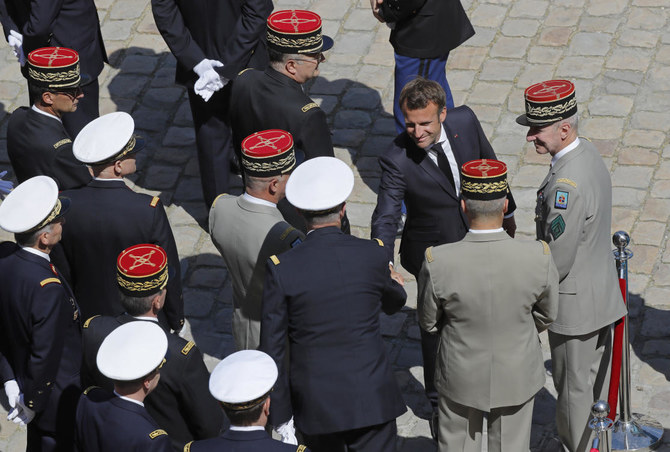
Macron to show off Euro defense cooperation at Paris parade
- Closer European defense cooperation has been one of Macron’s key foreign policy aims
- The president shows no sign of wavering despite growing political turbulence in Germany and Britain’s looming exit from the European Union


Woman, boy drown off Greece after migrant boat sinks
ATHENS: A boat carrying over 50 migrants sank off the Greek coast, killing a woman and a boy and leaving three others missing, the coast guard said Sunday.
“Fifty migrants have been rescued and are being cared for by the authorities,” after the accident off the island of Ikria in the northern Aegean Sea, a spokeswoman said.
“A rescue operation with a coast guard vessel is underway, and a team of rescuers and divers is expected later today,” she said.
Strong winds were hampering rescue efforts, according to public broadcaster ERT.
Ikaria lies close to Turkiye’s western coast, a frequent setoff point for migrants trying to enter the European Union.
Many migrants also take the much longer route from Libya to Crete in southern Greece.
The perilous crossings are often fatal. In early December, 17 people were found dead after their boat sank off Crete and 15 others were reported missing. Only two people survived.
According to the UN refugee agency 107 people died or went missing in 2025 off the Greek coast. The International Organization for Migration says about 33,000 migrants have died or gone missing in the Mediterranean since 2014.
“Fifty migrants have been rescued and are being cared for by the authorities,” after the accident off the island of Ikria in the northern Aegean Sea, a spokeswoman said.
“A rescue operation with a coast guard vessel is underway, and a team of rescuers and divers is expected later today,” she said.
Strong winds were hampering rescue efforts, according to public broadcaster ERT.
Ikaria lies close to Turkiye’s western coast, a frequent setoff point for migrants trying to enter the European Union.
Many migrants also take the much longer route from Libya to Crete in southern Greece.
The perilous crossings are often fatal. In early December, 17 people were found dead after their boat sank off Crete and 15 others were reported missing. Only two people survived.
According to the UN refugee agency 107 people died or went missing in 2025 off the Greek coast. The International Organization for Migration says about 33,000 migrants have died or gone missing in the Mediterranean since 2014.
Latest updates


Recommended


© 2026 SAUDI RESEARCH & PUBLISHING COMPANY, All Rights Reserved And subject to Terms of Use Agreement.