ISLAMABAD: The Islamabad High Court would have to examine a secretly taped video that appears to show a judge saying he was ‘blackmailed’ to convict former prime minister Nawaz Sharif as the court hears Sharif’s plea against the sentence later this year, top Pakistani lawyers said on Saturday.
Sharif is currently serving a seven year jail term for being unable to prove the source of income that had led to his ownership of the Al-Azizia steel mill in Saudi Arabia. Under Pakistani law, this is taken to prove corruption. The Islamabad High Court announced on Saturday that it will take up Sharif’s appeal against his conviction on September 18.
Last week, Sharif’s daughter Maryam Nawaz Sharif presented a video at a specially called news conference in which Arshad Malik, a senior judge on the accountability court, is seen telling a member of Sharif’s Pakistan Muslim League-Nawaz (PMLN) party that unidentified individuals had confronted him with compromising video footage to pressure him into convicting Sharif.
On Friday, Malik was sacked from his position as a judge of the accountability court, throwing many of his past verdicts into question and prompting immediate calls by the PMLN for the release of the 69-year-old ex-premier.
“The Islamabad High Court cannot skip the video controversy during its hearing of the acquittal plea [of Nawaz Sharif], and it will have to settle this matter [of whether the video is authentic] first,” top lawyer and columnist Babar Sattar told Arab News.
He said the leaked video of the judge would have a “strong bearing” on Sharif’s conviction and the appeal court would have to determine its veracity as well as ascertain whether Malik was indeed “blackmailed or pressured” to convict Sharif, as is being claimed by the Sharif family and the PMLN.
“If the video of the judge turns out to be authentic on the basis of forensic evidence and witnesses, the conviction of Nawaz Sharif in the case can be reverted,” Sattar said.
Malik has denied being blackmailed into convicting Sharif, saying his comments in the video were pieced together and presented out of context and he had never faced intimidation to rule against Sharif. Instead, he says, he was repeatedly offered bribes by representatives of the Sharif family as well as threats if he did not give a favorable ruling. The Sharifs deny the charge.
The Supreme Court on Friday said it would hear a petition seeking an investigation into the video on July 16.
“The Supreme Court has a wide jurisdiction under the law, and it is good that it has taken notice of the matter,” Sattar said.
Lawyer Saad Rasool said all electronic material, including videos and audios, were admissible as evidence in a court of law provided they were not edited and fabricated, stood the forensic test and all relevant witnesses corroborated them before the court.
He said if the Islamabad High Court accepted the leaked video as authentic evidence in the appeal hearing, it could lead to three verdicts: the dismissal of Sharif’s conviction, the case being sent to a lower court for a fresh trial or the IHC hearing the case again itself.
“The Sharif family will have to move an application in the court requesting to make the controversial video part of the hearing [in Nawaz Sharif’s acquittal plea],” Rasool said.
Barrister Masroor Shah said the Islamabad High Court would seek an affidavit from the Sharif family before starting the appeal hearing, asking them to testify that the video was authentic and should be made part of the case.
“If the video turns out to be fake, edited or fabricated during the forensic test,” Shah said, “this will have serious legal consequences for Maryam Nawaz who released it in a press conference.”


![]()

Islamabad court must examine leaked video of judge in Sharif appeal, lawyers say
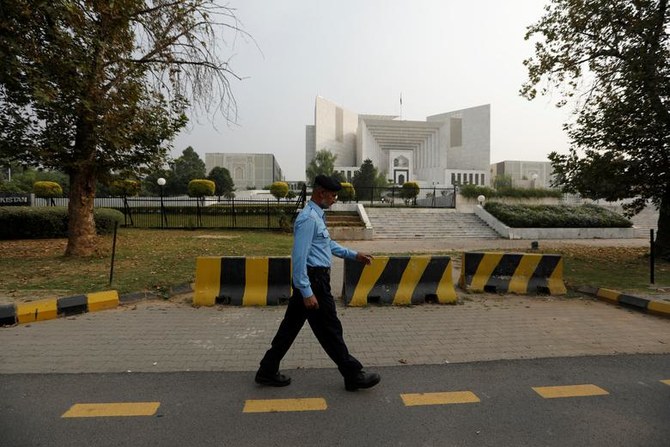
Islamabad court must examine leaked video of judge in Sharif appeal, lawyers say
- IHC set to hear Sharif’s plea against seven-year sentence for graft on September 18
- Lawyers say appeal court must first determine video’s authenticity, ascertain if Judge Malik was “blackmailed” to convict Sharif
Latest updates


© 2026 SAUDI RESEARCH & PUBLISHING COMPANY, All Rights Reserved And subject to Terms of Use Agreement.