

Bodies of Pakistani nationals who died attempting illegal migration repatriated from Iran

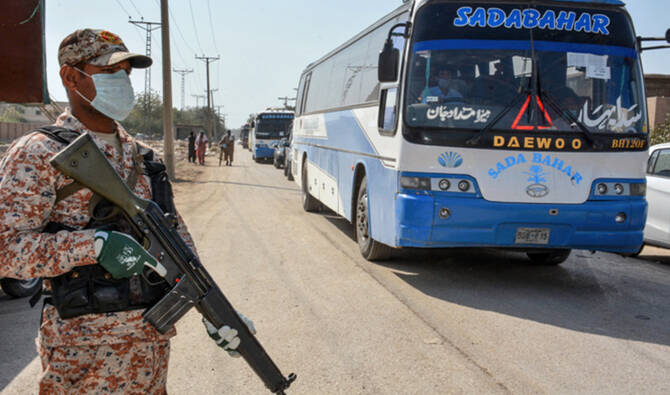
A soldier wearing a facemask stands guard as buses carry pilgrims returning from Iran via the Pakistan-Iran border town of Taftan in Sukkur in southern Sindh province on March 18, 2020. (AFP/File)
Short Url
Updated 31 December 2025
Follow

Bodies of Pakistani nationals who died attempting illegal migration repatriated from Iran

  • Pakistan’s envoy in Tehran warns youth against human smugglers after deaths in harsh weather
  • Pakistan reported sharp fall in illegal migration to Europe this year amid nationwide crackdown

ISLAMABAD: The bodies of two Pakistani nationals, who died near the Iran-Türkiye border after attempting to travel illegally to Europe, have been repatriated to the country, said a senior diplomat on Tuesday, reiterating warnings against human smugglers amid an intensified crackdown by authorities in Islamabad on illegal migration.

Pakistan says it has stepped up action against illegal immigration and human trafficking in recent years, reporting a 47% drop in illegal migration to Europe this year and the arrest of more than 1,700 suspected human smugglers, according to official figures.

However, people continue to attempt dangerous irregular journeys in search of work and better economic opportunities abroad.

“The mortal remains of Pakistani nationals Mr. Armanullah s/o Gul Rahman and Mr. Ihtasham s/o Mukhtar Gul, both residents of Nowshera, have been repatriated to Pakistan through Taftan border earlier today,” Pakistan’s ambassador to Iran, Muhammad Mudassir Tipu, said in a post on social media platform X. “Both had fallen victim to the greed of human smugglers and lost their lives in extremely harsh weather conditions near Iran’s border with Turkiye.”

“I once again request the youth back home not to be trapped by human smugglers and instead follow the legal path to travel abroad,” he added, thanking the government of the Balochistan province in Pakistan for arranging the transportation of the bodies and offering condolences to the victims’ families.

The issue illegal immigration has drawn heightened scrutiny since 2023, when hundreds of people, including Pakistani nationals, died attempting to cross the Mediterranean Sea in an overcrowded vessel that sank off the Greek coast, prompting Islamabad to launch nationwide investigations into human smuggling and trafficking networks.

Authorities have since arrested Pakistani and foreign nationals at airports with forged travel documents, highlighting the scale of document fraud linked to illegal departures.

In September, the Federal Investigation Agency (FIA) released a list of more than 100 of Pakistan’s “most wanted” human smugglers and identified major trafficking hubs across Punjab province and the capital, Islamabad.

Earlier this month, Pakistan announced plans to roll out an artificial intelligence-based immigration screening system at Islamabad airport from January, aimed at detecting forged documents and preventing illegal travel abroad, as part of broader efforts to curb human smuggling and unauthorized migration.


Pakistan to promote mineral sector at Saudi forum this month with 13 companies

Updated 02 January 2026
Follow

Pakistan to promote mineral sector at Saudi forum this month with 13 companies

  • Delegation will take part in the Future Minerals Forum in Riyadh from Jan. 13-15
  • Petroleum minister will lead Pakistan, participate in a 90-minute country session

ISLAMABAD: Around 13 Pakistani state-owned and private companies will attend the Future Minerals Forum (FMF) in Saudi Arabia from Jan. 13 to 15, an official statement said on Friday, as the country seeks to ramp up global engagement to develop its mineral resources.

The FMF is an international conference and investment platform for the mining sector, hosted by mineral-rich countries to attract global investors, companies and governments.

Petroleum Minister Ali Pervaiz Malik confirmed Pakistan’s participation in a meeting with the Saudi envoy, Nawaf bin Said Al-Malki.

Pakistan hosts one of the world’s largest copper-gold zones. The Reko Diq mine in southwestern Balochistan, with an estimated 5.9 billion tons of ore, is partly owned by Barrick Gold, which calls it one of the world’s largest underdeveloped copper-gold deposits. Its development is expected to boost Pakistan’s struggling economy.

“Upon an invitation of the Government of the Kingdom of Saudi Arabia, the Federal Minister informed the Ambassador that Pakistan will fully participate in the upcoming Future Minerals Forum (FMF), scheduled to be held in Riyadh later this month,” Pakistan’s Press Information Department (PID) said in an official statement.

The Pakistani minister will lead his country’s delegation at the FMF and take part in a 90-minute country showcase session titled “Unleashing Potential: Accelerating Pakistan’s Mineral Revolution” along with local and foreign investors.

Pakistan will also establish a dedicated pavilion to highlight the vast potential of its rich geological landscape to the global mineral community.

The Saudi envoy welcomed Pakistan’s decision to participate in the forum and discussed enhancing bilateral cooperation in the minerals and energy sectors during the meeting.

According to the statement, he highlighted the potential for cooperation between Saudi Arabia and Pakistan in the minerals and energy sectors, expressing confidence that the FMF would provide a platform to expand collaboration.
Pakistan’s mineral sector, despite its rich reserves of salt, copper, gold and coal, contributes only 3.2 percent to the country’s GDP and just 0.1 percent to global mineral exports.

However, many countries, including the United States, have shown interest in Pakistan’s underdeveloped mineral sector, particularly in copper, gold and other critical resources.

In October, Pakistan dispatched its first-ever shipment of rare earth and critical minerals to the United States, according to a Chicago-based US public relations firm’s report.