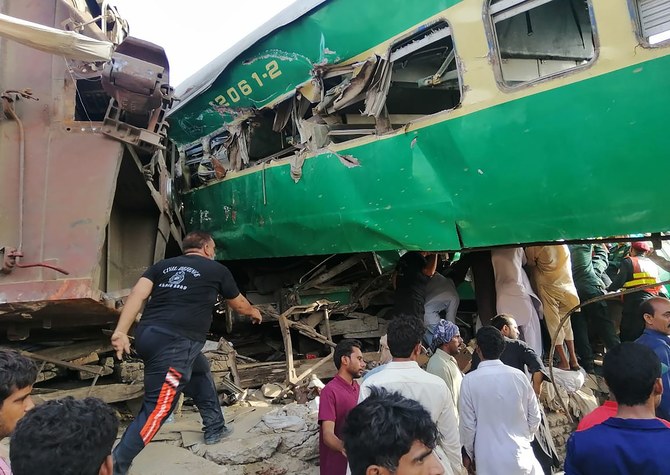
LAHORE: The Pakistan Railways said on Friday it had launched an inquiry to identify those responsible for the train collision in Sadiqabad on Thursday that claimed 24 lives and left 72 passengers injured.
The incident took place when the Quetta-bound Akbar Bugti Express from Lahore rammed into a stationary freight train in Rahim Yar Khan district of Punjab province.
“It’s difficult to fix responsibility until we finish the investigation,” the chief operating officer (CEO) of Pakistan Railways, Aftab Akbar, told Arab News on Friday. “A special fact finding committee, headed by the federal inspector of railways, has been constituted to investigate the accident and prepare its report. The team has gone to the site to probe the matter.”
However, the federal minister for railways, Shaikh Rasheed Ahmad, blamed the accident on human negligence. Speaking at a television show, he noted: “This has happened due to negligence, and I have ordered an investigation into the incident.”
The accident resulted in the loss of 22 lives on Thursday. According to hospital sources, 20 of them died on the spot while two others succumbed to their injuries while they were being treated.
“The rescue teams brought one dead body and 72 injured people here. One person could not survive and lost his life in the hospital. We also transferred as many as 19 seriously injured patients to the Shaikh Zayed Hospital, Rahim Yar Khan,” Dr. Liaqat Ali Chohan, medical superintendent of the Tehsil Headquarters Hospital Sadiqabad, told Arab News.
“We have been treating 19 people here,” confirmed Dr. Ghulam Rabbani, medical superintendent at the Sheikh Zayed Hospital Rahim Yar Khan. “Two of them lost their battle for life while two others are in serious condition.”
According to railway sources, the freight train was standing on the loop line when the passenger train, which should have been traveling on the main line, collided with it. The engine of the passenger train was completely destroyed.
Prime Minister Imran Khan expressed his grief on the sad incident while the opposition parties demanded the resignation of the railways minister.
Chairman of Pakistan Peoples Party (PPP) Bilawal Bhutto Zardari said that Sheikh Rasheed was “fully responsible” for the train accident and demanded an inquiry against him. He also asked the minister to step down until the inquiry was completed.
Pakistan Muslim League-Nawaz (PML-N) leader Maryam Sharif tweeted: “The ineptitude [and] misplaced priorities not only spell disaster but death for Pakistanis. No one is concerned. No one is bothered. Callousness is shocking.”
The local media has so far reported 79 train accidents in the brief tenure of the current government that assumed the country’s political power in August 2018.
The government has announced compensation for the families of the deceased and injured: The families of those who lost their lives in the tragic accident will receive Rs1.5 million rupees; those who were critically injured will get Rs.500,000; and the passengers who sustained minor injuries will be given Rs.200,000.


![]()

Pakistan Railways says inquiry launched into deadly train collision
Pakistan Railways says inquiry launched into deadly train collision
- Opposition demands resignation of railways minister
- Local media has so far reported 79 train accidents during the current government’s brief tenure
Latest updates


© 2026 SAUDI RESEARCH & PUBLISHING COMPANY, All Rights Reserved And subject to Terms of Use Agreement.