GAZA CITY: Due to Israeli restrictions and the separation between the Gaza Strip and the West Bank, Palestinian athletes do not enjoy regular sports competitions.
Last week, Israel blocked the Rafah football team from traveling to the West Bank from the Gaza Strip, preventing the final match of the Palestine Cup against the Balata Youth Center team. The match was scheduled a week ago at Nablus Stadium. They were forced to postpone it indefinitely.
A board member of the Rafah Club, Hudhayfah Lafi, said they were surprised to discover that Israeli authorities had only granted four permits to their 35-strong team to pass through the Erez crossing.
On Aug. 30, the Israeli authorities prevented three members of the Balata Youth Center, including their goalkeeper and coach, from passing through Erez to meet the Rafah team in the final match of the Palestine Cup.
“These complicated Israeli measures are aimed at obstructing the development of Palestinian sport, especially football, which has improved so much over the year,” Lafi said.
The Palestinian Football Federation organizes separate contests in the Gaza Strip and the West Bank due to Israeli restrictions. For four years, it has organized the Palestine Cup to determine the federation’s champions through two-legged matches.
The Palestinian Football Federation was established in 1928, and joined FIFA and the Asian Football Confederation in 1998. Since then, Palestinian teams have been participating in international and continental competitions.
But due to Israeli restrictions and the positions of Arab and Islamic countries that do not have relations with Israel, the Palestinian national team has been banned from playing their home games in Palestinian stadiums for many years and is forced to host them in nearby Arab countries.
The first official international game on Palestinian territory was recorded by FIFA in October 2008, where Palestine faced Jordan at the Stadium of Martyr Faisal Husseini in Jerusalem, which ended in a draw.
Ibrahim Abu Saleem, vice president of the Palestinian Football Federation, said that Palestinian teams are forced to establish training camps outside Palestine because of Israel’s refusal to grant Gaza Strip players permits to cross into the West Bank.
Israeli authorities have recently disrupted training camps by preventing trainers from the International Federation of Football from entering the Gaza Strip.
Abu Saleem said that Israel is fighting Palestinian youth by blocking sport, but it will not succeed in its efforts to limit its growth. He said that sport in Palestine will remain “one of the headlines of the national struggle.”
He added that Palestinian sport carries “a message of love and peace to the world,” which requires FIFA and the international community to confront Israeli violations against athletes and sports in Palestine.
The sports page editor of the Palestinian daily Al-Ayyam, Ashraf Matar, said that although much attention is dedicated to football, the obstacles imposed by Israel include many other sports, preventing the passage of coaches to hold courses in the Gaza Strip.
“Israel has banned members of the Olympic Committee and the delegation of the Scout and Girl Guides Association in Gaza from going to Jordan to participate in a sports event.
“Sports teams in Israeli settlements in the West Bank and Jerusalem are participating in local Israeli competitions and European competitions, and organizing games on playgrounds in these settlements,” Mattar added. “Israel prevents Palestinian sports teams from freely moving between Gaza and the West Bank.”
The president of the Palestinian Football Federation, Jibril Rajoub, submitted a draft resolution to the FIFA Congress in May 2015 to vote on the suspension of Israel’s membership until it complies with international laws and stops targeting Palestinian athletes. Rajoub later withdrew this resolution following advice from international federations. FIFA committed to investigating the Israeli violations through its Commission of Inquiry.
Abu Saleem expressed his indignation at FIFA’s “vague position,” which did not take the recommendations of its own fact-finding committee.


![]()
![]()
![]()
![]()
![]()

Israeli restrictions on Gaza and West Bank stifling Palestinian football

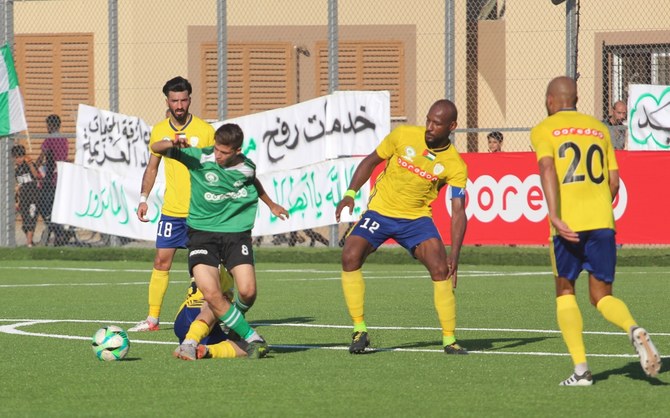


Israeli restrictions on Gaza and West Bank stifling Palestinian football
- Israeli authorities have recently disrupted training camps by preventing trainers from the International Federation of Football from entering the Gaza Strip
- Last week, Israel blocked the Rafah football team from traveling to the West Bank from the Gaza Strip


Latest updates


© 2026 SAUDI RESEARCH & PUBLISHING COMPANY, All Rights Reserved And subject to Terms of Use Agreement.