LONDON: Oil prices hit a six-week high on Thursday as oil rigs in the Gulf of Mexico were evacuated ahead of a storm, while an incident with a British tanker in the Middle East highlighted tensions in the region.
Brent crude futures reversed early losses and were up 40 cents at $67.41 a barrel by 0852 GMT. Earlier in the session they hit their highest since May 30 at $67.65, after ending Wednesday up 4.4 percent.
US West Texas Intermediate crude futures were up 33 cents, at $60.76 a barrel, having earlier touched their highest since May 23 at $60.94. They gained 4.5 percent in the previous session.
A day after Iran warned Britain would face “consequences” over the seizure of an Iranian oil tanker, three Iranian vessels tried to block the passage of a British ship run by BP through the Strait of Hormuz, the British government said. They withdrew after warnings from a British warship.
“What happened was partially expected. We pointed out last week that Iran was likely to do something of the sort,” Petromatrix oil analyst Olivier Jakob said.
“They might have created a little bit of disturbance, but nothing came out of it. For now, we are in the process of intimidation and psychological warfare ... To have a strong price reaction you need something to really happen.”
Oil prices were also supported by a decline in US inventories. US crude stocks fell 9.5 million barrels in the week to July 5, the Energy Information Administration (EIA) said, more than the 3.1 million-barrel draw analysts had expected as refineries ramped up output.
US oil producers on Wednesday also cut nearly a third of their output in the Gulf of Mexico ahead of what could be one of the first major storms of the Atlantic hurricane season.
Fifteen production platforms and four rigs were evacuated in the north central Gulf of Mexico, according to a US regulator, as oil firms moved workers to safety ahead of a storm expected to become a hurricane by Friday.
“There is nothing like an early start to the hurricane season to support oil prices, but looking under the hood of the EIA data, it paints an even rosier picture for US oil markets,” said Stephen Innes, managing partner, Vanguard Markets in Bangkok.
“Imports down, exports likely up and refinery utilization at yearly highs,” he said.
Stocks have now fallen for four consecutive weeks, according to the EIA.
US output is rising again after a brief drop from record levels, according to the EIA. Production last week rose to 12.3 million barrels a day.
“Rising US shale production levels, subdued global economic momentum and existing trade uncertainties will cap bullish gains for crude oil futures,” said Benjamin Lu, analyst at Phillip Futures in Singapore.

Oil at 6-week high on Gulf of Mexico storm, Iran tensions
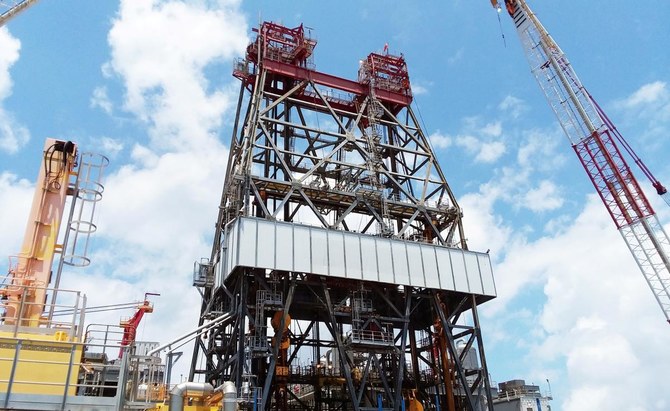
- Oil prices were also supported by a decline in US inventories
- Stocks have now fallen for four consecutive weeks, the Energy Information Administration said
Saudi non-oil exports jump 21% as trade balance improves: GASTAT
RIYADH: Saudi Arabia’s non-oil exports, including re-exports, rose 20.7 percent year on year in November to SR32.69 billion ($8.72 billion), official data showed.
According to preliminary figures released by the General Authority for Statistics, national non-oil exports, excluding re-exports, increased by 4.7 percent in November compared with the same month in 2024.
The strong performance highlights progress under the Kingdom’s Vision 2030 strategy, which aims to diversify the economy and reduce its long-standing dependence on crude oil revenues.
In its latest report, GASTAT stated: “The ratio of non-oil exports, including re-exports, to imports increased in November 2025, reaching 42.2 percent, compared with 34.9 percent in November 2024. This increase was driven by a 20.7 percent rise in non-oil exports, alongside a 0.2 percent decline in imports over the same period.”
It added: “The value of re-exported goods increased by 53.1 percent during the same period, driven by an 81.9 percent increase in ‘machinery, electrical equipment and parts’, which accounted for 51.5 percent of total re-exports.”
Machinery, electrical equipment and parts also led the non-oil export basket, making up 24.2 percent of outbound shipments and recording an 81.5 percent annual increase. This was followed by products of the chemical industries, which represented 20.3 percent of total non-oil exports and rose 0.5 percent year on year.
The data adds to signs of resilience in Saudi Arabia’s non-oil economy, with S&P Global’s Purchasing Managers’ Index at 57.4 in December, well above the 50 threshold that separates expansion from contraction.
Top non-oil destinations
The UAE was the leading destination for Saudi non-oil exports in November, with shipments valued at SR10.48 billion.
India ranked second at SR3.01 billion, followed by China at SR2.32 billion, Singapore at SR1.76 billion and Bahrain at SR900.7 million.
Exports to Egypt totaled SR815.5 million during the month, while Turkiye and Jordan received goods worth SR799.1 million and SR773.3 million, respectively.
GASTAT said ports and airports played a central role in facilitating non-oil shipments in November.
By sea, Jeddah Islamic Seaport handled the largest volume of non-oil exports at SR3.57 billion, followed by King Fahad Industrial Seaport in Jubail at SR3.51 billion.
Ras Al-Khair Seaport was the exit point for non-oil goods valued at SR2.66 billion, while Jubail Seaport and King Abdulaziz Seaport in Dammam handled outbound shipments worth SR2.32 billion and SR2.14 billion, respectively.
By air, King Abdulaziz International Airport handled goods worth SR5.60 billion, while King Khalid International Airport in Riyadh processed exports valued at SR3.53 billion.
Exports and imports
Saudi Arabia’s total merchandise exports reached SR99.73 billion in November, representing a 10 percent increase compared with the same month in 2024.
“Merchandise exports in November 2025 increased by 10.0 percent compared to November 2024, and oil exports increased by 5.4 percent. The percentage of oil exports in total exports declined from 70.1 percent in November 2024 to 67.2 percent in November 2025,” GASTAT added.
China remained the Kingdom’s largest export destination, accounting for 13.5 percent of total exports, followed by the UAE at 11.7 percent and Japan at 9.9 percent. India, South Korea, the US, Egypt, Singapore, Bahrain and Poland were also among the top 10 destinations, which together accounted for 71.4 percent of total exports.
Imports declined by 0.2 percent year on year in November to SR77.38 billion, while the merchandise trade surplus surged by 70.2 percent, the report showed.
China was the Kingdom’s largest source of imports, accounting for 26.7 percent of inbound shipments, followed by the US at 10.2 percent and the UAE at 6.2 percent.
“Germany, Japan, India, Italy, France, Switzerland, and Egypt were also among the top ten import sources, with total imports from these ten countries representing 68.6 percent of Saudi Arabia’s overall imports,” added GASTAT.
King Abdulaziz Port in Dammam was the leading entry point for goods, handling 22.8 percent of imports in November. Jeddah Islamic Port followed with 22.6 percent, ahead of King Khalid International Airport in Riyadh at 17 percent and King Abdulaziz International Airport in Jeddah at 11.9 percent.


