


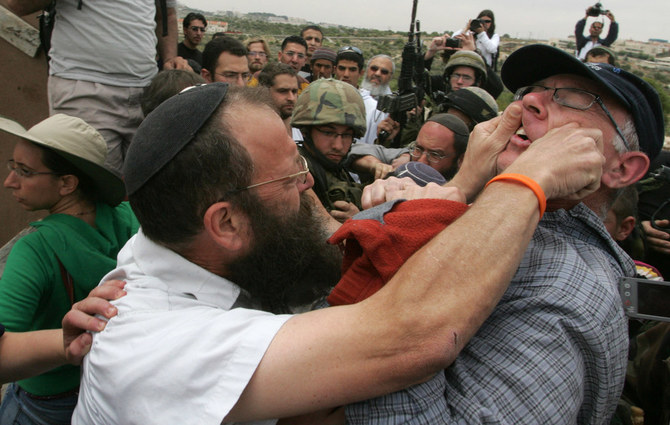
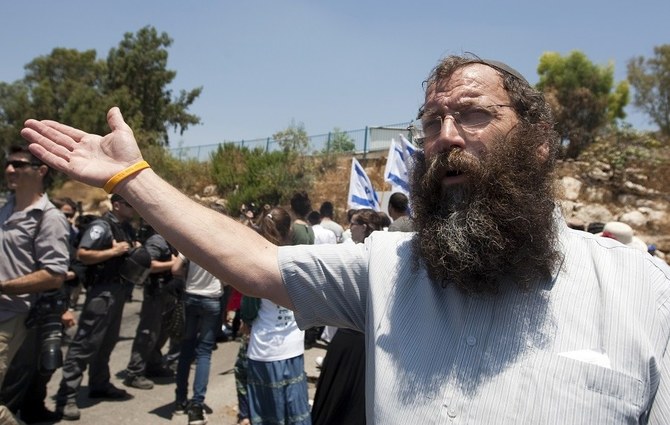

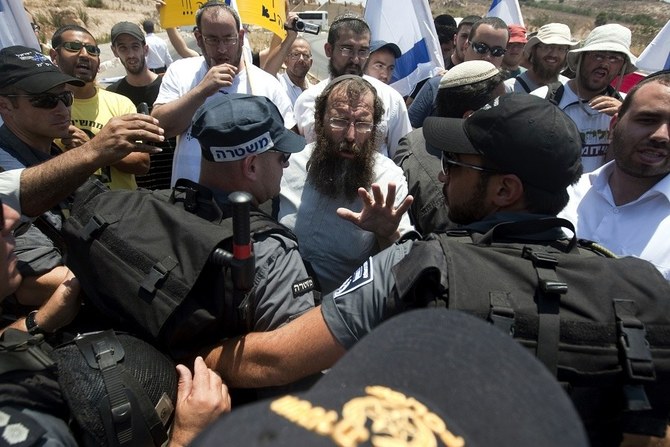

Baruch Marzel, who lives in a Jewish outpost built in the heart of the Palestinian city of Hebron, has confronted many Palestinians who have tried to witness Israeli restrictions on non-Jews visiting the Ibrahimi Mosque.
The mosque is famous for being the burial ground of the Prophet Abraham, and for being the site of the massacre in February 1994 of 29 Muslim worshippers by Chicago-born Israeli settler Baruch Goldstein, who was a close colleague of Marzel.
In 1995, when I was president of the Palestinian American Congress, Marzel’s colleagues threatened to beat me with clubs as I walked up to the Ibrahimi Mosque to view a memorial set up for Goldstein’s victims.
It was only because I am Christian and was holding a US passport that Israeli soldiers stood between me and Marzel’s settler friends.
BIO
• Name: Baruch Marzel
• Nationality: Israeli-American
• Place of Residence: Hebron, West Bank
• Organization: (Eretz Yisrael Shelanu, Jewish National Front)
• Occupation: Former spokesman of Meir Kahane’s Kach party
• Medium: Through interviews, videos and articles
Marzel was one of the early leaders of hate activist Meir Kahane’s Jewish Defense League (JDL). After Kahane was killed in November 1990, Marzel played a larger role in the organization, which has changed names several times and was represented in Israel’s Knesset (Parliament) as the Kach political party.
Marzel has run for political office in the Knesset and is a member of the Otzma Yehudit political party, which was reorganized from the outlawed Kach.
He has openly advocated the ethnic cleansing of Palestinians. “There’s no way we’ll have quiet or peace inside Israel as long as we have here millions of supporters of terror, people that believe in their religion that all of the Land of Israel … is theirs, and that we’re occupiers, and the Jews have no right to a state or can even exist here,” he said. “The only way to have peace is to get them out of Israel.”
Born in Boston, Marzel’s family moved to Israel when he was an infant. He joined the JDL at the age of 13.
Marzel claims to have joined the Israeli invasion of Lebanon in 1982, and to have shot dead several unarmed Syrian soldiers he had taken prisoner.
He said he did this as he was wounded by a captured Syrian commando who let off a concealed grenade and thought he might die, so he wished to exact revenge. Marzel took the same spirit of confrontation into his political activism.
“It’s a religious war. And they believe they have to destroy us … to kill us ... And we believe that ... they can’t stay here,” he said.
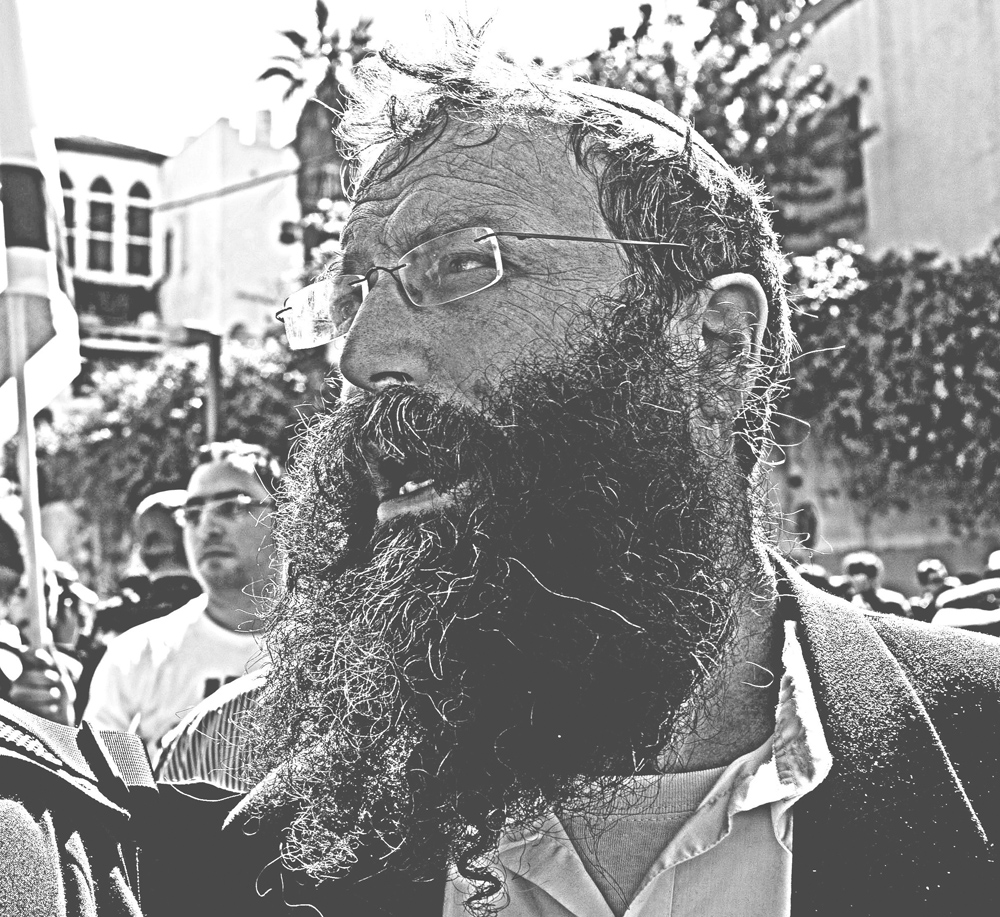
Hate preacher Baruch Marzel
In 1984, Kahane won a seat in the Knesset and appointed Marzel as his parliamentary aide. Marzel was renowned for his open hostility, harassing leftist and Palestinian Knesset members. After his mentor’s death, Marzel was elected head of Kach’s secretariat and ran for the Knesset.
He emerged from Kahane’s shadow to become a figurehead for Jewish radicalism in Hebron, where he has led attacks against its Palestinian residents. He has been imprisoned many times for his acts of violence and intimidation.
Hostility and confrontations between the small Israeli population in Hebron and its Palestinian residents are a daily occurrence.
But its darkest day was in 1994, when Goldstein opened fire on Muslim worshippers in the Ibrahimi Mosque during Ramadan. As the dead and wounded lay on the floor, survivors tackled him and beat him to death.
Marzel celebrated Goldstein after his death, and in 2000 held a party at his graveside during the Jewish festival of Purim. “We decided to make a big party on the day he was murdered by Arabs,” Marzel told the BBC.
“Without supporting what (he) did … Baruch Goldstein was one of the purest people in the world ... He was a saint,” Marzel said. “After what he did, terrorism stopped in Hebron for four years ... one Jew wasn’t hurt.”
To this day, Marzel encourages and takes part in aggressive activities against Palestinian residents of Hebron, while hosting Israeli troops stationed there at his house for lunch.
READ MORE:
The rotten apple did not fall far from the wretched tree
But his activism is not confined to Hebron. Alongside Ben-Zion Gopstein, Michael Ben-Ari and Itamar Ben-Gvir, Marzel founded and became a spokesman for the segregationist Lehava movement.
The Jewish far-right campaigning organization objects to almost every kind of personal relationship between Jews and non-Jews.
Marzel remains active in politics. He is a member of Otzma Yehudit, which calls for Arabs to leave Israel.
The willingness of Prime Minister Benjamin Netanyahu to work with such parties means their influence cannot be underestimated.
Netanyahu even received criticism from AIPAC, the largest pro-Israel lobby in the US, over the election alliance he agreed to with Otzma Yehudit.
Marzel is doing his best to make sure Kahanism passes onto the next generation. “Thank God, out of (my) nine kids, seven had trouble with the police for good causes,” he said. “I educate them to be fighters, and I’m proud that they fight ... They had a big fight with Arabs.”
Whether it is with his own children, other Jewish settlers in Hebron or far-right activists across Israel, Marzel will continue to radicalize Israeli politics and do all he can to prevent coexistence between Jews and Arabs.




