In keeping with close Pak-Saudi navy tradition, Saudi officers graduate from Pakistan academy

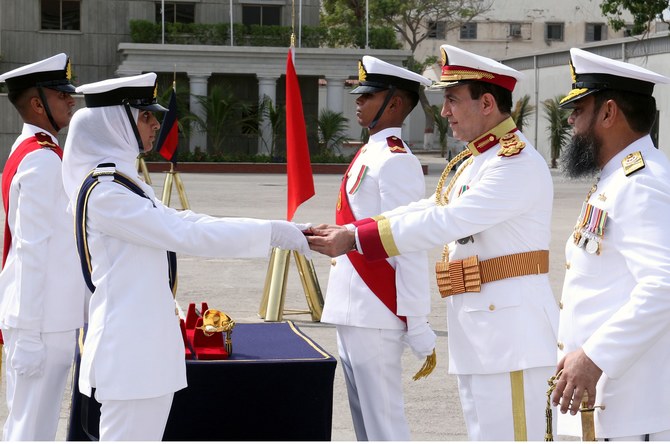
Commander Royal Saudi Naval Forces Vice Admiral Fahad bin Abdullah Al Ghofaily presents a gold medal to a Pakistan cadet officer at the 111th course commissioning parade of Pakistan’s Naval Academy in Karachi, June 29, 2019. (Photo Courtesy – Pakistan Navy)
Updated 02 July 2019
Follow

In keeping with close Pak-Saudi navy tradition, Saudi officers graduate from Pakistan academy

  • Commander of Royal Saudi Naval Forces says Pakistan has rendered countless sacrifices for peace
  • Pak-Saudi naval collaboration is historic and mutual, says former navy official

KARACHI: Three Saudi naval officers were among 175 graduates of the Pakistan naval academy’s 111th course commissioning parade in Karachi on Saturday, where commander of Royal Saudi Naval Forces (RSNF), Vice Admiral Fahad Bin Abdullah Al-Ghofaily, was chief guest, the Saudi embassy in Islamabad said on Monday.
According to a spokesperson for the Pakistan navy, the course commissioning parade at PNS RAHBAR comprised 65 Pakistanis and 12 midshipmen from friendly countries, as well as 98 cadets of short service commission courses, which included 25 female cadets.
The event’s chief guest from the RSNF, who was himself a graduate of PNS RAHBAR in 1984, was received by Pakistan’s navy chief, Admiral Zafar Mahmood Abbasi and thanked him for the opportunity to return to his alma mater.
Addressing the graduating officers, Commander RSNF highlighted the close collaboration between the armed forces of Pakistan and Saudi Arabia, and said there was a common desire in both nations for regional peace and stability.
The Saudi naval commander acknowledged that Pakistan had rendered countless sacrifices in the fight against militancy and for establishing peace.
Cadets from Bahrain, Jordan, Qatar and Yemen were also part of the graduation ceremony at PNS RAHBAR.
Dr. Anjum Sarfraz, a retired commodore of Pakistan navy and a senior research fellow at Strategic Vision Institute in Islamabad, told Arab News that Pakistan’s navy had been providing training to Saudi officers and sailors during the Saudi navy’s formative period between the 1970’s and 80’s. He said officers trained by the Pakistan navy are considered some of the most professional in the world.
“After the establishment of Saudi naval academy, the selected officials of Pakistan navy would go on deputation for training of Saudi officers and sailors,” he said, and added that during the years when Saudi Arabia was acquiring its arms and equipment, Pakistani officials would provide the Saudi navy with helpful recommendations.
“Today, the Saudi navy is one of the strongest navies of the region, with state-of-the-art weapons and equipment and great leadership,” he said.
But the help always ran both ways, the former navy official added.
“Saudi Arabia provided Pakistan navy with free-of-cost fuel on a few occasions,” he said, and said there had never been any reluctance shown by either parties to extend help to each other.


Pakistan, China to sign multiple MoUs at major agriculture investment conference today

Updated 18 January 2026
Follow

Pakistan, China to sign multiple MoUs at major agriculture investment conference today

  • Hundreds of Chinese and Pakistani firms to attend Islamabad event
  • Conference seen as part of expanding CPEC ties into agriculture, trade

KARACHI: Islamabad and Beijing are set to sign multiple memorandums of understanding (MoUs) to boost agricultural investment and cooperation at a major conference taking place in the capital today, Monday, with hundreds of Chinese and Pakistani companies expected to participate.

The conference is being billed by Pakistan’s Ministry of National Food Security and Research as a platform for deepening bilateral agricultural ties and supporting broader economic engagement between the two countries.

“Multiple memorandums of understanding will be signed at the Pakistan–China Agricultural Conference,” the Ministry of National Food Security said in a statement. “115 Chinese and 165 Pakistani companies will participate.”

The conference reflects a growing emphasis on expanding Pakistan-China economic cooperation beyond the transport and energy foundations of the flagship China-Pakistan Economic Corridor (CPEC) into agriculture, industry and technology.

Under its first phase launched in 2015, CPEC, a core component of China’s Belt and Road Initiative, focused primarily on transportation infrastructure, energy generation and connectivity projects linking western China to the Arabian Sea via Pakistan. That phase included motorways, power plants and the development of the Gwadar Port in the country's southwest, aimed at helping Pakistan address chronic power shortages and enhance transport connectivity.

In recent years, both governments have formally moved toward a “CPEC 2.0” phase aimed at diversifying the corridor’s impact into areas such as special economic zones, innovation, digital cooperation and agriculture. Second-phase discussions have highlighted Pakistan’s goal of modernizing its agricultural sector, attracting Chinese technology and investment, and boosting export potential, with high-level talks taking place between planning officials and investors in Beijing.

Agri-sector cooperation has also seen practical collaboration, with joint initiatives examining technology transfer, export protocols and value-chain development, including partnerships in livestock, mechanization and horticulture.

Organizers say the Islamabad conference will bring together government policymakers, private sector investors, industry associations and multinational agribusiness firms from both nations. Discussions will center on investment opportunities, technology adoption, export expansion and building linkages with global buyers within the framework of Pakistan-China economic cooperation.