KHARTOUM, Sudan: Tens of thousands of protesters took to the streets on Sunday in Sudan’s capital and elsewhere in the country calling for civilian rule, nearly three months after the army forced out the autocrat Omar Al-Bashir.
The demonstrations came amid a weeks-long standoff between the ruling military council and protest leaders. Talks between the two sides over a power-sharing agreement collapsed earlier this month when security forces violently broke up a protest camp in Khartoum. The ensuring clampdown killed at least 128 people cross the county, according to protest organizers. Authorities say the toll was 61, including three security forces.
The marches also mark the 30th anniversary of the Islamist-backed coup that brought Al-Bashir to power in 1989, toppling Sudan’s last elected government. The military removed Al-Bashir in April amid mass protests against his rule.
The crowds gathered at several points across the capital and its sister city of Omdurman, before marching toward the homes of those people killed since the uprising began. At first, the movement erupted in December over a failing economy and Al-Bashir’s 30-year rule, and then stayed in the streets to protest the generals who replaced him.
On Sunday, protesters chanted anti-military slogans like “Burhan’s council, just fall,” according to video clips circulated online.
Gen. Abdel-Fattah Burhan is head of the military council.
Mohammed Yousef Al-Mustafa, a spokesman for the Sudanese Professionals’ Association, a leading protest organization, told The Associated Press that security forces used tear gas to disperse protesters in Omdurman and the district of Bahri in the capital.
He said protests also erupted in Atbara, a railway city north of the capital and the birthplace of the uprising that led to Al-Bashir’s ouster.
The previous day, the military council had warned protest leaders that they will be held responsible for any vandalism or violence during the marches.
The protests came as the African Union and Ethiopia have stepped up their efforts to mediate an end to the crisis, and reach a deal over setting up a new transitional government.

Sudan’s protesters take to streets against army rule
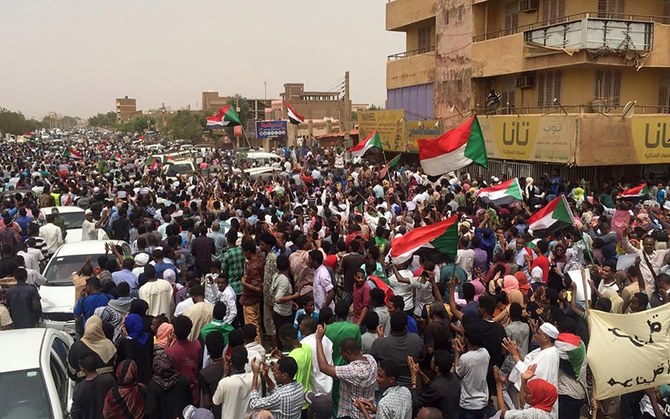
- Tens of thousands of protesters took to the streets on Sunday in Sudan’s capital
- The new protest comes at a time when Ethiopia and the African Union (AU) are jointly mediating between the protesters and generals
Israel’s Supreme Court suspends govt move to shut army radio
- Israel’s Supreme Court has issued an interim order suspending a government decision to shut down Galei Tsahal, the country’s decades-old and widely listened-to military radio station
JERUSALEM: Israel’s Supreme Court has issued an interim order suspending a government decision to shut down Galei Tsahal, the country’s decades-old and widely listened-to military radio station.
In a ruling issued late Sunday, Supreme Court President Isaac Amit said the suspension was partly because the government “did not provide a clear commitment not to take irreversible steps before the court reaches a final decision.”
He added that Attorney General Gali Baharav-Miara supported the suspension.
The cabinet last week approved the closure of Galei Tsahal, with the shutdown scheduled to take effect before March 1, 2026.
Founded in 1950, Galei Tsahal is widely known for its flagship news programs and has long been followed by both domestic and foreign correspondents.
A government audience survey ranks it as Israel’s third most listened-to radio station, with a market share of 17.7 percent.
Prime Minister Benjamin Netanyahu had urged ministers to back the closure, saying there had been repeated proposals over the years to remove the station from the military, abolish it or privatise it.
But Baharav-Miara, who also serves as the government’s legal adviser and is facing dismissal proceedings initiated by the premier, has warned that closing the station raised “concerns about possible political interference in public broadcasting.”
She added that it “poses questions regarding an infringement on freedom of expression and of the press.”
Defense Minister Israel Katz said last week that Galei Tsahal broadcasts “political and divisive content” that does not align with military values.
He said soldiers, civilians and bereaved families had complained that the station did not represent them and undermined morale and the war effort.
Katz also argued that a military-run radio station serving the general public is an anomaly in democratic countries.
Opposition leader Yair Lapid had condemned the closure decision, calling it part of the government’s effort to suppress freedom of expression ahead of elections.
Israel is due to hold parliamentary elections in 2026, and Netanyahu has said he will seek another term as prime minister.
In a ruling issued late Sunday, Supreme Court President Isaac Amit said the suspension was partly because the government “did not provide a clear commitment not to take irreversible steps before the court reaches a final decision.”
He added that Attorney General Gali Baharav-Miara supported the suspension.
The cabinet last week approved the closure of Galei Tsahal, with the shutdown scheduled to take effect before March 1, 2026.
Founded in 1950, Galei Tsahal is widely known for its flagship news programs and has long been followed by both domestic and foreign correspondents.
A government audience survey ranks it as Israel’s third most listened-to radio station, with a market share of 17.7 percent.
Prime Minister Benjamin Netanyahu had urged ministers to back the closure, saying there had been repeated proposals over the years to remove the station from the military, abolish it or privatise it.
But Baharav-Miara, who also serves as the government’s legal adviser and is facing dismissal proceedings initiated by the premier, has warned that closing the station raised “concerns about possible political interference in public broadcasting.”
She added that it “poses questions regarding an infringement on freedom of expression and of the press.”
Defense Minister Israel Katz said last week that Galei Tsahal broadcasts “political and divisive content” that does not align with military values.
He said soldiers, civilians and bereaved families had complained that the station did not represent them and undermined morale and the war effort.
Katz also argued that a military-run radio station serving the general public is an anomaly in democratic countries.
Opposition leader Yair Lapid had condemned the closure decision, calling it part of the government’s effort to suppress freedom of expression ahead of elections.
Israel is due to hold parliamentary elections in 2026, and Netanyahu has said he will seek another term as prime minister.
© 2025 SAUDI RESEARCH & PUBLISHING COMPANY, All Rights Reserved And subject to Terms of Use Agreement.


