

Sudan general warns against vandalism ahead of mass protest

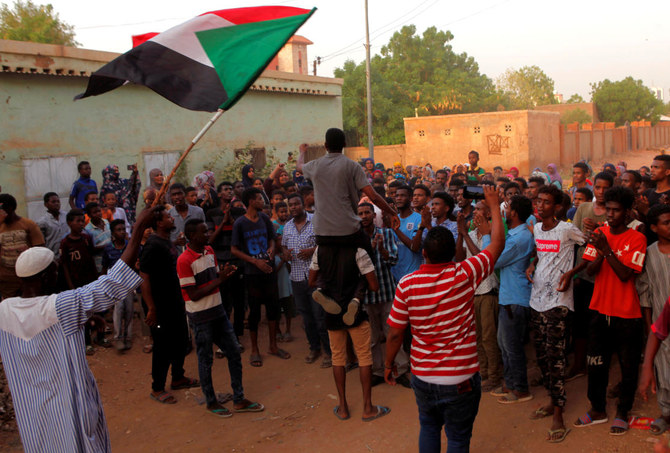
Sudanese protesters chant slogans and wave their national flag as they demonstrate against the ruling military council, in Khartoum, Sudan June 27, 2019. (Reuters)
Updated 29 June 2019
Follow

Sudan general warns against vandalism ahead of mass protest

  • The country’s protest movement called for a "million-man" march in Khartoum on Sunday against the ruling generals who have seized power since ousting Bashir
  • Sunday's mass rally will be the first attempt to mobilise protesters after the June 3 crackdown on the protest camp outside the military headquarters in Khartoum

KHARTOUM: A top Sudanese general Saturday warned he will not tolerate any vandalism at a planned mass protest, but insisted the ruling generals would hand power to a civilian administration.
General Mohamed Hamdan Dagalo's warning came as the country's umbrella protest movement called for a "million-man" march in Khartoum on Sunday against the generals who have seized power since ousting longtime ruler Omar Al-Bashir on April 11.
"There are vandals, there are people who have an agenda, a hidden agenda, we don't want problems," Dagalo, the deputy chief of the ruling military council, told a rally in comments broadcast by state television and apparently directed at organisers of the protest.
Dagalo commands the feared paramilitary Rapid Support Forces, which have been heavily deployed in Khartoum since a deadly crackdown on a protest camp on June 3 left dozens dead and hundreds wounded.
Dagalo, widely known by his nickname Himeidti, justified the heavy presence of security forces in the capital.
"The military forces who are deployed in Khartoum are there for the security of the people, not to disturb them," he said.
Sunday's mass rally will be the first attempt to mobilise protesters after the June 3 crackdown on the protest camp outside the military headquarters in Khartoum.
The violent dispersal of the sit-in came after talks between the generals and protest leaders collapsed over who should lead a new governing body - a civilian or soldier.
The generals have resisted to transfer power to a civilian administration as demanded by protesters, rights groups and Western nations.
Ethiopia and the African Union have mediated between the two sides and proposed the creation of a 15-member civilian-majority body to govern the country during a three-year transition period.
The generals said on Friday they have accepted a joint proposal from the African Union and Ethiopia to work toward a transitional government.
Lt. Gen. Shams Eddin Kabashi, a spokesman for the military council, said late Friday the generals are ready to resume "immediate, serious and honest" negotiations to end the political stalemate with the protesters based on the joint proposal.
Protest leaders, represented by the coalition Forces for Declaration of Freedom and Change, said Thursday the proposal was based on a previous initiative from Ethiopia for a power-sharing agreement.

Talks collapsed when Sudanese security forces cleared a protest camp in the capital, Khartoum, earlier this month.

About 130 people have been killed since the June 3 crackdown, according to doctors close to the protest movement.
Officials say 61 people died nationwide on June 3.
On Saturday, Dagalo insisted the generals had no intention of holding on to power.
"The military council is just a guarantor," he said.
"We are saying we want a civilian government, a government of competences, of independents. This is not political talk...This is true."


Arab and Islamic states reject Israel’s recognition of Somaliland

Updated 28 December 2025
Follow

Arab and Islamic states reject Israel’s recognition of Somaliland

  • Israel formally recognized Somaliland as an “independent and sovereign state” on Friday
  • Saudi Arabia on Friday expressed full support for sovereignty, unity, territorial integrity of Somalia

A group of foreign ministers from Arab and Islamic countries, alongside the Organisation of Islamic Cooperation (OIC), have firmly rejected Israel’s announcement of its recognition of the Somaliland region within Somalia.

In a joint statement issued on Saturday, the ministers condemned Israel’s decision, announced on December 26, warning that the move carries “serious repercussions for peace and security in the Horn of Africa and the Red Sea region” and undermines international peace and security, the Jordan News Agency reported.

The statement described the recognition as an unprecedented and flagrant violation of international law and the charter of the United Nations, which uphold the principles of state sovereignty, unity and territorial integrity, JNA added.

Israel formally recognized Somaliland as an “independent and sovereign state” and signed an agreement to establish diplomatic ties, as the region’s leader hailed its first-ever official recognition.

The ministers reaffirmed their full support for the sovereignty of Somalia, rejecting any measures that would undermine its unity or territorial integrity.

They warned that recognizing the independence of parts of states sets a dangerous precedent and poses a direct threat to international peace and security.

The statement also reiterated categorical opposition to any attempt to link the move with plans to displace the Palestinian people outside their land, stressing that such proposals are rejected “in form and substance.”

Alongside the Jordanian foreign ministry, the joint statement was issued by the foreign ministers of Egypt, Algeria, Comoros, Djibouti, The Gambia, Iran, Iraq, Kuwait, Libya, Maldives, Nigeria, Oman, Pakistan, Palestine, Qatar, Somalia, Sudan, Turkiye and Yemen, as well as the OIC.

Saudi Arabia on Friday expressed full support for the sovereignty, unity, and territorial integrity of Somalia, and expressed its rejection of the declaration of mutual recognition between Israel and Somaliland.