NEW DELHI: At least 15 people, including four children, were killed when a wall collapsed on shacks outside an apartment complex in western India, police said.
Most of those who died were sleeping when the 3 meter (10-foot) high brick wall came crashing down on several tin cabins built for a group of laborers who had work at a nearby construction site, according to police.
Two people were also injured in the accident and are “undergoing treatment at a hospital,” a local police official told AFP.
He said a search was on to find any survivors.
The shacks, located in the city of Pune in Maharashtra state, were mostly occupied by migrant workers from India’s north.
Authorities have ordered an inquiry into the incident and announced a cash compensation to the families of those killed.
The city has seen two days of heavy rains.
India’s millions of laborers and their families often live either on construction sites or in temporary huts nearby to save on accommodation costs.
It is the latest in a series of deadly building accidents in India that mostly occur during the rainy season that runs from June to September.
More than a dozen devotees were killed on Sunday after a tent collapsed on them during a religious event in western Rajasthan state.
In 2017, a wall collapsed collapse onto guests celebrating a wedding in Rajasthan state, killing two dozen people.


At least 15 killed in western India wall collapse
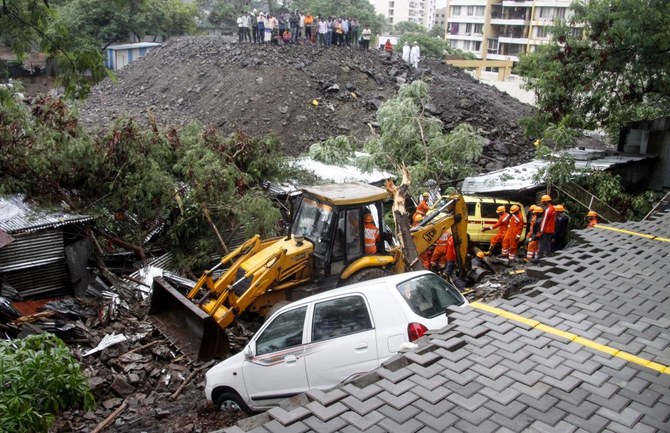


At least 15 killed in western India wall collapse

- Most of those who died were sleeping when the 3 meter (10-foot) high brick wall came crashing down on several tin cabins built for a group of laborers
- Two people were also injured in the accident and are “undergoing treatment at a hospital”


India, EU agree on trade deal slashing tariffs on 99.5% of Indian exports
- Agreement expected to be signed later this year and come into force in early 2027
- Duty cuts on 99.5% Indian exports to EU unlikely to offset US tariff impact, expert says
NEW DELHI: India and the EU have concluded negotiations on a deal creating a free trade zone of 2 billion people, European Commission President Ursula von der Leyen and Indian Prime Minister Narendra Modi said on Tuesday.
Talks for the pact, referred to by both leaders as the “mother of all deals,” started in 2007 and stalled repeatedly over the years, with the negotiation process only speeding up last year, following new US tariff polices.
The agreement is expected to be signed later this year and may come into force in early 2027.
“People around the world are calling it the ‘mother of all deals.’ This agreement brings huge opportunities for India’s 1.4 billion people and for millions of people across European countries,” Modi said during a joint press conference with Von der Leyen and European Council President Antonio Costa in New Delhi.
“It represents 25 percent of the global GDP and one-third of global trade.”
The deal paves the way for India to open its vast market to free trade with the EU, its biggest trading partner, and gain preferential access for almost all of its exports to the 27-nation European bloc.
“We have created a free trade zone of 2 billion people, with both sides set to gain economically,” Von der Leyen said. “We have sent a signal to the world that rules-based cooperation still delivers great outcomes.”
The conclusion of negotiations comes as US President Donald Trump slapped India with 50 percent tariffs and has threatened to impose new duties on several EU countries unless they support his efforts to take over Greenland.
“This is a signal to the US that like-minded entities, EU and India, are willing to come together and work together,” Prof. Harsh V. Pant, vice president of the Observer Research Foundation, told Arab News.
“Here are two countries that are bringing in a greater predictability and less volatility in their relationship, and they will move ahead irrespective of what the US does.”
The deal is expected to double EU goods exports to India by 2032 as tariffs on 96.6 percent of EU goods exports — from automobiles and industrial goods to wine and chocolates — will be eliminated or reduced, saving up to $4.75 billion per year in duties on European products, according to a European Commission press release on Tuesday.
At the same time, the EU will eliminate or reduce tariffs on 99.5 percent of goods imported from India over seven years, India’s Ministry of Commerce and Industry said in a statement, projecting gains mainly in labor-intensive sectors like textiles, leather, marine products, gems and jewelry.
“Indian services will also benefit from the trade deal. But, more than just export growth, the deal is part of a broader EU-India alliance on green tech, critical raw materials, digital rules and other aspects, which should channelize higher FDI (foreign direct investment) into India,” said Dr. Anupam Manur, professor of economics at the Takshashila Institution.
“India can potentially have a welfare and income gain of 0.5 percent of its GDP in the long run. It would also boost Indian exports to the EU by about $5 billion from the current level of about $76 billion.”
The agreement is unlikely to fully compensate for a slowdown in trade with the US.
“In the near term, this will partially offset the loss of exports to the US due to tariffs but cannot be expected to entirely mitigate it. Shifting supply chains and exports take time,” Manur said.
“The implementation of the FTA would take about a year’s time. The deal is expected to come into force by early 2027.”


