OSAKA, Japan: An exiled advocate for China’s ethnic Uighur minority Friday urged world leaders gathered in Japan for the G20 summit to confront Chinese President Xi Jinping over the “genocide” of her Muslim people.
Speaking to reporters on the sidelines of the Osaka meeting, Rebiya Kadeer said strong world pressure was essential to free an estimated one million people, mostly ethnic Uighurs, held in internment camps in western China.
“(The) entire Uighur people are facing (an) existential threat, and its real and urgent,” Kadeer, the 72-year-old head of the World Uyghur Congress, said through an interpreter.
Chinese officials describe the camps as voluntary “vocational education centers” where Turkic-speaking Uighurs receive job training.
But rights groups and former inmates describe them as “concentration camps” where Uighurs and other minorities are being forcefully assimilated into China majority ethnic Han society.
Kadeer said Uighur culture could vanish if “strong actions” are not taken by China’s trading partners.
“I call (on) European countries who are economically dependent on China to wake up and stand up against Chinese genocide of Uighurs and take practical actions immediately.”
More than 100 demonstrators later gathered in Osaka to protest against the camps, as well as moves in Hong Kong to diminish the Chinese city’s unique freedoms.
Kadeer’s presence in Osaka will no doubt anger China, which labels her a dangerous separatist and has previously condemned Japan for allowing her entry.
Kadeer extended her thanks to Japanese Prime Minister Shinzo Abe, the summit’s host, for resisting Beijing’s pressure.
Xinjiang is a remote, resource-rich region bordering on central Asia that has long seethed with sporadic violence over Uighur allegations of Chinese repression.
Kadeer was a successful Xinjiang businesswoman hailed in the 1990s by China as proof that its policies were good for the country’s many ethnic minorities.
But she fell out with authorities and was jailed six years after complaining about Uighur repression.
She was released and went abroad in 2005, settling in the United States and becoming leader of the World Uyghur Congress, which advocates respect for Uighur culture.
China accuses her of instigating deadly Uighur rioting in Xinjiang in 2009 that killed at least 197 people, according to state media.
She strongly denies the charge.

Uighur leader urges G20 pressure to end China ‘genocide’
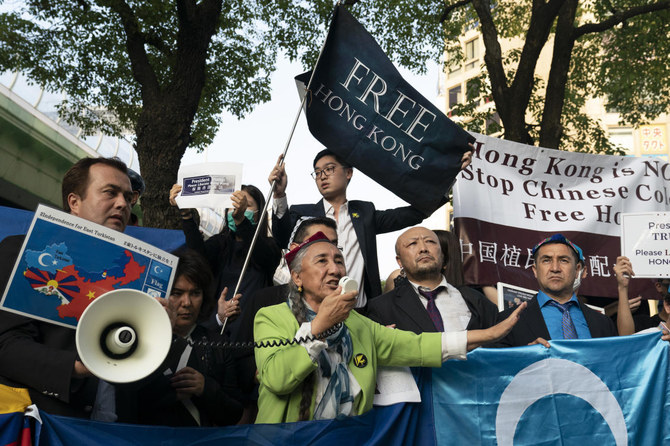
- Rebiya Kadeer said strong world pressure was essential to free an estimated one million people, mostly ethnic Uighurs, held in internment camps in western China
- Chinese officials describe the camps as voluntary vocational education centers where Turkic-speaking Uighurs receive job training
Trump to meet Venezuelan opposition leader Machado after praising its government
- Machado finds herself competing for Trump’s ear with members of Venezuela’s government
- The lunch marks the first time the two have met in person
WASHINGTON: Venezuelan opposition leader Maria Corina Machado arrived at the White House for lunch with Donald Trump on Thursday, a meeting that could affect how the US president seeks to shape the South American country’s political future.
Machado, who fled Venezuela in a daring seaborne escape in December, finds herself competing for Trump’s ear with members of Venezuela’s government and seeking to ensure she has a role in governing the nation going forward.
The lunch marks the first time the two have met in person.
HOPES OF MOVE TO DEMOCRACY
After the US captured Venezuela’s longtime leader, Nicolas Maduro, in a snatch-and-grab operation this month, various opposition figures, members of Venezuela’s diaspora and politicians throughout the US and Latin America have expressed hope that Venezuela will begin the process of democratization.
But for now, Trump has said he is focused on economically rebuilding Venezuela and securing US access to the country’s oil. The day after the January 3 operation, he expressed doubts that Machado had the backing needed to return to the country and govern, telling reporters, “She doesn’t have the support within or the respect within the country.” Trump has on several occasions praised Delcy Rodriguez, Venezuela’s interim president, telling Reuters in an interview on Wednesday, “She’s been very good to deal with.”
Machado was banned from running in Venezuela’s 2024 presidential election by a top court stacked with government allies. Maduro claimed victory, but outside observers widely believe Edmundo Gonzalez, an opposition figure backed by Machado, in fact won more votes by a substantial margin. While the current government has freed dozens of political prisoners in recent days, outside groups and advocates have said the scale of the releases has been exaggerated by Caracas.
One potential topic of conversation for Thursday’s White House meeting will be the Nobel Peace Prize, which was awarded to Machado last month, a snub to Trump, who has long sought the award. Machado has suggested she would give the prize to the US president for having deposed Maduro, though the Norwegian Nobel Institute has said the prize cannot be transferred, shared or revoked.
Asked if he wanted Machado to give him the prize, Trump told Reuters on Wednesday: “No, I didn’t say that. She won the Nobel Peace Prize.”
Pressed on what he would do if she brought the prize nonetheless, he responded: “Well, that’s what I’m hearing. I don’t know, but I shouldn’t be the one to say.”
“I think we’re just going to talk,” Trump told Reuters. “And I haven’t met her. She’s a very nice woman. I think we’re just going to talk basics.”
After her visit with Trump, Machado will meet with a bipartisan group of senior senators on Capitol Hill in the afternoon. The opposition leader has generally found more enthusiastic allies in Congress than in the White House, with some lawmakers having expressed concerns about Trump’s dismissals of her ability to govern.