

Trump to meet Venezuelan opposition leader Machado after praising its government

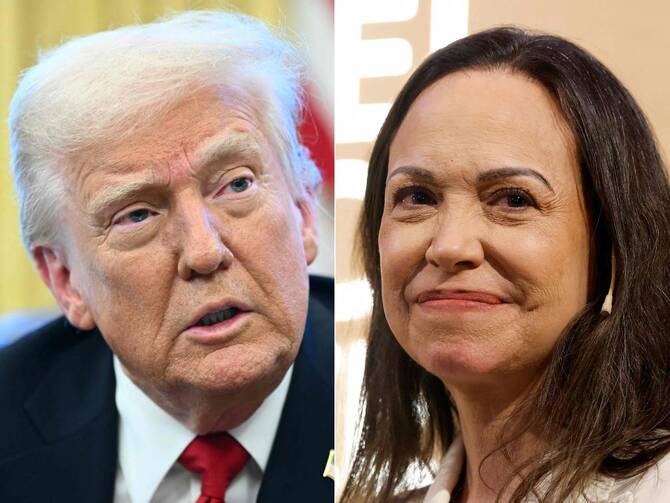
This combination of pictures created on Jan. 14, 2026 shows US President Donald Trump and Nobel peace laureate Maria Corina Machado. (AFP)
Short Url
Updated 15 January 2026
Follow

Trump to meet Venezuelan opposition leader Machado after praising its government

  • Machado finds herself competing for Trump’s ear with members of Venezuela’s government
  • The lunch marks the first time the two have met in person

WASHINGTON: Venezuelan opposition leader Maria Corina Machado arrived at the White House for lunch with Donald Trump on Thursday, a meeting that could affect how the US president seeks to shape the South American country’s political future.
Machado, who fled Venezuela in a daring seaborne escape in December, finds herself competing for Trump’s ear with members of Venezuela’s government and seeking to ensure she has a role in governing the nation going forward.
The lunch marks the first time the two have met in person.

HOPES OF MOVE TO DEMOCRACY
After the US captured Venezuela’s longtime leader, Nicolas Maduro, in a snatch-and-grab operation this month, ⁠various opposition figures, members of Venezuela’s diaspora and politicians throughout the US and Latin America have expressed hope that Venezuela will begin the process of democratization.
But for now, Trump has said he is focused on economically rebuilding Venezuela and securing US access to the country’s oil. The day after the January 3 operation, he expressed doubts that Machado had the backing needed to return to the country and govern, telling reporters, “She doesn’t have the support within or the respect within the country.” Trump has on several ⁠occasions praised Delcy Rodriguez, Venezuela’s interim president, telling Reuters in an interview on Wednesday, “She’s been very good to deal with.”
Machado was banned from running in Venezuela’s 2024 presidential election by a top court stacked with government allies. Maduro claimed victory, but outside observers widely believe Edmundo Gonzalez, an opposition figure backed by Machado, in fact won more votes by a substantial margin. While the current government has freed dozens of political prisoners in recent days, outside groups and advocates have said the scale of the releases has been exaggerated by Caracas.
One potential topic of conversation for Thursday’s White House meeting will be the Nobel Peace Prize, which was awarded to Machado last month, a snub to Trump, who has long sought the award. Machado has suggested she would give ⁠the prize to the US president for having deposed Maduro, though the Norwegian Nobel Institute has said the prize cannot be transferred, shared or revoked.
Asked if he wanted Machado to give him the prize, Trump told Reuters on Wednesday: “No, I didn’t say that. She won the Nobel Peace Prize.”
Pressed on what he would do if she brought the prize nonetheless, he responded: “Well, that’s what I’m hearing. I don’t know, but I shouldn’t be the one to say.”
“I think we’re just going to talk,” Trump told Reuters. “And I haven’t met her. She’s a very nice woman. I think we’re just going to talk basics.”
After her visit with Trump, Machado will meet with a bipartisan group of senior senators on Capitol Hill in the afternoon. The opposition leader has generally found more enthusiastic allies in Congress than in the White House, with some lawmakers having expressed concerns about Trump’s dismissals of her ability to govern.


Community conflict creeps close to DR Congo capital

Updated 5 sec ago
Follow

Community conflict creeps close to DR Congo capital

KINSHASA: Tensions over land between two communities in the Democratic Republic of Congo (DRC) is gradually morphing into an armed conflict that has reached the outskirts of the capital, Kinshasa.
It started with a dispute between tenant farmers and landowners, spread to involve spiritual rituals and then led to actual fightin1g with guns and machetes.
The conflict in the fertile Bateke plateau region, about 70 kilometers (40 miles) northeast of the DRC capital has been smoldering for nearly four years and has already claimed several thousand lives.
Little about it reaches the outside world, overshadowed as it is by the violence raging in the east of the vast central African country since the resurgence in late 2021 of anti-government armed group M23.
On one side are the Teke, whose members consider themselves to be the original inhabitants and owners of the villages located along a 200-kilometer stretch of the Congo river.
On the other side are the members of the Yaka community, farmers who settled there after the Teke.
In 2022, conflict broke out between the two groups when the Yaka rejected an attempt by Teke chiefs to raise the fee they charged for farming the land.
Tensions then escalated into “widespread violence,” according to Human Rights Watch.

- ‘Divine intervention’ -

Several thousand Mobondo militiamen, presented as members of the Yaka community, are thought to be involved in killings that continue in parts of Mai-Ndombe province, just northeast of the capital, despite army deployments in the region.
They take their name from “fetishes that protect against bullets,” engage in spiritual rituals and, according to survivors, believe themselves to be invulnerable.
They have been accused of several attacks in recent months, including one in November where 27 villagers were killed in the Mai-Ndombe village of Nkana, 75 kilometers from Kinshasa.
In early January, a 37-year-old Belgian-Congolese man was hacked to death by machete on his farm in Mbakana, just east of the capital.
His wife and two children escaped the attack, which has been blamed on suspected Mobondo fighters.
Two years earlier, university lecturer Jonathan Kwebe, eluded an attack in Mai-Ndombe. It was thanks to “divine intervention,” he told AFP.
He was on a bus with around 40 other passengers, including women and children, when they were ambushed on the road to the western town of Bandundu by Mobondo militias.
“They were armed with machetes, arrows and hunting rifles. They made us get off the bus and took us to their village. Then they said they’d behead everyone who was Teke,” Kwebe recalled.
Luckily, they were rescued at dawn by Congolese soldiers who had launched a raid against Mobondo fighters in Bandundu.
They fled on another bus along a road “littered with corpses,” the teacher recalled.

- Creeping closer to Kinshasa -

Currently, the Mobondo are active in all three provinces neighboring Kinshasa to the east.
Witnesses say violence has spread from village to village where the Yaka and Teke had previously coexisted peacefully.
The Mobondo have now extended their presence to the outskirts of the capital and even encroached on parts of Central Kongo, on the west side of Kinshasa, according to a report in November by the Danish Institute for International Studies.
The Bateke plateau, northeast of Kinshasa, is one of the capital’s main sources of farm produce — one reason why the Congolese authorities have made several bids to stem the spiral of violence.
But attempts to get the Yaka and Teke to negotiate have failed.
And a government campaign launched in January to encourage the Mobondo to surrender has so far resulted in the demobilization of only around 100 fighters, according to Deputy Defense Minister Eliezer Thambwe.
In February, as the threat drew closer to the capital, former deputy prime minister Peter Kazadi accused certain traditional chiefs of seeking to barter peace for cash.
It is hard to assess the toll from this poorly documented conflict.
In a report published in December, the DRC’s Diocesan Justice and Peace Commission calculated that more than 5,000 people had been killed and more than 280,000 displaced since the conflict began.