WASHINGTON: Kamala Harris spoke slowly but bluntly as she stared at Joe Biden, then began treating him as a hostile witness.
The former federal prosecutor turned California senator started by saying she didn’t think the former vice president “was a racist.” But she criticized him for recently “defending segregationists” in the Senate and for once opposing mandatory busing of students to desegregated public schools.
Harris described a young girl in the 1970s who boarded such buses before dramatically offering, “That little girl was me.”
The moment was as powerful as it was unexpected, a searing line of attack against Biden, who served as vice president to the first African American president. Biden entered back-to-back nights of Democratic presidential debates in Miami as the leading Democratic candidate. Harris showed promise but had not made much of a mark lately.
That changed Thursday.
That Harris and other Democratic presidential hopefuls would come out swinging against Biden was no surprise, and her verbal strike was hardly spontaneous. Moments after the exchange, her campaign tweeted a picture of a school-age Harris with pigtails, over the caption: “There was a little girl in California who was bussed to school. That little girl was me.”
In deeply personal tones, Harris hammered Biden for policy choices that she suggested betrayed the spirit of the civil rights movement, if not directly opposing all it stood for. Then she really hit her stride, exhibiting the controlled force of a practiced cross-examiner.
“Do you agree today that you were wrong to oppose busing in America?” Harris asked.
A visibly angry Biden responded that his record was mischaracterized. But he was left denying Harris’ comments on a technicality, saying he didn’t oppose public school busing, just it being ordered by the Department of Education — decrying federal intervention on the issue on behalf of states.
Harris shot back, “There are moments in history where states fail to support the civil rights of people.”
Biden offered only curt responses after that, and was so flustered that he failed to lean on his time as Obama’s vice president — seeming unsure of himself for prolonged stretches on national television.
Senior advisers to Biden insisted afterward that they weren’t surprised by the confrontation with Harris and were satisfied with his response in the time allowed. They noted that while he dismissed Harris’ characterization of his relationship with segregationist senators in his early years in the Senate more than 45 years ago, Biden appeared to be listening while she criticized his position on busing.
“I thought it was an important moment. He listened. And you don’t judge other people’s pain,” said Cedric Richmond, Biden’s campaign chairman.
Richmond added that, had Biden had more time, he would have spent it discussing his campaign’s focus on educational opportunity, and his work in the Obama administration curbing disproportionate school arrests of African American students.
“We know that we are the front-runner and that people are going to try to bring the front-runner down,” said Richmond, a Louisiana congressman. “Since when is experience and wisdom a bad thing?“
Adding to the drama, though, was the fact that Harris and Biden have long been friends. She grew close to the former vice president’s son, Beau, during their time as state attorneys general. Harris served in California while Beau Biden was serving in Delaware. The two were partners during negotiations with banks amid the foreclosure crisis and Harris texted and talked with Beau Biden daily, sometimes more, before his death in 2015 after being diagnosed with brain cancer.
When Joe Biden endorsed Harris during her 2016 Senate race, he noted that his son “always supported her.”
At a fundraiser last week, Biden hailed the importance of “civility” in politics, mentioning that he worked decades ago alongside senators who supported segregation. Biden has been roundly criticized by members of his own party for the comments, but hasn’t apologized.
Others also tried to hit Biden during Thursday’s debate. Mere moments into the action, 38-year-old California Rep. Eric Swalwell recalled being just 6 when he saw Biden speak, saying the ex-vice president was “right when he said it was time to pass the torch to a new generation of Americans.”
Biden, 76, was better prepared for quips about his age, retorting, “I’m still holding onto that torch.” Subsequently jumping to Biden’s defense was 77-year-old Vermont Sen. Bernie Sanders, who said the issue “is not generational.”
Harris appeared to want to defuse things, saying: “Hey, guys. You wanna know what America does not want to witness? A food fight. They want to know how they’re going to put food on the table.”
But that only set the stage for Harris’ dramatic exchange with Biden later.
Afterward, even some of Harris’ rivals praised her performance. New York Sen. Kirsten Gillibrand said, “What Kamala said was a fair shot.”


![]()
![]()

Kamala Harris gets personal, delivers civil rights blow on Biden at Democrats' presidential debate

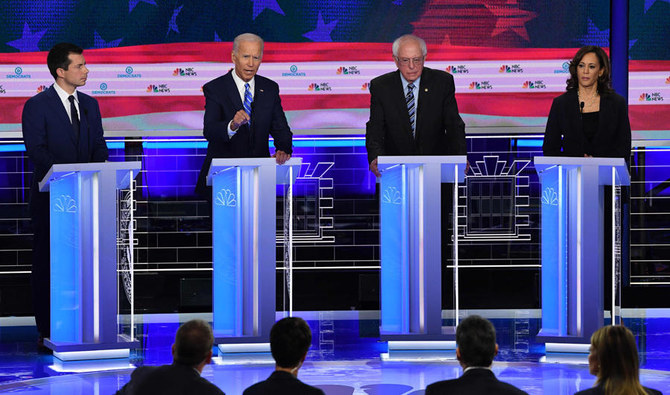
Kamala Harris gets personal, delivers civil rights blow on Biden at Democrats' presidential debate
- Senator Harris criticized Biden for recently “defending segregationists” in the Senate
- Biden, a former vice president, responded that his record was mischaracterized


Latest updates


© 2026 SAUDI RESEARCH & PUBLISHING COMPANY, All Rights Reserved And subject to Terms of Use Agreement.