MIAMI: A lot could have gone wrong for Elizabeth Warren at Wednesday’s Democratic presidential debate.
It didn’t.
Warren, a US senator from Massachusetts, arrived in Miami riding a wave of momentum among the race’s more than 20 candidates. By luck of the draw, she was onstage a night before most of the other top-tier Democratic contenders, such as former Vice President Joe Biden and US Senator Bernie Sanders.
As the first night’s top-polling candidate, she did not falter. Her progressive platform — similar to Sanders’— largely went unchallenged by the moderates standing alongside her.
Most important, her status in the race to take on Republican President Donald Trump in the November 2020 election placed her front and center for the Democratic voters watching at home, and she was given ample time at the outset to detail the populist, anti-corporate themes of her candidacy.
“When you’ve got a government, when you’ve got an economy that does great for those with money and isn’t doing great for everyone else, that is corruption, pure and simple,” Warren said in the early moments of the debate, when viewership is typically highest. “We need to call it out. We need to attack it head- on.”
Warren benefited as well from the sheer chaos of the program. With 10 candidates onstage clamoring for attention and each given only a minute to respond, the evening often felt like a 10-car pileup or a round of speed dating.
It was difficult for viewers to track the questions and responses as some candidates often changed the subject. They talked over one another in an effort to reassure the Democratic base that they all mostly shared a common set of progressive values, making it hard for lesser-known contenders to distinguish themselves.
Given the chance to take Warren on, some centrist candidates punted. Early in the debate, US Senator Amy Klobuchar of Minnesota was asked about Warren’s plan to provide tuition-free college at public universities. Instead of criticizing Warren’s plan as being too far-reaching, Klobuchar talked about her own support of community college and Pell grants for college students.
The evening illustrated the difficulty Democrats may face next year if the US economy remains robust. Following Warren’s lead, several candidates framed the issue in terms of the economy failing to serve middle-class, working-class and minority voters.
“I live in a low-income black and brown community,” said US Senator Cory Booker of New Jersey. “I see every single day that this economy is not working for average Americans.”
Booker, Castro score points
Despite Warren’s strong performance, there were signs of potential pitfalls ahead. She was one of the few candidates onstage to promote the idea of doing away with private health insurance entirely in favor of Medicare. That earned some skepticism from others such as former Congressman Beto O’Rourke.
Her pledge was quickly highlighted by the Republican National Committee, which promised to use it against her in an effort to alarm voters worried about changes to their coverage.
Beyond Warren, the candidate who likely helped himself the most on Wednesday was Booker, who spoke more than anyone else and gave passionate, engaged answers on immigration and guns.
On gun violence, Booker said it was “something that I’m tired of. And I’m tired of hearing people, all they have to offer is thoughts and prayers.”
Former US Housing Secretary Julian Castro also may have raised his stock by getting into a sharp exchange with O’Rourke over decriminalizing border crossings by migrants.
Warren’s moment in the sun likely will be short-lived. On Thursday, Biden and Sanders will take the stage along with other top-tier White House hopefuls, including South Bend, Indiana, Mayor Pete Buttigieg and US Senator Kamala Harris of California.

Warren emerges from first Democratic debate unscathed
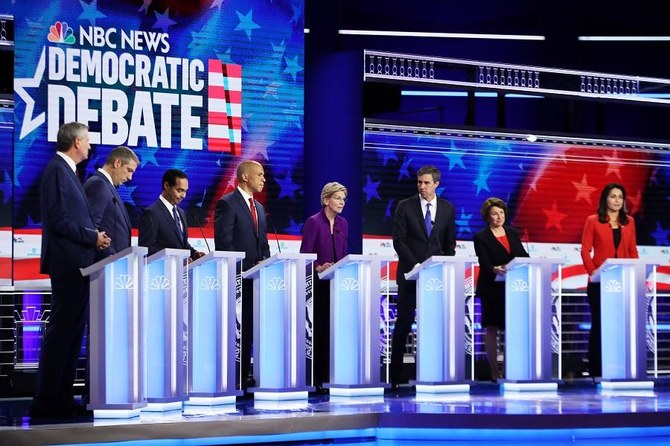
- With 10 candidates onstage clamoring for attention and each given only a minute to respond, the evening often felt like a 10-car pileup or a round of speed dating
- Warren benefited as well from the sheer chaos of the program
House to vote on Iran war powers resolution in a test of Trump’s strategy
WASHINGTON: The House is preparing to vote Thursday on a war powers resolution to halt President Donald Trump’s attack on Iran, a sign of unease in Congress over the rapidly widening conflict that is reordering US priorities at home and abroad.
It’s the second vote in as many days, after the Senate defeated a similar measure along party lines. Lawmakers are confronting the sudden reality of representing the American people in wartime and all that entails — with lives lost, dollars spent and alliances tested by a president’s unilateral decision to go to war with Iran.
The tally in the House is expected to be tight, but the outcome will provide an early snapshot of the political support, or opposition, to the US-Israel military operation and Trump’s rationale for bypassing Congress, which alone has the power to declare war.
“Donald Trump is not a king, and if he believes the war with Iran is in our national interest, then he must come to Congress and make the case,” said Rep. Gregory Meeks, the top Democrat on the House Foreign Affairs Committee.
Meeks said in his nearly three decades in Congress, the hardest votes he has taken have been deciding whether to send US troops to war.
The roll calls are a clarifying moment for the president and the parties just days into the overseas conflict that has quickly carried echoes of the long US wars in Afghanistan and Iraq. Many veterans of those wars have since run for office and now serve in Congress.
Republicans largely back Trump, and most Democrats oppose the war
Trump’s Republican Party, which narrowly controls the House and Senate, largely sees the conflict with Iran not as the start of a new war, but the end of a regime that for decades has long menaced the West. The operation has killed Iran’s Supreme Leader Ayatollah Ali Khamenei, which some view as an opportunity for regime change, though others warn of a chaotic power vacuum.
Rep. Brian Mast of Florida, the GOP chairman of the House Foreign Affairs Committee, publicly thanked Trump for taking action against Iran, saying the president is using his own constitutional authority to defend the US against the “imminent threat” the country posed.
Mast, an Army veteran who worked as a bomb disposal expert in Afghanistan, said the war powers resolution was effectively asking “that the president do nothing.”
For Democrats, Trump’s war with Iran, influenced by Israeli Prime Minister Benjamin Netanyahu, is a war of choice that is testing the balance of powers in the US Constitution.
“The framers weren’t fooling around,” said Rep. Jamie Raskin, D-Md., arguing that the Constitution is clear that only Congress can decide matters of war.
He said whether lawmakers support or oppose the Trump administration’s military action, they should have the debate. “It’s up to us, we’ve got to vote on it.”
While views in Congress are largely falling along party lines, there are crossover coalitions. Both the House and Senate resolutions were bipartisan, and are drawing bipartisan support and opposition. The House is also voting on a separate resolution affirming that Iran is the largest state sponsor of terrorism.
The war powers resolution, if signed into law, would immediately halt Trump’s ability to conduct the war unless Congress approved the military action. The president would likely veto the measure.
As an alternative, a small group of Democrats has proposed a separate war powers resolution that would allow the president to continue the war for 30 days before he must seek congressional approval. It is not expected to come yet for a vote.
Trump officials provide shifting rationale for war
After launching a surprise attack against Iran on Saturday, Trump has scrambled to win support for a conflict that Americans of all political persuasions were already wary of entering. Trump administration officials spent hours behind closed doors on Capitol Hill this week trying to reassure lawmakers that they have the situation under control.
Six US military members were killed over the weekend in a drone strike in Kuwait, and Trump has said more Americans could die. Thousands of Americans abroad have scrambled for flights, many lighting up the phone lines at congressional offices as they sought help trying to flee the Middle East.
Defense Secretary Pete Hegseth said that the war could extend eight weeks, twice as long as the president himself first estimated. Trump has left open the possibility of sending US troops into what, so far, has largely been bombing campaign by air. Hundreds of people in the region have died.
The administration said the goal is to destroy Iran’s ballistic missiles that it believes are shielding its nuclear program. It has also said Israel was ready to act against Iran, and American bases would face retaliation if the US did not strike first. On Wednesday, the US said it torpedoed an Iranian warship near Sri Lanka.
“This administration can’t even give us a straight answer of as to why we launched this preemptive war,” said Rep. Thomas Massie, the Republican from Kentucky who is often an outlier in his party.
Massie and Rep. Ro Khanna, D-Calif., who had teamed up to release the Jeffrey Epstein files, also forced the war powers resolution to the floor, pushing past objections from House Speaker Mike Johnson.
Johnson has warned that it would be “dangerous” to limit the president’s authority while the US military is already in conflict.
Senators sit in their desks for solemn vote
In the Senate, Republican leaders have successfully, though narrowly, defeated a series of war powers resolutions pertaining to several other conflicts during Trump’s second term. This one, however, was different.
Underscoring the gravity of the moment Wednesday, Democratic senators filled the chamber and sat at their desks as the voting got underway.
“Today every senator — every single one — will pick a side,” Senate Democratic leader Chuck Schumer said before the vote. “Do you stand with the American people who are exhausted with forever wars in the Middle East or stand with Donald Trump and Pete Hegseth as they bumble us headfirst into another war?”
Sen. John Barrasso, second in Senate Republican leadership, said “Democrats would rather obstruct Donald Trump than obliterate Iran’s national nuclear program.”
The legislation failed on a 47-53 tally mostly along party lines, with Republican Sen. Rand Paul of Kentucky in favor and Democratic Sen. John Fetterman of Pennsylvania against.
It’s the second vote in as many days, after the Senate defeated a similar measure along party lines. Lawmakers are confronting the sudden reality of representing the American people in wartime and all that entails — with lives lost, dollars spent and alliances tested by a president’s unilateral decision to go to war with Iran.
The tally in the House is expected to be tight, but the outcome will provide an early snapshot of the political support, or opposition, to the US-Israel military operation and Trump’s rationale for bypassing Congress, which alone has the power to declare war.
“Donald Trump is not a king, and if he believes the war with Iran is in our national interest, then he must come to Congress and make the case,” said Rep. Gregory Meeks, the top Democrat on the House Foreign Affairs Committee.
Meeks said in his nearly three decades in Congress, the hardest votes he has taken have been deciding whether to send US troops to war.
The roll calls are a clarifying moment for the president and the parties just days into the overseas conflict that has quickly carried echoes of the long US wars in Afghanistan and Iraq. Many veterans of those wars have since run for office and now serve in Congress.
Republicans largely back Trump, and most Democrats oppose the war
Trump’s Republican Party, which narrowly controls the House and Senate, largely sees the conflict with Iran not as the start of a new war, but the end of a regime that for decades has long menaced the West. The operation has killed Iran’s Supreme Leader Ayatollah Ali Khamenei, which some view as an opportunity for regime change, though others warn of a chaotic power vacuum.
Rep. Brian Mast of Florida, the GOP chairman of the House Foreign Affairs Committee, publicly thanked Trump for taking action against Iran, saying the president is using his own constitutional authority to defend the US against the “imminent threat” the country posed.
Mast, an Army veteran who worked as a bomb disposal expert in Afghanistan, said the war powers resolution was effectively asking “that the president do nothing.”
For Democrats, Trump’s war with Iran, influenced by Israeli Prime Minister Benjamin Netanyahu, is a war of choice that is testing the balance of powers in the US Constitution.
“The framers weren’t fooling around,” said Rep. Jamie Raskin, D-Md., arguing that the Constitution is clear that only Congress can decide matters of war.
He said whether lawmakers support or oppose the Trump administration’s military action, they should have the debate. “It’s up to us, we’ve got to vote on it.”
While views in Congress are largely falling along party lines, there are crossover coalitions. Both the House and Senate resolutions were bipartisan, and are drawing bipartisan support and opposition. The House is also voting on a separate resolution affirming that Iran is the largest state sponsor of terrorism.
The war powers resolution, if signed into law, would immediately halt Trump’s ability to conduct the war unless Congress approved the military action. The president would likely veto the measure.
As an alternative, a small group of Democrats has proposed a separate war powers resolution that would allow the president to continue the war for 30 days before he must seek congressional approval. It is not expected to come yet for a vote.
Trump officials provide shifting rationale for war
After launching a surprise attack against Iran on Saturday, Trump has scrambled to win support for a conflict that Americans of all political persuasions were already wary of entering. Trump administration officials spent hours behind closed doors on Capitol Hill this week trying to reassure lawmakers that they have the situation under control.
Six US military members were killed over the weekend in a drone strike in Kuwait, and Trump has said more Americans could die. Thousands of Americans abroad have scrambled for flights, many lighting up the phone lines at congressional offices as they sought help trying to flee the Middle East.
Defense Secretary Pete Hegseth said that the war could extend eight weeks, twice as long as the president himself first estimated. Trump has left open the possibility of sending US troops into what, so far, has largely been bombing campaign by air. Hundreds of people in the region have died.
The administration said the goal is to destroy Iran’s ballistic missiles that it believes are shielding its nuclear program. It has also said Israel was ready to act against Iran, and American bases would face retaliation if the US did not strike first. On Wednesday, the US said it torpedoed an Iranian warship near Sri Lanka.
“This administration can’t even give us a straight answer of as to why we launched this preemptive war,” said Rep. Thomas Massie, the Republican from Kentucky who is often an outlier in his party.
Massie and Rep. Ro Khanna, D-Calif., who had teamed up to release the Jeffrey Epstein files, also forced the war powers resolution to the floor, pushing past objections from House Speaker Mike Johnson.
Johnson has warned that it would be “dangerous” to limit the president’s authority while the US military is already in conflict.
Senators sit in their desks for solemn vote
In the Senate, Republican leaders have successfully, though narrowly, defeated a series of war powers resolutions pertaining to several other conflicts during Trump’s second term. This one, however, was different.
Underscoring the gravity of the moment Wednesday, Democratic senators filled the chamber and sat at their desks as the voting got underway.
“Today every senator — every single one — will pick a side,” Senate Democratic leader Chuck Schumer said before the vote. “Do you stand with the American people who are exhausted with forever wars in the Middle East or stand with Donald Trump and Pete Hegseth as they bumble us headfirst into another war?”
Sen. John Barrasso, second in Senate Republican leadership, said “Democrats would rather obstruct Donald Trump than obliterate Iran’s national nuclear program.”
The legislation failed on a 47-53 tally mostly along party lines, with Republican Sen. Rand Paul of Kentucky in favor and Democratic Sen. John Fetterman of Pennsylvania against.
© 2026 SAUDI RESEARCH & PUBLISHING COMPANY, All Rights Reserved And subject to Terms of Use Agreement.


