DHAKA: At least sixteen people were facing the death penalty in a trial that started Thursday over the gruesome death of a young Bangladeshi woman that sparked protests and government promises of tough action.
Nusrat Jahan Rafi, 19, was set on fire in April after allegedly refusing to withdraw claims of sexual harassment against the head teacher of the Islamic seminary she attended.
She was lured onto the seminary rooftop in the southeastern town of Sonagazi, doused in kerosene and set alight, prosecutors say. She died five days later, triggering countrywide outrage.
The 16 people indicted — including the teacher — could face the death penalty if convicted. All defendants pleaded not guilty, while eight of the accused told the court that police forced them to sign written statements confessing involvement in the murder.
A special tribunal opened the trial Thursday at a crowded courtroom in the southeastern Feni district, with the first testimony by Rafi’s elder brother Mahmudul Hasan Noman who filed the case.
Noman — one of 92 people due to testify — described the killing in the court, saying the murder could have been avoided if police had acted upon Rafi’s harassment complaint.
The trial is expected to finish in six months, but Noman has urged the court to fast-track the hearings.
“Several defendants have alleged they were tortured and given electric shocks to sign confessional statements,” defense lawyer Giasuddin Ahmed told AFP, adding the case has become “politically motivated.”
Rafi had gone to police in March to report the alleged harassment. A leaked video shows the then district police chief registering her complaint but dismissing it as “not a big deal.”
The police official was later dismissed and arrested early this month for failing to properly investigate her allegations.
Police said at least five people — including three of Rafi’s classmates — tied her up with a scarf before setting her on fire. The plan was to stage the incident as a suicide case.
Rafi suffered burns to 80 percent of her body and died on April 10. But she recorded a video before her death, repeating her allegations against the head teacher.
Rights groups are closely monitoring the case as it came amid a spike in the number of rape and sexual assaults reported in Bangladesh.
They have said “a culture of impunity” is partly to blame for rise in sexual violence in the country.
According to Bangladesh Mahila Parishad, a women’s rights group, only three percent of rape cases end in convictions.
It said about 950 women were raped in Bangladesh last year.

Trial opens over Bangladesh teen’s grisly murder
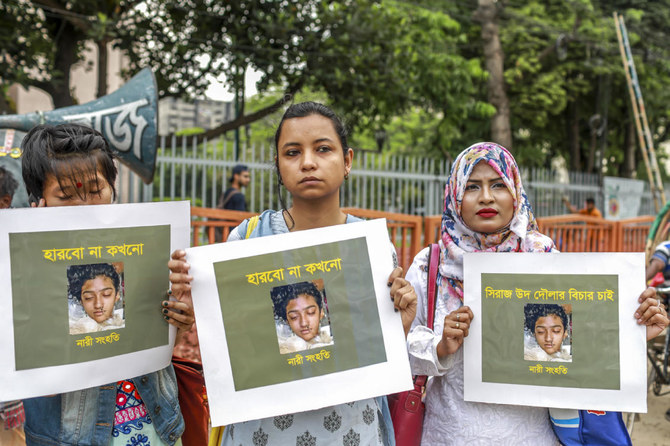
- Nusrat Jahan Rafi, 19, was set on fire in April after allegedly refusing to withdraw claims of sexual harassment against the head teacher of the Islamic seminary she attended
- She was lured onto the seminary rooftop in the southeastern town of Sonagazi, doused in kerosene and set alight, prosecutors say
Gaza student evacuated to UK with her family after government climbdown
- Manar Al-Houbi was initially denied permission to bring her husband and children after changes to UK rules on foreign scholarship recipients
- Several students still stranded in Gaza as relocation deadline looms, after refusing to abandon family members
LONDON: A student from Gaza granted permission to live and study in the UK has been evacuated from the Palestinian territory, with her family, by the British government.
Manar Al-Houbi won a full scholarship to study for a doctorate at the University of Glasgow. It also allowed her to bring her husband and children with her, and they applied for the required visas. But shortly before her studies were due to start, UK authorities told her the rules for international students and their dependents had changed and her family could no longer accompany her.
Shortly after her story was reported in October, however, the government backed down as said it would consider evacuation of international students’ dependents on a “case-by-case basis.”
Al-Houbi and her family are now in Jordan, on their way to the UK, The Guardian newspaper reported on Friday. The British scheme for the evacuation of students from Gaza is due to expire on Dec. 31. People who have attempted to use it have described it as being riddled with issues, as a result of which some students with scholarships have been left stranded in the Palestinian territory.
Several told the Guardian they had decided not to travel to the UK because they had felt pressured into leaving loved ones behind, including children.
Wahhaj Mohammed, 32, said he was told by the Foreign, Commonwealth and Development Office to travel to the UK alone, and his wife and children would be allowed to join him later. Two months after he arrived in Glasgow, his family are still in Gaza with no time frame for them to follow him.
“The uncertainty affects every aspect of my life here,” he told The Guardian. “It’s difficult to settle, to feel present or to engage academically when the people you love most remain living under constant threat.”
The Guardian said UK officials were “hopeful” his family would be evacuated in 2026 but could offer no guarantee about when this might happen.
Another student, Amany Shaher, said she refused to leave her family behind in Gaza and as a result was denied permission to travel to the UK this week. She does not know whether she will be permitted to defer her scholarship to study at the University of Bristol.
The 34-year-old, who has three children, said: “How can I even consider leaving my children behind in Gaza? Nowhere else in the world would a mother be expected to part so easily from her children. It’s dehumanizing. We have a right to stick together as a family and not be forced to separate — that should not be too much to ask.
“None of us know if the UK’s student evacuation scheme will be extended or not. We haven’t been given any clear guidance or timelines and have no idea what 2026 will bring.”
Mohammed Aldalou also refused to leave behind his family, including his 5-year-old autistic and non-verbal son, to take up a scholarship for postgraduate studies at the London School of Economics.
He said the Foreign Office had suggested to him he travel separately from them, as they did with Mohammed.
“They should ask themselves what they would do if they were in my shoes,” he said. “It’s heartbreaking that after everything we’ve been through, we’re being asked to make this impossible decision.”
Sources told The Guardian it was unlikely the Foreign Office would extend the scheme to allow students to travel from Gaza to the UK later, but that a meeting took place last week with the Department for Education to discuss whether students could begin their studies online.


