

Tunisian president hospitalised ‘in severe health crisis’

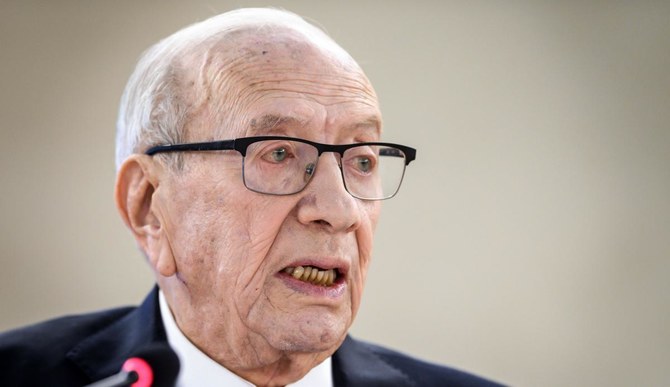
Tunisian President Beji Caid Essebsi was taken “seriously ill” on Thursday and hospitalized. (File/AFP)
Updated 27 June 2019
Follow

Tunisian president hospitalised ‘in severe health crisis’

  • Essebsi has been a prominent figure in Tunisia since the overthrow of autocrat Zine El-Abidine Ben Ali in 2011 which set the North African country on a path to democracy
  • Tunisian Prime Minister Youssef Chahed visited President Beji Caid Essebsi in hospital and called on people to stop spreading fake news about his health

TUNIS: Tunisian President Beji Caid Essebsi, 92, a major player since the country's transition to democracy since 2011, was on Thursday taken to a military hospital after suffering a "severe health crisis", the presidency said.
One of his advisers told Reuters he was in a "very critical" condition but was alive, denying media reports he had died. No more details were immediately available.
Essebsi was hospitalised last week as well, for what the presidency described as non-serious treatment.
Essebsi has been a prominent figure in Tunisia since the overthrow of autocrat Zine El-Abidine Ben Ali in 2011 which set the North African country on a path to democracy, avoiding the more violent upheavals seen in the rest of the region.
He led the immediate transition as prime minister in 2011 and was elected president three years later. Essebsi was a senior figure before 2011, having served as foreign minister under state founder Habib Bourguiba and parliamentary speaker under Ben Ali.
He said in June he would not run for a second term in presidential elections this year, despite his party’s calls for him to stand. The party has not identified another candidate yet.
Under a new constitution guaranteeing democratic freedoms, Essebsi has limited powers compared with Ben Ali. His is mainly responsible for foreign and defence policies.
The day-to-day business of government and economic policy is run by Prime Minister Youssef Chahed, in office since 2016. He is also the main contact person for the International Monetary Fund and other donors which have kept Tunisia afloat amid its economic crisis.

Meanwhile, Tunisian Prime Minister Youssef Chahed visited President Beji Caid Essebsi in hospital and called on people to stop spreading fake news about his health, he said on his Facebook page.
"I assure the Tunisians that the President of the Republic is in the process of receiving all the necessary attention he needs," Chahed wrote.
"I call on everyone to refrain from broadcasting false news that will cause confusion among Tunisians."


’Not much is standing’ in Gaza, says UN official

Updated 4 sec ago
Follow

’Not much is standing’ in Gaza, says UN official

  • “We can’t wait, we can’t procrastinate,” da Silva said, adding that Gazans across the territory were living in an “inhumane situation“
  • He said the launch of phase two of the Gaza truce plan marked a “historical” moment

JERUSALEM: A top United Nations official on Thursday called for accelerating reconstruction work in Gaza, saying Palestinians there were living in “inhumane” conditions, even as a US-backed truce entered its second phase.
“I wouldn’t have imagined what I saw today, which is total destruction, not much is standing,” Jorge Moreira da Silva, head of UN Office for Project Services (UNOPS) told journalists after a visit to the Gaza Strip.
“We can’t wait, we can’t procrastinate,” he said, adding that Gazans across the territory were living in an “inhumane situation.”
The two-year war between Hamas and Israeli forces has left Gaza facing destruction on a scale unseen in previous conflicts, with vast swathes reduced to rubble.
Entire residential neighborhoods, hospitals, schools and basic infrastructure have been heavily damaged or destroyed, forcing hundreds of thousands of people to live in makeshift shelters.
Da Silva said the launch of phase two of the Gaza truce plan marked a “historical” moment that should be seized to kick-start reconstruction efforts.
“This opens the opportunities for reconstruction, knowing that we will need $52 billion, according to the assessment conducted by the World Bank, UN and the European Commission, for the reconstruction of Gaza,” he said.
“But the point is we can’t wait for the big reconstruction, which requires billions, to immediately launch the early recovery that requires millions.”
On Wednesday, US Middle East envoy Steve Witkoff announced the start of phase two of the Gaza ceasefire, saying it aimed to pave the way for reconstruction and the demilitarization of all armed factions in the territory.
The war was triggered by the Palestinian Islamist group’s unprecedented attack on Israel on October 7, 2023.
The ensuing Israeli offensive has devastated Gaza, home to about 2.2 million people, a territory that was already suffering severely from previous rounds of fighting and from an Israeli blockade imposed since 2007.
Da Silva said the war had left about 60 million tons of rubble scattered across the strip.
“Gaza is flooded by rubble and debris,” he said.
“The problem is not just the volume of rubble, it’s also the fact that its content is quite a matter of concern, with unexploded ordnance in the rubble, dangerous waste, and unfortunately also human remains.”
The environmental and urban planning specialist said one of the most urgent priorities was ensuring reliable access to fuel — a critical resource in Gaza, where most electricity is generated by fuel-powered generators.
He also cited the need for demining, rebuilding water supply networks, lifting restrictions on the entry of aid, and allowing in spare parts required for repairs — long-standing demands by humanitarian organizations operating in Gaza.
Aid groups have for months complained of difficulties bringing in equipment and supplies, blaming Israeli restrictions.
Israel rejects those accusations, saying it oversees the entry of goods into Gaza to ensure its security.