

One dead, several wounded in suicide bomber attacks in Tunisian capital

1 / 4
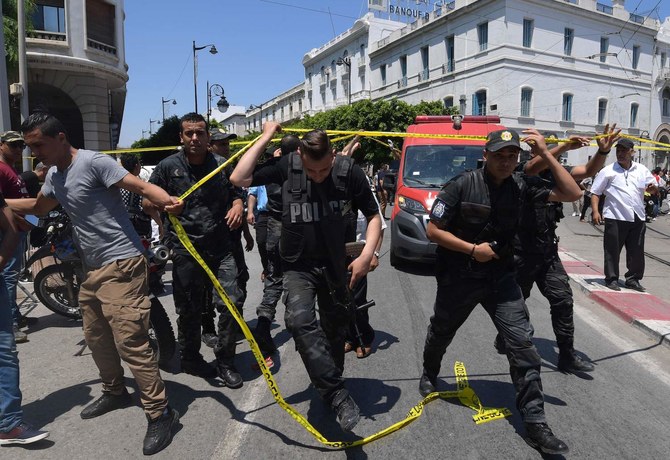
Tunisian police work at the site of an attack in the Tunisian capital's main avenue Habib Bourguiba on June 27, 2019. (AFP)
2 / 4
Tunisian security forces cordon off the site of an attack in the Tunisian capital's main avenue Habib Bourguiba on June 27, 2019. (AFP)
3 / 4
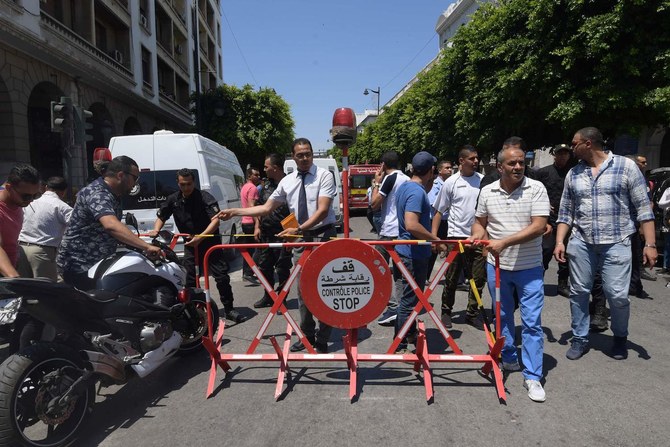
A member of security forces secure the site of an explosion at Charles de Gaulle street in downtown Tunis, Tunisia June 27, 2019. (Reuters)
4 / 4
Updated 28 June 2019
Follow

One dead, several wounded in suicide bomber attacks in Tunisian capital

  • A suicide attack targeted police on the main street of Tunisia's capital on Thursday morning, killing one police officer and wounding several other people
  • A second suicide bomber blew himself up near a police station in Al-Qarjani district in the Tunisian capital

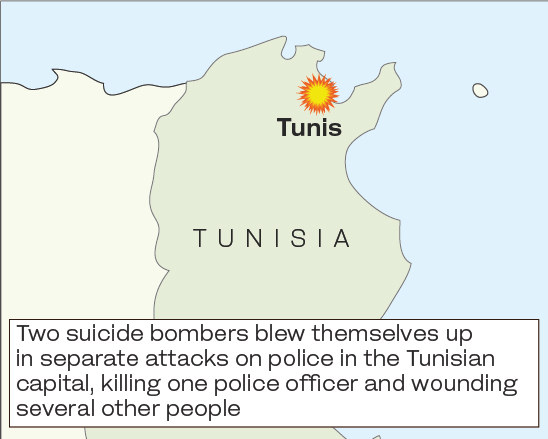
TUNIS: Two suicide bombers blew themselves up in separate attacks on police in the Tunisian capital on Thursday, killing one police officer and wounding several other people, the government said.

Daesh claimed it was behind the attacks, which come months before an election and at the peak of a tourist season in which Tunisia is hoping for a record number of visitors.

The first attack targeted a police patrol in Charles de Gaulle Street in central Tunis. One police officer was killed and at least one other as well as three civilians were wounded, the Interior Ministry said.

Shortly afterwards, a second suicide bomber blew himself up near a police station in Al-Gorjani district. Four people were wounded, the Interior Ministry said.

Heavily armed police cordoned off the locations of the attacks, one of which was about 200 meters away from the French embassy.

Reuters witnesses saw people rushing away from the scene, while the body of one suicide bomber lay on the ground.

“I was shopping with my daughter and we heard a big explosion. We saw the body of the terrorist lying on the ground near a police vehicle after he blew himself up,” said a man who give his name only as Mohamed.

Interior Ministry spokesman Sofian Zaak said the attackers had not yet been identified, and he called on the public to show strength and not panic.

The Saudi Ministry of Foreign Affairs condemned the two suicide attacks in Tunis that killed a police man and injured others.
The ministry offered condolences to the families of the victims and wished the injured a speedy recovery.
It also expressed the Kingdom’s solidarity with Tunisia in combating violence, terrorism, and extremism.

Tunisia has been battling militant groups operating in remote areas near the border with Algeria since an uprising overthrew autocratic leader Zine Abidine Ben Ali in 2011. High unemployment has also stoked unrest in recent years.

Last October, a woman blew herself up in the center of the capital Tunis, wounding 15 people including 10 police officers in an explosion that broke a long period of calm after dozens had died in militant attacks in 2015.

Security has improved since authorities imposed a state of emergency in November 2015 after those attacks — one at a museum in Tunis and another on a beach in Sousse. A third attack targeted presidential guards in the capital. Daesh claimed responsibility.

The attacks scared off holidaymakers and investors, worsening the country’s economic problems.


Israeli airstrikes pound areas north of Litani River as tensions with Hezbollah escalate

Updated 5 sec ago
Follow

Israeli airstrikes pound areas north of Litani River as tensions with Hezbollah escalate

  • Raids day after Tel Aviv signaled possible resumption of strikes, accusing Lebanon of ‘not moving fast enough’
  • US President Donald Trump says Hezbollah ‘must be completely disarmed’

BEIRUT: Israeli airstrikes on Friday hit several areas north of the Litani River, a day after Israel signaled it could resume its attacks on Hezbollah after claiming the Lebanese army was “not moving fast enough” and that the Iran-backed group was “rebuilding its military system.”

The raids struck multiple locations across the Iqlim Al-Tuffah region, the heights of Jabal Al-Rihane, and the towns of Mlikh and Aaramta in the Jezzine District, as well as the area around Qal’at Meiss between Ansar and Al-Zrariyah. Strikes on the Tabna area, on the outskirts of Al-Baisariyah in the Sidon–Zahrani district, cut the road linking nearby villages.

Airstrikes also hit the valley between Kafroue and Aazze in the Nabatieh District, the outskirts of Ain Al-Tineh, and Jabal Machghara in Western Bekaa, while Israeli warplanes flew at low altitude over the south, reaching the airspace of Baalbek, northern Bekaa, and the surrounding villages.

Israeli army spokesperson Avichay Adraee claimed that Israel’s forces had targeted a “training compound” of the Radwan Force of Hezbollah allegedly used to conduct training for its members “in order to plan and carry out terrorist plots against army forces and the citizens of the state of Israel. The terrorist operatives were undergoing shooting training and qualification in the use of various combat means.”

Adraee added that the Israeli army struck “buildings and military facilities (used) for storing weapons” belonging to Hezbollah, and suggested that attacks were likely to continue.

Political writer Ali Al-Amin told Arab News: “The areas targeted by the Israeli airstrikes on Friday had previously been targeted repeatedly, but these areas are valleys and closed spaces belonging to the party, extending from the south to the Western Bekaa, and everyone knows that they contain bases and armament centers.”

Al-Amin added that Hezbollah “is currently living (in) an unprecedented moment of weakness. Iran, on the other hand, is facing a renewed predicament, confronting internal protests at a moment of external pullback, which means that whether Hezbollah hands over its weapons or does not hand them over, it is in a state of exposure at a time of a major imbalance.”

The end of 2025 marked the deadline Lebanon committed to for the state’s monopoly of arms south of the Litani River. On Jan. 8, its first session of the year, the Cabinet is expected to hear the Lebanese army’s report announcing the completion of its mission, preceding the second phase which covers the southern area up to the Awali River. Prime Minister Nawaf Salam said the country remained committed to meeting the deadline.

An official political source confirmed to Arab News: “The army commander will present his report and the military institution will continue its mission. There will be no postponement.”

Hezbollah’s Secretary-General Naim Qassem said in a statement: “Hezbollah’s disarmament is a US-Israeli project targeting Lebanon and its sovereignty and independence, even if it is marketed under the banner of exclusive state control of arms.”

He added that the demand for control of weapons amid “continued Israeli attacks means that you are not working in Lebanon’s interest, but in Israel’s interest.”

On Thursday, following his meeting with Israeli Prime Minister Benjamin Netanyahu, US President Donald Trump said that Hezbollah “has been behaving badly” and “must be completely disarmed,” adding that “the Lebanese government is at a little bit of a disadvantage” with the group.

Asked whether Israel should strike Hezbollah in Lebanon due to the group’s refusal to disarm, Trump replied: “We’re going to see about that.”

Sirens sounded in Baram in Western Galilee in Israel on Friday morning, and a missile was launched toward a target in Upper Galilee, exploding in the north near the Lebanese towns of Maroun Al-Ras and Yaroun. Israeli Army Radio later reported that it had been a false alarm and the “suspect was a flock of birds.”