

One dead, several wounded in suicide bomber attacks in Tunisian capital

1 / 4
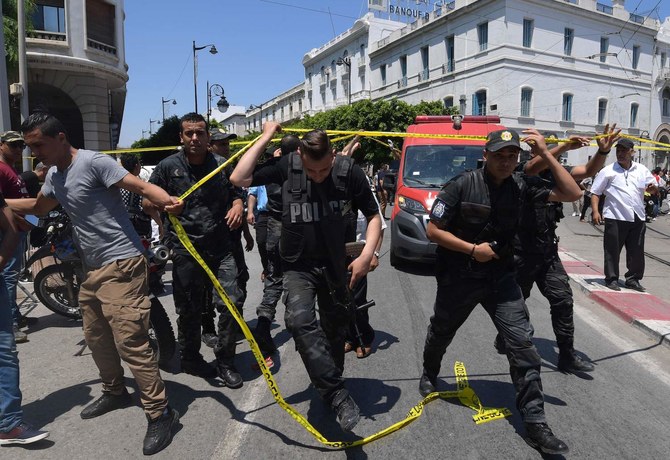
Tunisian police work at the site of an attack in the Tunisian capital's main avenue Habib Bourguiba on June 27, 2019. (AFP)
2 / 4
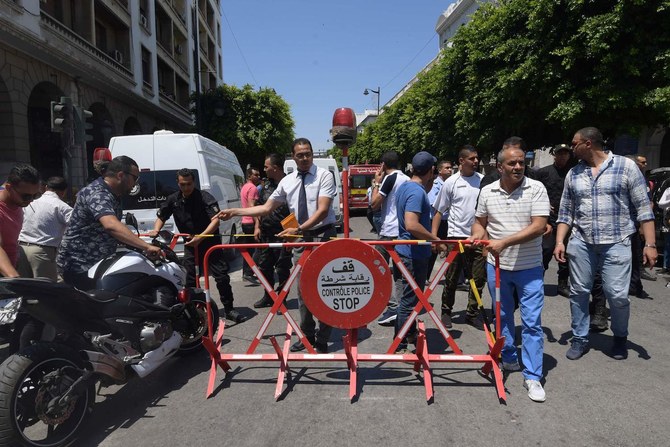
Tunisian security forces cordon off the site of an attack in the Tunisian capital's main avenue Habib Bourguiba on June 27, 2019. (AFP)
3 / 4
A member of security forces secure the site of an explosion at Charles de Gaulle street in downtown Tunis, Tunisia June 27, 2019. (Reuters)
4 / 4
Updated 28 June 2019
Follow

One dead, several wounded in suicide bomber attacks in Tunisian capital

  • A suicide attack targeted police on the main street of Tunisia's capital on Thursday morning, killing one police officer and wounding several other people
  • A second suicide bomber blew himself up near a police station in Al-Qarjani district in the Tunisian capital

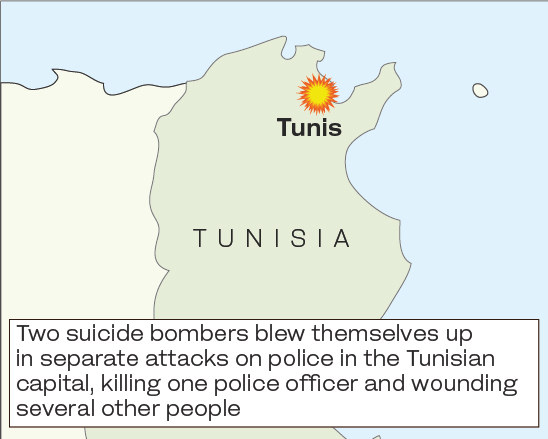
TUNIS: Two suicide bombers blew themselves up in separate attacks on police in the Tunisian capital on Thursday, killing one police officer and wounding several other people, the government said.

Daesh claimed it was behind the attacks, which come months before an election and at the peak of a tourist season in which Tunisia is hoping for a record number of visitors.

The first attack targeted a police patrol in Charles de Gaulle Street in central Tunis. One police officer was killed and at least one other as well as three civilians were wounded, the Interior Ministry said.

Shortly afterwards, a second suicide bomber blew himself up near a police station in Al-Gorjani district. Four people were wounded, the Interior Ministry said.

Heavily armed police cordoned off the locations of the attacks, one of which was about 200 meters away from the French embassy.

Reuters witnesses saw people rushing away from the scene, while the body of one suicide bomber lay on the ground.

“I was shopping with my daughter and we heard a big explosion. We saw the body of the terrorist lying on the ground near a police vehicle after he blew himself up,” said a man who give his name only as Mohamed.

Interior Ministry spokesman Sofian Zaak said the attackers had not yet been identified, and he called on the public to show strength and not panic.

The Saudi Ministry of Foreign Affairs condemned the two suicide attacks in Tunis that killed a police man and injured others.
The ministry offered condolences to the families of the victims and wished the injured a speedy recovery.
It also expressed the Kingdom’s solidarity with Tunisia in combating violence, terrorism, and extremism.

Tunisia has been battling militant groups operating in remote areas near the border with Algeria since an uprising overthrew autocratic leader Zine Abidine Ben Ali in 2011. High unemployment has also stoked unrest in recent years.

Last October, a woman blew herself up in the center of the capital Tunis, wounding 15 people including 10 police officers in an explosion that broke a long period of calm after dozens had died in militant attacks in 2015.

Security has improved since authorities imposed a state of emergency in November 2015 after those attacks — one at a museum in Tunis and another on a beach in Sousse. A third attack targeted presidential guards in the capital. Daesh claimed responsibility.

The attacks scared off holidaymakers and investors, worsening the country’s economic problems.


Village in southern Lebanon buries a child and father killed in Israeli drone strike

Updated 7 sec ago
Follow

Village in southern Lebanon buries a child and father killed in Israeli drone strike

  • Hassan Jaber, a police officer, and his 3-year-old son, Ali, were on foot when the strike hit a passing car in Yanouh on Monday
  • The car’s driver, Ahmad Salami, was also killed. The Israeli military said Salami was an artillery official with Hezbollah
YANOUH: Mourners in southern Lebanon on Tuesday buried a father and his young son killed in an Israeli drone strike that targeted a Hezbollah member.
Hassan Jaber, a police officer, and his child, Ali, were on foot when the strike on Monday hit a passing car in the center of their town, Yanouh, relatives said. Lebanon’s health ministry said the boy was 3 years old. Both were killed at the scene along with the car driver, Ahmad Salami, who the Israeli military said in a statement was an artillery official with the Lebanese militant group.
It said it was aware of a “claim that uninvolved civilians were killed” and that the case is under review, adding it “makes every effort to reduce the likelihood of harm” to civilians.
Salami, also from Yanouh, was buried in the village Tuesday along with the father and son.
“There are always people here, it’s a crowded area,” with coffee shops and corner stores, a Shiite religious gathering hall, the municipality building and a civil defense center, a cousin of the boy’s father, also named Hassan Jaber, told The Associated Press.
When the boy and his father were struck, he said, they were going to a bakery making Lebanese breakfast flatbread known as manakish to see how it was made. They were standing only about 5 meters (5.5 yards) from the car when it was struck, the cousin said.
“It is not new for the Israeli enemy to carry out such actions,” he said. “There was a car they wanted to hit and they struck it in the middle of this crowded place.”
Jaber said the little boy, Ali, had not yet entered school but “showed signs of unusual intelligence.”
“What did this innocent child do wrong, this angel?” asked Ghazaleh Haider, the wife of the boy’s uncle. “Was he a fighter or a jihadi?”
Attendees at the funeral carried photos of Ali, a striking child with large green eyes and blond hair. Some also carried flags of Hezbollah or Amal, a Shiite party that is allied with but also sometimes a rival of Hezbollah.
Lebanon’s Internal Security Forces, of which the child’s father was a member, said in a statement that the 37-year-old father of three had joined in 2013 and reached the rank of first sergeant.
The strike came as Israel has stepped up its campaign against Hezbollah and its allies in Lebanon.
The night before the strike in Yanouh, Israeli forces launched a rare ground raid in the Lebanese village of Hebbarieh, several kilometers (miles) from the border, in which they seized a local official with the Sunni Islamist group Al-Jamaa Al-Islamiya, or the Islamic Group in English. The group is allied with Hezbollah and the Palestinian militant group Hamas.
The low-level conflict between Lebanon and Israel escalated into full-scale war in September 2024, later reined in but not fully stopped by a US-brokered ceasefire two months later.
Since then, Israel has accused Hezbollah of trying to rebuild and has carried out near-daily strikes in Lebanon that it says target Hezbollah militants and facilities.
Israeli forces also continue to occupy five hilltop points on the Lebanese side of the border. Hezbollah has claimed one strike against Israel since the ceasefire.