Kushner’s Peace to Prosperity plan met with guarded enthusiasm

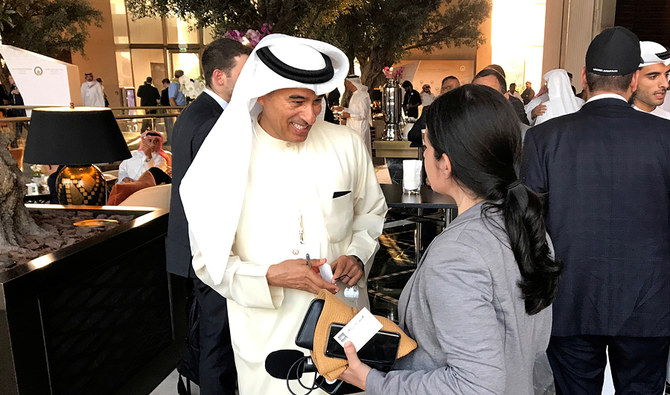
Mohamed Alabbar, chairman of Dubai-based Emaar Properties, talks to an Israeli radio journalist at the Peace to Prosperity conference in Manama. (Reuters)
Updated 26 June 2019
Follow

Kushner’s Peace to Prosperity plan met with guarded enthusiasm

  • Palestine is very important for all Arabs, says Alabbar, UAE property magnate

MANAMA: Business leaders from the US and the Middle East reacted with guarded enthusiasm to the Peace to Prosperity plan presented by White House special adviser Jared Kushner to an audience of global decision-makers in Bahrain’s capital Manama.

Stephen Schwarzman, chairman and CEO of the big investment business Blackstone Group, said the plan “could happen in the right circumstances. We all have to have a dream, and this is a very sensible dream.”

Mohamed Alabbar, chairman of the UAE property and leisure group Emaar, said Palestine is very important for all Arabs.

“The issue is very close to our hearts. Everyone of us is Palestinian at heart, and I feel I represent them here tonight,” he said in reference to the absence of Palestinian Authority delegates at the event.

Earlier, the audience of business leaders and policymakers from around the world listened attentively as Kushner unveiled details of the $50 billion plan to revive the Palestinian and regional economy.

He is hoping to attract investment from Middle Eastern and other governments, as well as private enterprise from around the world, for the proposals, which are designed to revive the Palestinian economy, create 1 million jobs and cut the poverty rate in the occupied territories.

HIGHLIGHT

The audience of business leaders and policymakers from around the world listened attentively as Kushner unveiled details of the $50 billion plan to revive the Palestinian and regional economy.

About $27 billion of the total is earmarked for Palestine, and only 20 percent of that will be straight equity.

“That’s only $5.5 billion, and it’s not that much money. It’s a good-sized proposal you’d expect to be financing at the World Bank,” Schwarzman said.

“This type of transformation is financially doable. It’s a question of whether there’s the political will.”

Alabbar said he had been a big investor in the region around Palestine for 12 years, and in some ways it was easier to do business in the Middle East than in North America, where getting planning permission for big developments could take as long as seven years.

He pointed to Emaar’s successful developments in Serbia as an example of “a war-torn region that has come good.”

Schwarzman gave examples from his firm’s investments in Uganda and Poland as the kind of transformational investments Palestine needs.

Both men were asked what effect Kushner’s proposals would have shown in two years’ time. “I think we’d all be overjoyed if this situation was normalized,” Schwarzman replied. Alabbar said: “I think the velocity of the change could surprise us all positively.”


Iraq says it will prosecute Daesh detainees sent from Syria

Updated 8 sec ago
Follow

Iraq says it will prosecute Daesh detainees sent from Syria

  • Iraq government says transfer was pre-emptive step to protect national security
  • Prosoners have been held for years in prisons and camps guarded by the Kurdish-led SDF
BAGHDAD: Iraq’s Supreme Judicial Council said on Thursday it would begin ​legal proceedings against Daesh detainees transferred from Syria, after the rapid collapse of Kurdish-led forces in northeast Syria triggered concerns over prison security.
More than 10,000 members of the ultra-hard-line militant group have been held for years in about a dozen prisons and detention camps guarded by the Kurdish-led Syrian Democratic Forces (SDF) in Syria’s northeast.
The US military said on Tuesday its forces had transferred 150 Daesh detainees from Syria to Iraq and that the operation could eventually see up to 7,000 detainees moved out of Syria.
It cited concerns over security at the prisons, which also hold thousands more women and children with ties to the militant group, after military setbacks ‌suffered by the ‌SDF.
A US official told Reuters on Tuesday that about 200 low-level ‌Daesh ⁠fighters ​escaped from ‌Syria’s Shaddadi prison, although Syrian government forces had recaptured many of them.
Iraqi officials said Prime Minister Mohammed Shia Al-Sudani mentioned the transfer of Daesh prisoners to Iraq in a phone call with Syrian President Ahmad Al-Sharaa on Tuesday, adding that the transfers went ahead following a formal request by the Iraqi government to Syrian authorities.
Iraqi government spokesperson Basim Al-Awadi said the transfer was “a pre-emptive step to protect Iraq’s national security,” adding that Baghdad could not delay action given the rapid pace of security and political developments in Syria.
Daesh emerged in Iraq and Syria, and at the ⁠height of its power from 2014-2017 held swathes of the two countries. The group was defeated after a military campaign by ‌a US-led coalition.
An Iraqi military spokesperson confirmed that Iraq had received ‍a first batch of 150 Daesh detainees, including ‍Iraqis and foreigners, and said the number of future transfers would depend on security and field assessments. The ‍spokesperson described the detainees as senior figures within the group.
In a statement, the Supreme Judicial Council said Iraqi courts would take “due legal measures” against the detainees once they are handed over and placed in specialized correctional facilities, citing the Iraqi constitution and criminal laws.
“All suspects, regardless of their nationalities or positions within the terrorist ​organization, are subject exclusively to the authority of the Iraqi judiciary,” the statement said.
Iraqi officials say under the legal measures, Daesh detainees will be separated, with senior figures including foreign nationals to ⁠be held at a high-security detention facility near Baghdad airport that was previously used by US forces.
Two Iraqi legal sources said the Daesh detainees sent from Syria include a mix of nationalities, with Iraqis making up the largest group, alongside Arab fighters from other countries as well as European and other ‌Western nationals.
The sources said the detainees include nationals of Britain, Germany, France, Belgium and Sweden, and other European Union countries, and will be prosecuted under Iraqi jurisdiction.