Sudan protesters accept Ethiopia proposal for political transition

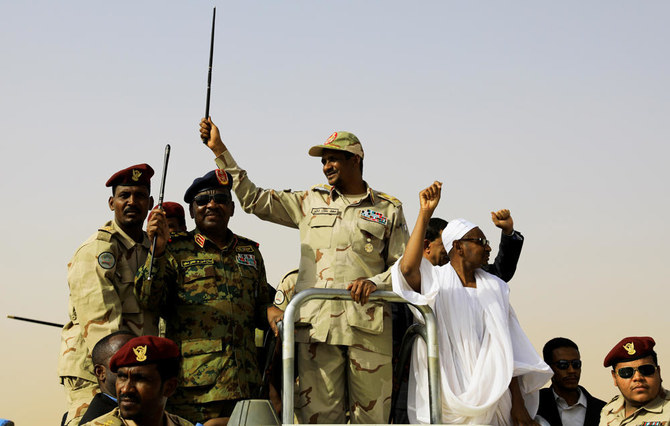
Lieutenant General Mohamed Hamdan Dagalo, deputy head of Sudan's military council and head of paramilitary Rapid Support Forces (RSF), greets his supporters as he arrives at a meeting in Aprag village, 60 kilometers away from Khartoum, Sudan, on June 22, 2019. (REUTERS/Umit Bektas)
Updated 23 June 2019
Follow

Sudan protesters accept Ethiopia proposal for political transition

  • The ruling military council has yet to give its decision on the Ethiopian proposal
  • Ethiopia has stepped up its efforts to resolve the political crisis in Sudan since the deadly June 3 dispersal of a protest camp

KHARTOUM: Sudanese protest leaders on Saturday said they accepted the creation of a civilian-majority governing body for a political transition in Sudan as proposed by an Ethiopian envoy.
The compromise blueprint suggests the creation of a 15-member governing body that would install a civilian administration — comprising eight civilians and seven members of the military, they said.
The ruling military council has yet to give its decision on the Ethiopian proposal.
“We think that our acceptance of the proposal is a major leap toward meeting the goals of the revolution, which are freedom, peace and justice,” protest leader Babiker Faisal told reporters in a brief statement.
“It will put the country on the right track to create the transitional period that would usher in sustainable democracy.”
Of the eight civilians, seven will be from the umbrella protest movement the Alliance for Freedom and Change, another protest leader Amjad Farid had told AFP earlier on Saturday.
Ethiopia has stepped up its efforts to resolve the political crisis in Sudan since the deadly June 3 dispersal of a long-running protest camp outside army headquarters in Khartoum.
Sudan has been wracked by tensions between protest leaders and generals, who seized power after ousting president Omar Bashir in April, and the situation was exacerbated after the crackdown that killed dozens and wounded hundreds.
The crackdown carried out by men in military uniforms came after talks between protest leaders and the generals failed to reach an agreement on the composition of a new ruling body and who should lead it — a civilian or soldier.
Days after the crackdown, Ethiopian Prime Minister Abiy Ahmed led the mediation between the two sides.
In previous talks before the June 3 crackdown, protest leaders and the generals had agreed on a three-year transition period and to form a 300-member parliament, with two-third lawmakers from the protest movement.
At least 128 people have been killed in the crackdown, the majority of them on that day, doctors linked to the protest movement say.
The health ministry put the June 3 death toll at 61 nationwide.
The generals deny they ordered the army HQ protest broken up, insisting they authorized only a limited operation to clear drug dealers from around the camp.
It expressed “regret” over the “excesses” that happened on June 3.


Palestinians attempt to use Gaza’s Rafah Border crossing amidst delays

Updated 58 min 22 sec ago
Follow

Palestinians attempt to use Gaza’s Rafah Border crossing amidst delays

  • The Rafah Crossing opened to a few Palestinians in each direction last week, after Israel retrieved the body of the last hostage held in Gaza and several American officials visited Israel to press for the opening

CAIRO: Palestinians on both sides of the crossing between Gaza and Egypt, which opened last week for the first time since 2024, were making their way to the border on Sunday in hopes of crossing, one of the main requirements for the US-backed ceasefire. The opening comes as Prime Minister Benjamin Netanyahu is expected to travel to Washington this week, though the major subject of discussion will be Iran, his office said.
The Rafah Crossing opened to a few Palestinians in each direction last week, after Israel retrieved the body of the last hostage held in Gaza and several American officials visited Israel to press for the opening. Over the first four days of the crossing’s opening, just 36 Palestinians requiring medical care were allowed to leave for Egypt, plus 62 companions, according to United Nations data.
Palestinian officials say nearly 20,000 people in Gaza are seeking to leave for medical care that they say is not available in the war-shattered territory. The few who have succeeded in crossing described delays and allegations of mistreatment by Israeli forces and other groups involved in the crossing, including and an Israeli-backed Palestinian armed group, Abu Shabab.
A group of Palestinian patients and wounded gathered Sunday morning in the courtyard of a Red Crescent hospital in Gaza’s southern city of Khan Younis, before making their way to the Rafah crossing with Egypt for treatment abroad, family members told The Associated Press.
Amjad Abu Jedian, who was injured in the war, was scheduled to leave Gaza for medical treatment on the first day of the crossing’s reopening, but only five patients were allowed to travel that day, his mother, Raja Abu Jedian, said. Abu Jedian was shot by an Israeli sniper while he was building traditional bathrooms in the central Bureij refugee camp in July 2024, she said.
On Saturday, his family received a call from the World Health Organization notifying them that he is included in the group that will travel on Sunday, she said.
“We want them to take care of the patients (during their evacuation),” she said. “We want the Israeli military not to burden them.”
The Israeli defense branch that oversees the operation of the crossing did not immediately confirm the opening.
A group of Palestinians also arrived Sunday morning at the Egyptian side of the Rafah crossing border to return to the Gaza Strip, Egypt’s state-run Al-Qahera News satellite television reported.
Palestinians who returned to Gaza in the first few days of the crossing’s operation described hours of delays and invasive searches by Israeli authorities and an Israeli-backed Palestinian armed group, Abu Shabab. A European Union mission and Palestinian officials run the border crossing, and Israel has its screening facility some distance away.
The crossing was reopened on Feb. 2 as part of a fragile ceasefire deal that stopped the war between Israel and Hamas. Amid confusion around the reopening, the Rafah crossing was closed Friday and Saturday.
The Rafah crossing, an essential lifeline for Palestinians in Gaza, was the only crossing not controlled by Israel prior to the war. Israel seized the Palestinian side of Rafah in May 2024, though traffic through the crossing was heavily restricted even before that.
Restrictions negotiated by Israeli, Egyptian, Palestinian and international officials meant that only 50 people would be allowed to return to Gaza each day and 50 medical patients — along with two companions for each — would be allowed to leave, but far fewer people than expected have crossed in both directions.