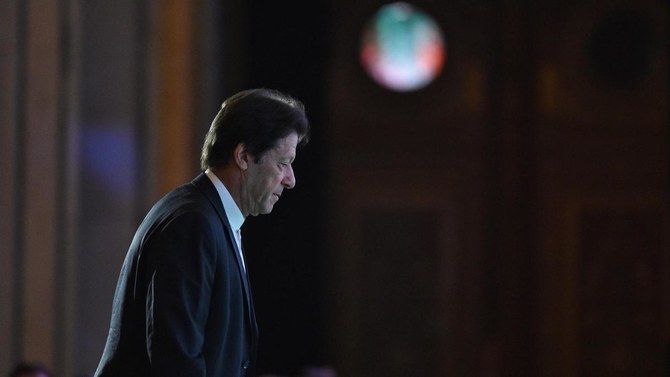
ISLAMABAD: Prime Minister Imran Khan on Friday called on the citizens to join hands with the government to put an end to tax evasion by declaring their hidden domestic and foreign assets under a tax amnesty scheme which is set to expire on June 30.
Pakistan has been struggling for years to increase its tax revenue by bringing more people into the tax net. Currently, only one percent people among the population of 208 million pay income tax due to corruption and loopholes in the system.
Prime Minister Khan’s Pakistan Tehreek-e-Insaf party that promised to fix the country’s crumbling economy before winning the last general elections announced the tax amnesty scheme on May 14 for a period of 45 days, allowing people to declare their hidden assets and whiten their money.
“I need your support to put an end to tax evasion,” the premier said in a televised address to the nation, adding that this was a “golden opportunity” for them to declare their concealed money, jewelry, dollars, gold and assets stashed abroad.
Khan said that Pakistan’s debt increased from Rs6,000 billion to Rs30,000 billion in the last ten years and half of the tax revenue was consumed on paying the interest on these loans. “This means we are stuck in a debt trap,” he said, noting that “corruption and tax evasion” were the main reasons behind the country’s existing economic woes.
“Now you don’t need worry about corruption as we won’t spare [the corrupt elements] … The problem, however, is tax evasion and if the public and the government don’t join hands, we won’t come out of the debt trap.”
Discussing the Rs5.5 trillion ($36 billion) tax revenue target set for the next fiscal year, he said there was, in his opinion, enough potential to collect around Rs8 trillion in taxes. “If we manage do it, our problems will be solved. We can be free, we can stand on our feet, get our people out of poverty. We can brighten our children’s future. But for this, I need your support.”
Urging people to benefit from the tax amnesty scheme, the premier said he did not want people to face any problem since the Federal Board of Revenue, the country’s tax collection body, had the record of each individual. “Therefore, I want you to benefit from [the scheme], and play your part to steer the country out of this crisis,” he said.


Pakistan PM asks public to avail ‘golden opportunity’ to declare hidden assets
Pakistan PM asks public to avail ‘golden opportunity’ to declare hidden assets

- Deadline to benefit from a tax amnesty program ends on June 30
- Khan says Pakistan has potential to collect Rs8 trillion in taxes

Pakistan plans 3,000 EV charging stations as green mobility push gathers pace
- Roadmap unveiled by energy efficiency regulator and a private conglomerate amid early-stage EV rollout
- New EV Policy and related plans aim to install 3,000 EV stations by 2030, including 240 stations in current fiscal year
ISLAMABAD: Pakistan’s energy efficiency regulator and a private conglomerate have unveiled an approved roadmap to establish 3,000 electric vehicle (EV) charging stations across the country, state-run Associated Press of Pakistan (APP) reported on Tuesday.
The announcement comes as Pakistan looks to build out basic EV charging infrastructure, which remains limited and unevenly distributed, largely concentrated in major cities. Despite policy commitments to promote electric mobility as part of climate and energy-efficiency goals, the absence of a nationwide charging network has slowed broader EV adoption.
Pakistan’s EV ecosystem is still at a formative stage, with progress constrained by regulatory approvals, grid connectivity issues and coordination challenges among utilities, regulators and fuel retailers. Expanding charging infrastructure is widely seen as a prerequisite for scaling electric transport for both private and commercial use.
According to APP, the roadmap was presented during a meeting between Malik Group Chief Executive Officer Malik Khuda Baksh and National Energy Efficiency and Conservation Authority Managing Director and Additional Secretary Humayon Khan.
“Baksh ... in a meeting with Khan, unveiled the approved roadmap for establishing 3,000 electric vehicle charging stations across Pakistan,” APP reported. “Khan reaffirmed the authority’s full institutional backing and pledged to expand the initiative to 6,000 EV charging stations nationwide.”
The discussion reviewed hurdles delaying the rollout, including EV charger imports, customs duties, regulatory documentation and inter-agency coordination.
APP said Khan welcomed the proposal and sought recommendations for “internationally compliant EV charger brands,” while asking for a detailed “issue-and-solutions report within three days” to facilitate timely implementation of the national green mobility initiative.
Despite the issuance of 13 licenses by NEECA and the arrival of five EV charging units at designated sites, progress has been slowed by procedural bottlenecks, officials said. These include delays in electricity connections, prolonged installation of separate meters and pending no-objection certificates from power distribution companies and oil marketing firms, which continue to stall operational readiness.
Pakistan’s electric vehicle ecosystem is still in its early stages, with charging infrastructure far behind levels seen in more advanced markets. The government’s New Energy Vehicle Policy and related plans aim to install 3,000 EV charging stations by 2030, including 240 stations planned in the current fiscal year, but actual deployment remains limited and uneven, mostly clustered in major cities and along key urban corridors.
Despite regulatory backing, including the 2024 Electric Vehicles Charging Infrastructure and Battery Swapping Stations framework, progress has been slow. Many proposed stations have yet to become operational due to delays in grid connections and approvals, and public maps of nationwide charging coverage are not yet available.
Private players are beginning to install more chargers, and there are over 20 public EV charging points reported in urban centers, offering both slower AC chargers and faster DC options. However, such infrastructure is still sparse compared with the growing number of electric vehicles and the government’s long-term targets.


