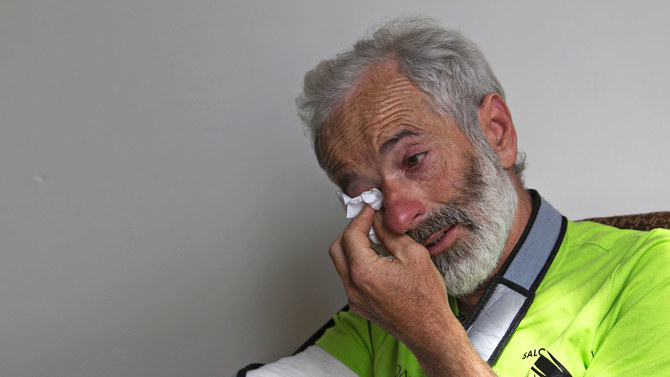
ISLAMABAD: An Italian mountaineer who along with five other climbers narrowly survived an expedition in Pakistan, burst into tears Thursday as he recalled helplessly looking on as one of his Pakistani colleagues was swept away by an avalanche at an altitude of around 5,300 meters (17,390 feet) earlier this week.
Team leader Tarcisio Bellò, 57, well known in mountaineering circles, was descending a peak in the Ishkoman Valley on Monday in the northern district of Ghizar when he and the rest of the group were caught in an avalanche, killing Pakistani Mohammad Imtiaz, whose body has yet to be retrieved, and injuring the rest. An army helicopter successfully rescued the six stranded climbers Tuesday.
The rescued climbers were initially treated at a hospital in the town of Gilgit and they arrived at a hotel in the capital Islamabad on Thursday, where Bellò in an interview with The Associated Press praised the Pakistan army for saving them.
He also promised to come again on another expedition. “Life is an adventure and it should not stop before death,” he said.
The four surviving Italians mourned the death of their fellow mountaineer, saying they would do whatever possible to help his family.
Bellò said he was happy to soon be rejoining his family but was “devastated” over the death of Imtiaz, who was killed when the avalanche hit the group suddenly, despite nice weather. He said it was supposed to be a “simple climb” that turned into a nightmare.
The “mountain suddenly changed and felt as if the whole mountain had fallen on us,” he said.
Bellò said despite injuries to his right arm, leg and shoulder, he continued helping the team members to reach a camp, which their injured guides and porters had also reached.
Sobbing, Bellò recalled how two sisters of the slain Pakistani mountaineer who were also part of the team, despite their own injuries, insisted on climbing to the area where the body of their brother was buried in a snow. He said they wanted to cover the body with some cloth, saying it was “too cold” there and that “our brother is alone.”
“It was not possible to do it,” he said.
Bellò said the remaining climbers waited helplessly for a rescue helicopter, which reached them a day after the incident.
Mountaineers from across the world travel to Pakistan every year to try scaling its high northern mountains. Harsh weather and other climbing conditions often prove a test for the most experienced of climbers.
Earlier on Thursday, three Pakistani mountaineering officials said a search team had spotted the bodies of two climbers, one from China and the other from Hong Kong, who went missing last week while scaling a peak in northern Pakistan.
The officials said the two died amid harsh winter weather. Their bodies were spotted Wednesday at the Liligo glacier in the north. Their bodies still haven’t been retrieved. A military helicopter rescued a third expedition member, also from Hong Kong.
The officials spoke on condition of anonymity because they were not authorized to talk to reporters.


![]()

Surviving Italian climbers mourn death of Pakistan colleague
Surviving Italian climbers mourn death of Pakistan colleague
- Italian mountaineer Tarcisio Bellò along with five other climbers narrowly survived expedition in Pakistan
- Pakistani climber Mohammad Imtiaz was killed when the group was hit by an avalanche
Latest updates


© 2026 SAUDI RESEARCH & PUBLISHING COMPANY, All Rights Reserved And subject to Terms of Use Agreement.