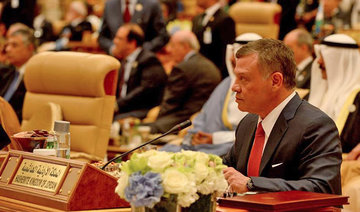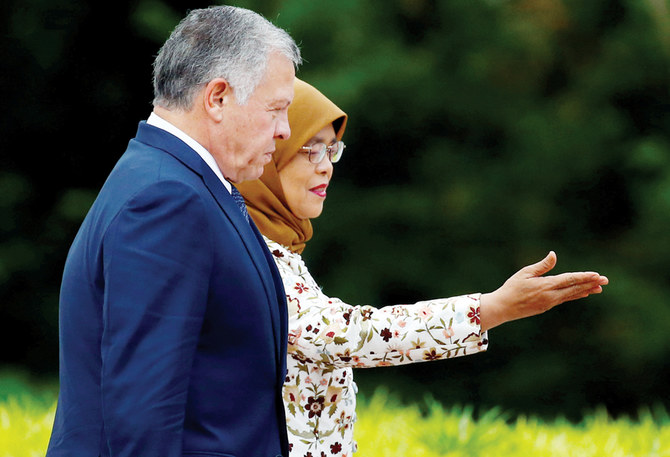
AMMAN / SINGAPORE: Attacks on interfaith harmony, mutual respect and trust are the “world’s single most important threat,” King Abdullah of Jordan warned.
Speaking on Thursday at the International Conference on Cohesive Societies (ICCS) in Singapore, Jordan’s monarch condemned both “outlaws of Islam and extremist Islamophobes.”
“Perpetuators of hate-filled messages are distorting our religion’s great heritage and teachings,” he said.
King Abdullah called on the global community to tackle this challenge by “resisting hatred and exclusion,” supporting economic growth and protecting the environment.
In a keynote speech, the Jordanian ruler urged 700 delegates from 40 countries to apply the golden rule. “Loving one’s neighbor is not just an ideal. It is the golden rule that enables all of us to live side by side, to look beyond ourselves, and to achieve what we can only achieve in common.”
The conference was organized by the S. Rajaratnam School of International Studies (RSIS) with the support of Singapore’s Ministry of Culture, Community and Youth.
Ong Keng Yong, executive deputy chairman of RSIS, described the Singapore conference as a platform for constructive dialogue to strengthen mutual trust and understanding across communities.
“Singapore is a multiracial, multi-religious society, and we work hard to keep our country peaceful and secure. At the same time, we are part of the global community, which faces challenges posed by increased connectivity, intensifying identity politics, and infinite technological development,” he said.
King Abdullah listed Jordanian efforts including the Amman Message, the Common Word Initiative, and UN World Interfaith week.
However, when it comes to hate speech on the internet, solutions are not exclusively the responsibility of governments and big companies, he said.
“In a very real way, the internet belongs to its users. Moderate, positive voices need to reclaim this space and redirect the dialogue away from misinformation, insults and fear, and toward understanding and respect. Young men and women have a vital role in speaking up on social media and social networking sites, and using their talent for innovation to promote mutual understanding and hope.”
The Jordanian monarch also called for a “holistic approach to address security and the issues that extremists exploit.”
Perpetuators of hate-filled messages are distorting our religion’s great heritage and teachings.
King Abdullah
“We must also help to resolve conflicts, especially the core crisis of my region, the long denial of Palestinian statehood. The Palestinian-Israeli conflict has fueled global discord and radicalism. We all need a lasting peace, meeting the needs of both sides, with a viable, independent, sovereign Palestinian state, on 1967 lines, with East Jerusalem as its capital, but living side by side with Israel, in peace and security.
“We must safeguard Jerusalem, a holy city to billions of people around the world. As Hashemite Custodian of Jerusalem’s Islamic and Christian holy sites, I am bound by a special duty. But for all of us, Jerusalem must be a unifying city of peace.”
“King Abdullah is in a very difficult spot,” said Dr. James M. Dorsey, a Middle East expert and senior fellow at Singapore’s Nanyang Technological University.
Speaking to Arab News, Dr. Dorsey said the king’s speech reflects the geographical situation his country is facing.
“Every single border of his country is conflict-risk and impacts the country’s stability. If there is one country that desperately needs to get away from polarization and conflict and move toward conflict resolution, it is Jordan.”
Other speakers are the conference include Dr. Ali Al-Nuaimi, chairman of the World Muslim Communities Council; Bishop Miguel Angel Ayuso Guixot, president of the Pontifical Council for Inter-Religious Dialogue; Dr. Nazirudin Mohd Nasir, deputy mufti and senior director at Majlis Ugama Islam Singapura; and John Alderdice, former Speaker of the Northern Ireland Assembly.
Over the weekend, Singaporeans can experience key elements of the conference through a series of “Heartland Dialogues and Experiences” at locations across the city. These include “learning journeys” and opportunities to speak with conference speakers.
In parallel with the conference, the “Many Beliefs, One Future” exhibition explores human connections across different beliefs through a collection of artworks and artifacts.
The exhibition is open until June 13 at the Raffles City Shopping Center.
“We must also help to resolve conflicts, especially the core crisis of my region, the long denial of Palestinian statehood. The Palestinian-Israeli conflict has fueled global discord and radicalism. We all need a lasting peace, meeting the needs of both sides, with a viable, independent, sovereign Palestinian state, on 1967 lines, with East Jerusalem as its capital, but living side by side with Israel, in peace and security.
“We must safeguard Jerusalem, a holy city to billions of people around the world. As Hashemite Custodian of Jerusalem’s Islamic and Christian holy sites, I am bound by a special duty. But for all of us, Jerusalem must be a unifying city of peace.”
“King Abdullah is in a very difficult spot,” said Dr. James M. Dorsey, a Middle East expert and a senior fellow at Singapore’s Nanyang Technological University.
Speaking with Arab News Dr. Dorsey said the king’s speech reflects the geographical situation his country is facing.
“Every single border of his country is conflict-risk and has an impact on the stability of Jordan. If there is one country that desperately needs to get away from the polarization and conflict and toward conflict resolution, it is Jordan.”
Other speakers are the conference include Dr. Ali Al-Nuaimi, chairman of the World Muslim Communities Council; Bishop Miguel Angel Ayuso Guixot, president of the Pontifical Council for Inter-Religious Dialogue; Dr. Nazirudin Mohd Nasir, deputy mufti and senior director at Majlis Ugama Islam Singapura; and John Alderdice, former Speaker of the Northern Ireland Assembly.
Over the weekend, Singapore people can experience key elements of the conference through a series of “Heartland Dialogues and Experiences” at locations across the city. These include “learning journeys” and opportunities to speak with conference speakers.
In parallel with the conference, the “Many Beliefs, One Future” exhibition explores human connections across different beliefs through a collection of artworks and artefacts. The exhibition is open until June 13 at the Raffles City Shopping Center.