YANGON: The UN has warned it will pare back aid to thousands of Rohingya Muslims left destitute as Myanmar’s government closes camps in Rakhine state, over fears its continued support “risks entrenching segregation.”
Aid agencies are facing an increasingly sharp dilemma in the region as they balance relief for desperate communities with leverage over the government.
The majority of Myanmar’s Rohingya were driven into Bangladesh by a 2017 army crackdown, but around 400,000 remain inside conflict-battered Rakhine.
Those include nearly 130,000 held since 2012 in squalid camps, currently supported by UN agencies and humanitarian groups.
As part of its strategy to address the crisis, Myanmar has closed several camps holding around 9,000 Rohingya.
But they have not been allowed to return to their former homes and remain dependent on handouts. Instead, they are being settled in new accommodation close to the former camps.
That has sparked fears aid agencies are effectively being used to prop-up a policy that fails to address the fundamental needs of the Rohingya, including housing, work, food and security.
The camp closure plan “risks entrenching segregation,” UN Resident and Humanitarian Coordinator in Myanmar Knut Ostby wrote to the government in a leaked letter, dated 6 June and seen by AFP.
The letter, also written on behalf of aid groups, warned support “beyond life-saving assistance” at the closed sites would in future be linked to “tangible” progress made on “the fundamental issue of freedom of movement.”
“Life-saving” support includes food, health and water, but site planning, shelter construction and education facilities could be phased out, aid agency sources told AFP.
The UN has faced criticism for a slow response to violence against the Rohingya, which escalated after 2012 riots between Muslim Rohingyas and ethnic Rakhine Buddhists.
A UN report released Monday admitted “systemic failures” in its handling of the build-up to the Rohingya crisis.
Limited access to Rakhine’s camps makes independent reporting on conditions difficult.
But AFP has reviewed recent interviews conducted in five camps by an NGO requesting anonymity to protect its work.
“If I build a house, it can be seized arbitrarily,” one Rohingya man said.
“I have no right to the land and I can also be arrested at any time.”
An aid worker called the remaining 23 sites in Rakhine little more than “concentration camps.”
On condition of anonymity, she spoke of the “complicity” humanitarian staff feel for perpetuating the segregation.
Amnesty International has described Rakhine as an “apartheid state.”
All aid must be “heavily conditioned,” researcher Laura Haigh said, warning donors that building infrastructure could make them complicit in crimes against humanity.
The government defended the camp closures, telling AFP it would continue working with the UN and NGOs on the issue.
Any former camp resident holding a National Verification Card (NVC) will be able to “move freely within their township” and access “education, health facilities and livelihood activities,” the social welfare ministry said.
Most Rohingya refuse to apply for the card believing they should already be treated as full citizens.
Those interviewed said the few to have caved had no more rights than anyone else.
They were also forced to designate themselves as “Bengali,” a term implying they are from Bangladesh.
“They are just trying to dominate us and make us illegal through different ways,” one Rohingya man said.

UN gives Myanmar aid cut warning over Rohingya camp closures
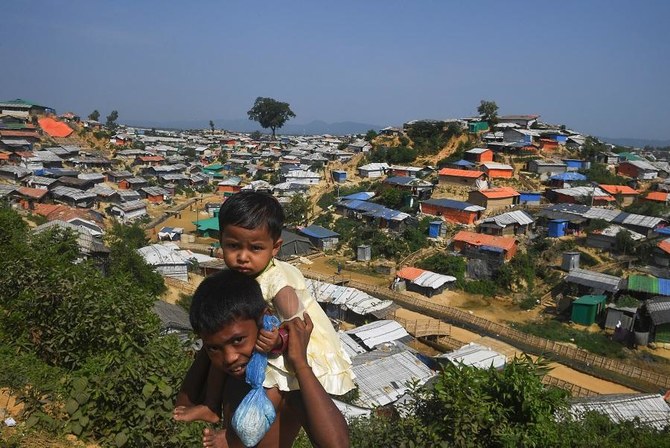
- Myanmar has closed several camps holding around 9,000 Rohingya
- They have not been allowed to return to their former homes and remain dependent on handouts
Carney says Canada has no plans to pursue free trade agreement with China as Trump threatens tariffs
TORONTO: Canadian Prime Minister Mark Carney said Sunday his country has no intention of pursuing a free trade deal with China. He was responding to US President Donald Trump’s threat to impose a 100 percent tariff on goods imported from Canada if America’s northern neighbor went ahead with a trade deal with Beijing.
Carney said his recent agreement with China merely cuts tariffs on a few sectors that were recently hit with tariffs.
Trump claims otherwise, posting that “China is successfully and completely taking over the once Great Country of Canada. So sad to see it happen. I only hope they leave Ice Hockey alone! President DJT”
The prime minister said under the free trade agreement with the US and Mexico there are commitments not to pursue free trade agreements with nonmarket economies without prior notification.
“We have no intention of doing that with China or any other nonmarket economy,” Carney said. “What we have done with China is to rectify some issues that developed in the last couple of years.”
In 2024, Canada mirrored the United States by putting a 100 percent tariff on electric vehicles from Beijing and a 25 percent tariff on steel and aluminum. China had responded by imposing 100 percent import taxes on Canadian canola oil and meal and 25 percent on pork and seafood.
Breaking with the United States this month during a visit to China, Carney cut its 100 percent tariff on Chinese electric cars in return for lower tariffs on those Canadian products.
Carney has said there would be an initial annual cap of 49,000 vehicles on Chinese EV exports coming into Canada at a tariff rate of 6.1 percent, growing to about 70,000 over five years. He noted there was no cap before 2024. He also has said the initial cap on Chinese EV imports was about 3 percent of the 1.8 million vehicles sold in Canada annually and that, in exchange, China is expected to begin investing in the Canadian auto industry within three years.
Trump posted a video Sunday in which the chief executive of the Canadian Vehicle Manufacturers’ Association warns there will be no Canadian auto industry without US access, while noting the Canadian market alone is too small to justify large scale manufacturing from China.
“A MUST WATCH. Canada is systematically destroying itself. The China deal is a disaster for them. Will go down as one of the worst deals, of any kind, in history. All their businesses are moving to the USA. I want to see Canada SURVIVE AND THRIVE! President DJT,” Trump posted on social media.
Trump’s post on Saturday said that if Carney “thinks he is going to make Canada a ‘Drop Off Port’ for China to send goods and products into the United States, he is sorely mistaken.”
“We can’t let Canada become an opening that the Chinese pour their cheap goods into the U.S,” US Treasury Secretary Scott Bessent said on ABC’s “This Week.”
“We have a , but based off — based on that, which is going to be renegotiated this summer, and I’m not sure what Prime Minister Carney is doing here, other than trying to virtue-signal to his globalist friends at Davos.”
Trump’s threat came amid an escalating war of words with Carney as the Republican president’s push to acquire Greenland strained the NATO alliance.
Carney has emerged as a leader of a movement for countries to find ways to link up and counter the US under Trump. Speaking in Davos before Trump, Carney said, “Middle powers must act together because if you are not at the table, you are on the menu” and he warned about coercion by great powers — without mentioning Trump’s name. The prime minister received widespread praise and attention for his remarks, upstaging Trump at the World Economic Forum.
Trump’s push to acquire Greenland has come after he has repeatedly needled Canada over its sovereignty and suggested it also be absorbed into the United States as a 51st state. He posted an altered image on social media this week showing a map of the United States that included Canada, Venezuela, Greenland and Cuba as part of its territory.


