

South Korea halts Iranian oil imports as sanction waivers cease

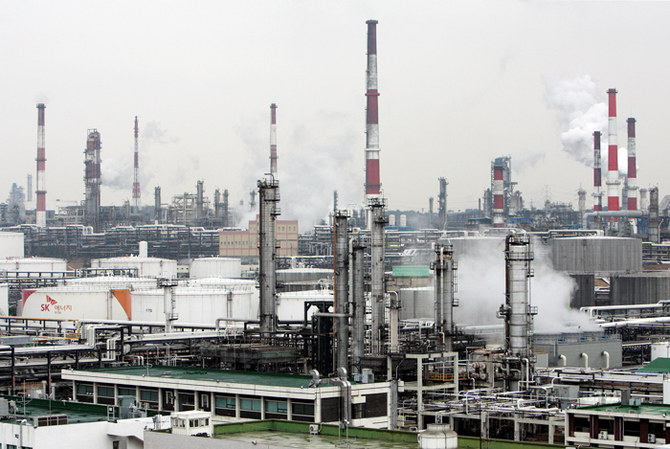
South Korea's top refiner SK Energy's main factory is seen in Ulsan, about 410 km (southeast of Seoul. (REUTERS/File Photo)
Updated 17 June 2019
Follow

South Korea halts Iranian oil imports as sanction waivers cease

  • Government plans to extend freight rebates for shipments of non-Middle East crude to the end of 2021

SEOUL: South Korea has turned to alternative sources to replace its oil imports from Iran, which were halted in May when waivers on US sanctions against the Islamic republic expired, officials told Arab News on Sunday.

South Korea is the world’s fifth-largest crude oil importer, and was one of the countries granted a waiver by the US when President Donald Trump’s administration re-imposed sanctions on Iran last November.

Customs data shows South Korea’s imports of Iranian crude for January through May were 3.87 million tonnes, or 187,179 barrels per day (bpd), compared to 5.45 million tonnes over the same period last year.

South Korea is the biggest buyer of Iranian condensate, an ultra-light oil that is low in sulfur and produces no residue, and is used as a raw material for the manufacture of petrochemicals. Iranian condensate is also cheaper than condensate from other countries, such as Qatar, and provides a higher yield of heavy naptha — , a raw material for the production of petrochemicals including paraxylene, which is used the manufacture of plastic bottles.

SK Incheon Petrochem, Hyundai Oilbank and Hanwha Total Petrochemical have turned to other countries, including Qatar and Russia, to replace Iranian condensate, according to industry sources.

Last year, South Korea bought and tested as many as 23 different types of condensate from 15 countries as possible substitutes for condensate from Iran, at a cost of around $9 billion, government and trade data
showed.

South Korean petrochemical makers bought condensate from gas fields in Africa and Europe, in addition to tapping more supplies from Qatar, Saudi Arabia, the US and Australia.

“We’ve increased imports of condensate from Qatar, Australia and Russia,” an employee of Hanwha Total Petrochemical told Arab News, on condition of anonymity. “We also started buying oil from the Republic of Equatorial Guinea.”

The refiner has also raised its imports of heavy naphtha in the absence of Iranian condensate, he added.

According to customs data, South Korea’s Qatari crude oil imports rose 10.1 percent year-on-year to 660,752 tonnes, or 155,596 bpd in May, while oil shipments from Saudi Arabia rose 5.1 percent to 3.39 million tonnes, or 798,695 bpd. Meanwhile, imports of crude oil from the US more than tripled.

In an effort to help local refiners find alternative oil supplies, the South Korean government plans to extend freight rebates for shipments of non-Middle East crude to the end of 2021, according to the Ministry of Trade, Industry and Energy.


Blacklisted naphtha tanker from Russia enters Venezuelan waters while another diverts, ship data shows

Updated 4 sec ago
Follow

Blacklisted naphtha tanker from Russia enters Venezuelan waters while another diverts, ship data shows

  • Under U.S. sanctions related to Russia, the ship has a different sanctions profile than Skipper, the tanker that was seized by the U.S. on December 10

HOUSTON: A tanker subject to U.S. sanctions carrying some 300,000 barrels of naphtha from Russia entered Venezuelan waters late ​on Thursday, while another began redirecting course in the Atlantic Ocean, ship tracking data showed, a reflection of diverging last-minute decisions by ship owners after President Donald Trump ordered a "blockade" of oil tankers under sanctions bound for the OPEC country earlier this week.
The move ramped up pressure on Venezuelan president Nicolas Maduro by targeting the country's main source of income and followed the seizure by the U.S. of an oil tanker off the coast of Venezuela earlier in December.
Vessels that were not subject to sanctions began setting sail on Wednesday from Venezuelan waters after a week's pause, helping drain the country's mounting crude stocks.
Gambia-flagged medium tanker Hyperion docked on Friday at Amuay ‌Bay on Venezuela's ‌western coast, according to LSEG ship tracking data. It loaded near ‌Murmansk ⁠in ​Russia in ‌late November.
Under U.S. sanctions related to Russia, the ship has a different sanctions profile than Skipper, the tanker that was seized by the U.S. on December 10.
The U.S. can only seize vessels outside of its jurisdiction, or vessels that aren't heading to or from the country, if Washington has placed them under sanctions for links to groups it designates as terrorist, said David Tannenbaum, a director at consulting firm Blackstone Compliance Services that specializes in sanctions and anti-money laundering compliance.
Skipper, formerly called the Adisa, was under sanctions for what the U.S. says was involvement in Iranian oil trading that generated ⁠revenue for Iranian groups it has designated as foreign terrorist organizations.
With the Hyperion, though, sanctions were imposed to reduce Russian revenues from energy because of ‌its war with Ukraine.
"The Hyperion doesn't have known ties to ‍terrorism, and therefore unless they can prove it's subject ‍to the jurisdiction of the U.S., Washington can't grab it extraterritorially," said Tannenbaum, who previously worked with the ‍U.S. Treasury's Office of Foreign Assets Control that administers and enforces economic and trade sanctions.

REDIRECTS AND U-TURNS
The Angola-flagged Agate, another medium tanker under sanctions that loaded in Russia and had been sailing toward the Caribbean, was seen redirecting on Friday, according to LSEG ship tracking. The vessel was pointing towards Africa, but had not yet signaled a new destination.
Oman-flagged Garnet, also under sanctions ​and loaded in Russia, continued on its track, signaling the Caribbean as its destination on Friday.
Benin-flagged tanker Boltaris, under sanctions and carrying some 300,000 barrels of Russian naphtha bound for Venezuela, made ⁠a U-turn earlier this month and was heading for Europe without having discharged, according to LSEG vessel monitoring data.
Two very large crude carriers not subject to sanctions set sail for China on Thursday from Venezuela, according to sources familiar with Venezuela's oil export operations, marking only the second and third tankers unrelated to Chevron to depart the country since the U.S. seized Skipper.
The American oil major, which has continued to ship Venezuelan crude under a U.S. authorization, exported a crude cargo on Thursday bound for the U.S., LSEG data showed.
Secretary of State Marco Rubio on Friday said the U.S. was not concerned about the four vessels that sailed from Venezuela on Thursday, as those were not ships under sanctions.
"Sanctioned boats, we have the capabilities necessary to enforce our laws. We'll have a judicial order, we'll execute on those orders and there's nothing that will impede us from being able to do that," Rubio said.
Venezuela's government ‌called Trump's blockade a "grotesque threat" in a statement on Tuesday, saying it violates international law, free commerce and the right of free navigation.