

UAE says Gulf tanker attacks ‘dangerous escalation’

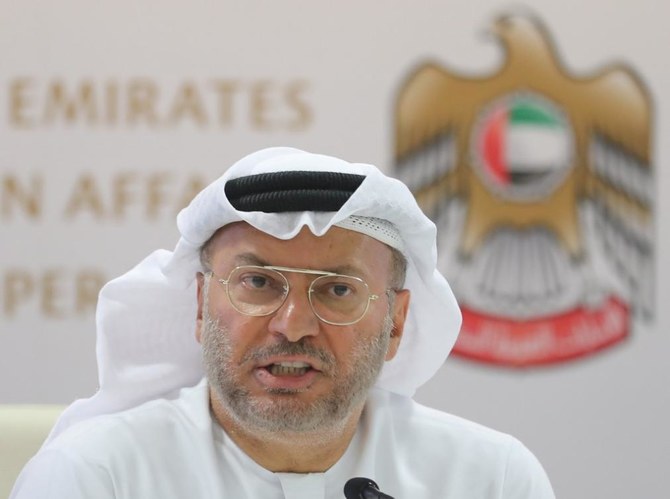
Anwar Gargash, the UAE minister of state for foreign affairs, also condemned the Houthi militia missile attack which wounded 26 civilians at an airport in southwestern Saudi Arabia. (AFP)
Updated 14 June 2019
Follow

UAE says Gulf tanker attacks ‘dangerous escalation’

  • ‘The responsibility for avoiding an escalation is collective’
  • Gargash also condemned the Houthi militia missile attack which wounded 26 civilians at Abha Airport

ABU DHABI: The United Arab Emirates said Friday that twin attacks on tankers in the Sea of Oman just weeks after four ships were damaged off the UAE marked a “dangerous escalation.”
“The attack against the tankers in the Gulf of Oman is a worrying development and a dangerous escalation,” the UAE minister of state for foreign affairs, Anwar Gargash, tweeted after Thursday’s blasts.
Gargash also condemned the Houthi militia missile attack which wounded 26 civilians at an airport in southwestern Saudi Arabia on Wednesday.
He said the “blatant attack on civilians” was only the latest in a spate of rebel assaults “undermining the UN’s political work and sending a message of continuing violence and hostility.”
These developments “must spur the international community to act to maintain peace and security in the region,” Gargash said.
“The responsibility for avoiding an escalation is collective.”


The two tankers, one Norwegian-operated and one Japanese-owned, were set ablaze in the Gulf of Oman off the coast of Iran on Thursday, escalating tensions across the region and sending world oil prices soaring.

US Secretary of State Mike Pompeo said there was strong evidence of Iran’s culpability, after US Central Command reported seeing an Iranian patrol boat removing an “unexploded limpet mine” from the hull of one of the vessels.

Iranian Foreign Minister Mohammad Javad Zarif charged that the US administration had “immediately jumped to make allegations against Iran without a shred of factual or circumstantial evidence.”

He accused it of seeking to “sabotage diplomacy” as Japanese Prime Minister Shinzo Abe visited Tehran in a bid to ease Iran-US tensions.

In a subsequent tweet, Gargash said Zarif’s “credibility (is) diminishing.”

"Every single day Iran’s Foreign Minister Zarif’s reference to team B becomes more farcical and his credibility diminishing," Gargash tweeted. "Public relations is no real substitute to constructive policies. De-escalation in current situation requires wise actions not empty words."


Thursday’s incidents came a month after four oil tankers — two Saudi, one Norwegian and one Emirati — were damaged in still unexplained attacks off the nearby UAE port of Fujairah.


First responders enter devastated Aleppo neighborhood after days of deadly fighting

Updated 12 January 2026
Follow

First responders enter devastated Aleppo neighborhood after days of deadly fighting

  • The US-backed SDF, which have played a key role in combating the Daesh group in large swaths of eastern Syria, are the largest force yet to be absorbed into Syria’s national army

ALEPPO, Syria: First responders on Sunday entered a contested neighborhood in Syria’ s northern city of Aleppo after days of deadly clashes between government forces and Kurdish-led forces. Syrian state media said the military was deployed in large numbers.
The clashes broke out Tuesday in the predominantly Kurdish neighborhoods of Sheikh Maqsoud, Achrafieh and Bani Zaid after the government and the Syrian Democratic Forces, the main Kurdish-led force in the country, failed to make progress on how to merge the SDF into the national army. Security forces captured Achrafieh and Bani Zaid.
The fighting between the two sides was the most intense since the fall of then-President Bashar Assad to insurgents in December 2024. At least 23 people were killed in five days of clashes and more than 140,000 were displaced amid shelling and drone strikes.
The US-backed SDF, which have played a key role in combating the Daesh group in large swaths of eastern Syria, are the largest force yet to be absorbed into Syria’s national army. Some of the factions that make up the army, however, were previously Turkish-backed insurgent groups that have a long history of clashing with Kurdish forces.
The Kurdish fighters have now evacuated from the Sheikh Maqsoud neighborhood to northeastern Syria, which is under the control of the SDF. However, they said in a statement they will continue to fight now that the wounded and civilians have been evacuated, in what they called a “partial ceasefire.”
The neighborhood appeared calm Sunday. The United Nations said it was trying to dispatch more convoys to the neighborhoods with food, fuel, blankets and other urgent supplies.
Government security forces brought journalists to tour the devastated area, showing them the damaged Khalid Al-Fajer Hospital and a military position belonging to the SDF’s security forces that government forces had targeted.
The SDF statement accused the government of targeting the hospital “dozens of times” before patients were evacuated. Damascus accused the Kurdish-led group of using the hospital and other civilian facilities as military positions.
On one street, Syrian Red Crescent first responders spoke to a resident surrounded by charred cars and badly damaged residential buildings.
Some residents told The Associated Press that SDF forces did not allow their cars through checkpoints to leave.
“We lived a night of horror. I still cannot believe that I am right here standing on my own two feet,” said Ahmad Shaikho. “So far the situation has been calm. There hasn’t been any gunfire.”
Syrian Civil Defense first responders have been disarming improvised mines that they say were left by the Kurdish forces as booby traps.
Residents who fled are not being allowed back into the neighborhood until all the mines are cleared. Some were reminded of the displacement during Syria’s long civil war.
“I want to go back to my home, I beg you,” said Hoda Alnasiri.
