

KSRelief highlights Saudi aid role at Warsaw Humanitarian Expo 2019

1 / 4
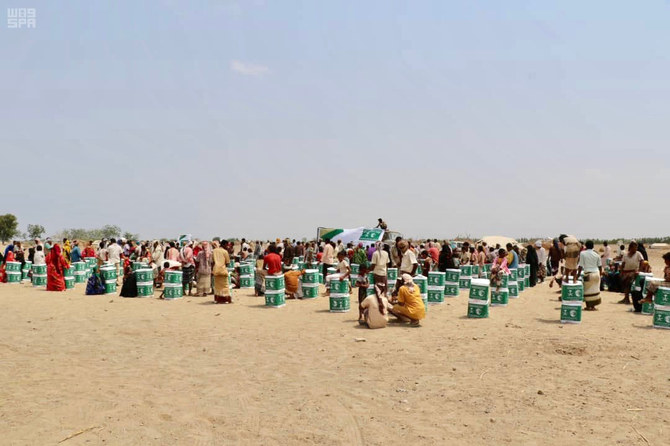
Residents of Socotra island in Yemen receive relief aid from KSRelief on June 13, 2019. (SPA)
2 / 4
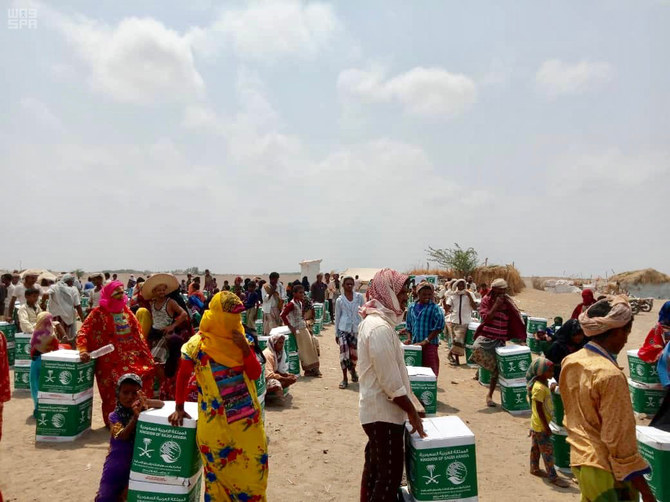
Residents of Jucca in Yemen receive relief aid from KSRelief on June 13, 2019. (SPA)
3 / 4
Residents of Socotra island in Yemen receive relief aid from KSRelief on June 13, 2019. (SPA)
4 / 4
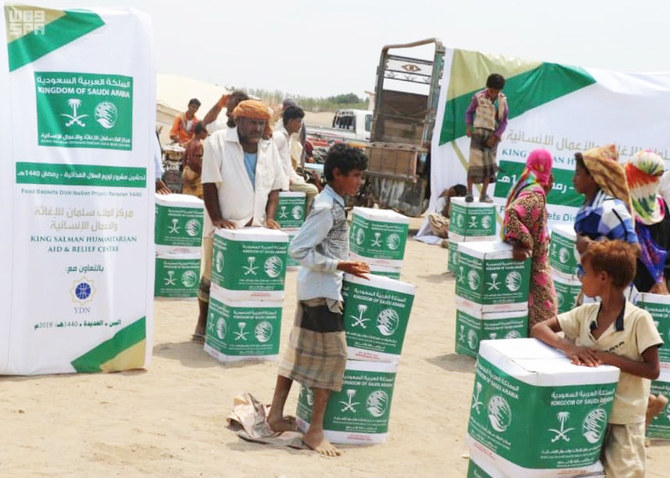
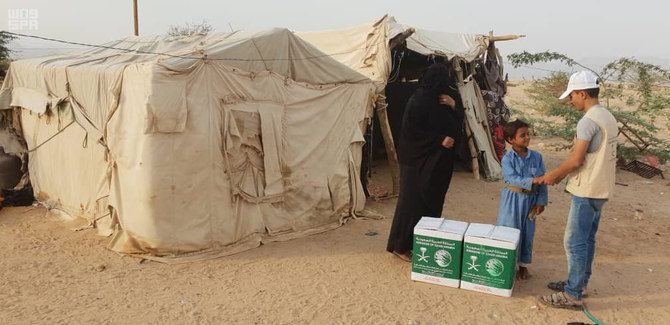
King Salman Relief Center distributes food baskets and shelter aid in Al-Jouf and Lahj governates in Yemen. (SPA)
Updated 14 June 2019
Follow

KSRelief highlights Saudi aid role at Warsaw Humanitarian Expo 2019

  • KSRelief has implemented 1,011 projects in 44 countries worth $3,439,139,000 since its inception
  • King Salman gave directives on May 13, 2015 to establish KSRelief to provide humanitarian and relief programs

RIYADH: The King Salman Humanitarian Aid and Relief Center (KSRelief) hosted a symposium titled “Saudi humanitarian aid, past and present” on Wednesday on the sidelines of the Warsaw Humanitarian Expo 2019.

The Warsaw Humanitarian Expo 2019 (WHE2019), from June 11 to 13, run by the Ministry of Foreign Affairs, is the first expo on humanitarian and development matters organized in Poland, and the only one taking place in central and eastern Europe.

The symposium was attended by KSRelief Supervisor General Abdullah Al-Rabeeah, Saudi Ambassador to Poland Mohammed bin Hussain Madani, officials from the Saudi Ministry of Foreign Affairs and diplomatic corps, humanitarian and human rights organizations, and media professionals.

Speaking at the symposium, Al-Rabeeah highlighted that King Salman had supported humanitarian work early on through responsibilities including heading several government and grassroots committees for disaster relief in Egypt, Pakistan, Sudan, Bosnia and Herzegovina.

The KSRelief chief added that the Kingdom’s foreign aid efforts had reached record amounts in the past few years, with the volume of Saudi aid, provided impartially to 81 countries, exceeding $86 billion between 1996 and 2018.

King Salman gave directives on May 13, 2015 to establish KSRelief to provide humanitarian and relief programs.

“Since its inception, KSRelief has implemented 1,011 projects in 44 countries worth $3,439,139,000, with 225 projects worth $389,682,000 targeting women and 234 projects worth $529,463,000 targeting children,” he said.

Al-Rabeeah added: “Saudi Arabia hosts 12 million immigrants of different nationalities representing 37 percent of its population, making it rank second in the world in the number of immigrants, preceded only by the United States.”

He noted that 561,911 of these immigrants are Yemenis, 262,573 are Syrians and 249,669 are from Myanmar.

“Under the guidance of King Salman, KSRelief has established the first transparent platform in the region, the Saudi Humanitarian Aid Platform, to act as an accurate and reliable reference that provides information and guides researchers and media professionals on the Kingdom’s external contributions, which are being built over three stages, the first of which includes documenting aid since 2007, the second includes documenting aid since 1996, while the third includes documenting aid since 1975.”

KSRelief had recently launched the electronic “Volunteer Platform,” which allows donors to make contributions online using credit cards and other online payment methods and track programs supported by KSRelief.

He said that Saudi aid to Yemen had exceeded $12 billion since 2015, including aid provided through KSRelief, aid provided to Yemeni refugees inside the Kingdom, development and government assistance, and support allocated to the Central Bank of Yemen.

Al-Rabeeah highlighted that the Saudi program to separate conjoined twins successfully conducted 74 separations in 20 countries across three continents.

He said that KSRelief supported 78 projects worth $352,966,000 in Palestine, 191 projects worth $267,056,000 in Syria, and 11 projects worth $6,188,000 in Djibouti.

On the margins of the WHE 2019, Al-Rabeeah met Minister of Foreign Affairs Jacek Czaputowicz and reviewed bilateral relations between the Kingdom and Poland, and discussed means of enhancing them in the humanitarian field.


‘Cake not hate’ campaign becomes ‘Dates not hate’ in Madinah

“The Joshie-Man” and his father Dan Harris in the courtyard of the Prophet’s Mosque in Madinah. (Supplied)
Updated 02 February 2026
Follow

‘Cake not hate’ campaign becomes ‘Dates not hate’ in Madinah

  • Dan said he was very impressed by Saudi hospitality and that his family was warmly welcomed
  • He said being in Madinah exposed him to the true diversity of Islam

LONDON: A British autistic and non-verbal boy who has been visiting UK mosques and distributing cakes to promote solidarity amid an increase in far-right support in the country has taken his message of love to Madinah.

Joshua Harris, or “The Joshie-Man” as the 12-year-old is known to his social media fans, has handed out hundreds of his baked goods to worshipers at mosques in major British cities over the last few months.

The “Cake not hate” campaign came about after an Islamophobic attack on a mosque in his home city of Peterborough in October 2025.

Harris and his father visited Masjid Darassalaam, the mosque that was targeted, with cakes that the boy had baked and distributed them to the congregation soon after the attack. Since then, Harris has visited dozens of mosques in the UK.

On a recent trip to the Middle East, he and his father visited Madinah. In a local twist that pays tribute to the holy city’s famous date varieties including ajwa and ambar, Harris handed out dates to people in the courtyard of the Prophet’s Mosque. The “Cake not hate” campaign became “Dates not hate” for Saudi Arabia.

“He was greeted really, really warmly. There were some really touching moments where people were kissing his hands and his head. It was really lovely,” his father, Dan Harris, said.

Dan, the founder of global charity Neurodiversity in Business, said being in Madinah exposed him to the true diversity of Islam.

“We met people from all around the world. It was amazing. It’s like the United Nations there, you get people from different countries and it just goes to show you that the Muslim community, or the Ummah more generally, is not a homogeneous group,” he said.

“We saw people from Tajikistan and Uzbekistan and it was really interesting for us.”

Dan said his visit to Madinah, considered the second holiest city in Islam after Makkah for Muslims, was “profound and life-changing.”

He added: “I would say it’s my favourite city in the world due to the peace and tranquillity I felt there.”

Dan added that he was very impressed by Saudi hospitality: “Everywhere we went, people were taking down my number and insisting that we come for dinner, insisting they pick us up from the location. They were extremely attentive to Joshie as well, making sure his needs were met. We felt a great sense of welcome, something Saudi Arabia is known for.”