

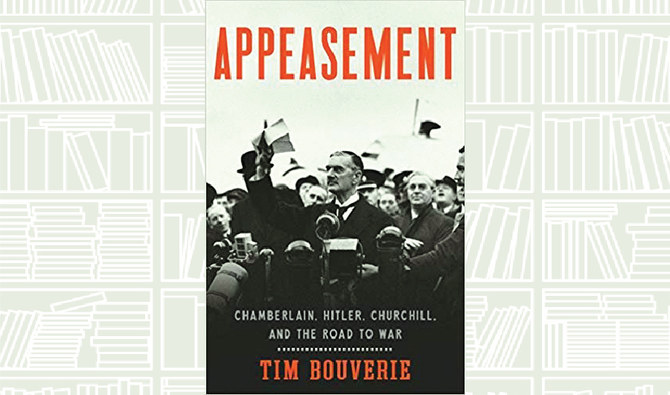
What We Are Reading Today: Appeasement by Tim Bouverie

Updated 14 June 2019
Follow

What We Are Reading Today: Appeasement by Tim Bouverie

  • Bouverie details the rise of Hitler from the early 1930s to the fall of France in the summer of 1940

Appeasement is a comprehensive and eminently readable account of the failure of Britain’s politicians and diplomats to prevent the domination of Europe by Adolf Hitler and the Nazi regime.

This is a “brilliant debut by former political journalist, Tim Bouverie, detailing the rise of Hitler from the early 1930s to the fall of France in the summer of 1940,” said a review in goodreads.com.

He “examines every aspect of Britain’s repeated attempts to satisfy Hitler’s growing demands to extend Germany’s power in Central Europe,” it added.

The author “takes readers inside 10 Downing Street during the tenure of Neville Chamberlain, the beloved prime minister determined to avert war at any cost,” said the review. 

Critic Lynne Olson, writing for The New York Times, said: “Throughout his minutely detailed survey, Bouverie rightly rejects the arguments of revisionist historians who claim that Britain’s lack of military preparedness, as well as the strength of pacifist public opinion, justified its determination to offer repeated concessions 

to Hitler.”


What We Are Reading Today: ‘The Bell Jar’

Photo/Supplied
Updated 20 December 2025
Follow

What We Are Reading Today: ‘The Bell Jar’

  • The bell jar — clear, enclosing, and distorting the air she breathes — becomes the perfect image of Greenwood’s entrapment. Just as telling is the fig tree she imagines, with each fig representing a possible future: writer, traveler, mother, lover

Author: Sylvia Plath

Sylvia Plath’s “The Bell Jar” (1963) is a raw and luminous portrait of a young woman standing at the edge of adulthood, grappling with ambition, doubt, and the suffocating weight of expectation. 

Through the eyes of the novel’s troubled protagonist Esther Greenwood, Plath reveals the loneliness that can lie hidden beneath achievement and the unease brought on by future expectations.  

The novel opens in New York, where Greenwood’s magazine internship seems the gateway to success. Yet the city’s glamor soon feels hollow, and the confidence around her thin and brittle. 

Her sense of direction begins to fade, and the life laid out before her starts to feel both too small and impossibly distant.  

The bell jar — clear, enclosing, and distorting the air she breathes — becomes the perfect image of Greenwood’s entrapment. Just as telling is the fig tree she imagines, with each fig representing a possible future: writer, traveler, mother, lover. 

Torn between these possibilities, she hesitates until the figs shrivel and drop. This image, perhaps more than any other, reveals how fear of choice can quietly undo a person.   

Plath’s writing is sharp and deeply humane. She exposes the subtle pressures shaping women’s lives at that time without sentiment or complaint. 

The narrative’s erratic rhythm mirrors the character’s disoriented state of mind, where thought and memory blur at the edges. 

“The Bell Jar” speaks to anyone who has felt caught between possibility and paralysis, between who they are and who they are expected to be. 

Plath writes with precision and compassion, turning confusion into clarity and despair into something almost inspiring.