

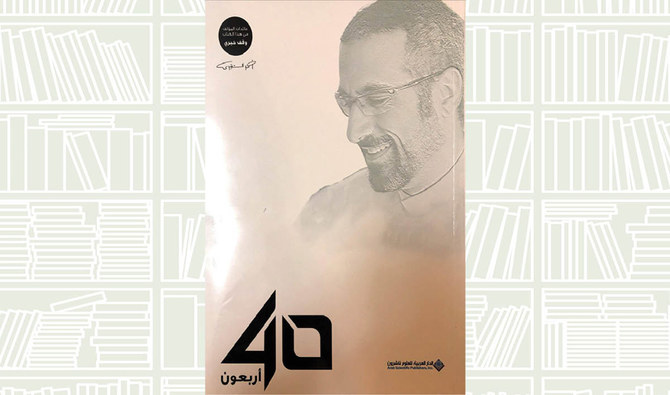
What We Are Reading Today: ‘40’ by Ahmad Al-Shugairi

Updated 13 June 2019
Follow

What We Are Reading Today: ‘40’ by Ahmad Al-Shugairi

Saudi media personality Ahmad Al-Shugairi has written an autobiography produced during 40 days of seclusion on a remote island.

During this time Al-Shugairi forfeited all technology and connections with people to reflect on his life — and on how to improve it and become a better human being closer to Allah.

In the introduction to the book, Al-Shugairi writes about spiritual seclusion and lists the life-changing effects it can bring. The book comprises 10 chapters. Each section is a dive into the author’s life in which he reminisces about the lessons he has learned. The book reflects on his favorite books, quotes and verses from the Qur’an, which led him to contemplate all aspects of his life, both personal and career-wise.

What most stands out is how raw the experiences are — he does not shy away from difficult periods of growth — Al-Shugairi reminisces on awkward moments that made him who he is today.

The book is written in a simple form to reach audiences of any age. It is a straightforward, thoughtful and filled with insights. It is a memoir, but can also be considered a self-help book.

All proceeds from the book will go to charity.


Al Habtoor Research Centre marks 3rd anniversary, honors Arabic language initiative winners

Updated 8 sec ago
Follow

Al Habtoor Research Centre marks 3rd anniversary, honors Arabic language initiative winners

LONDON: Al Habtoor Research Centre on Thursday marked the third anniversary of its founding by honoring the winners of the Khalaf Al Habtoor Initiative to Preserve the Arabic Language, recognizing their efforts to strengthen Arabic as a language of knowledge, research and scientific production.
The annual event featured a special dialogue session with Emirati businessman Khalaf Ahmad Al Habtoor, founder and chairman of Al Habtoor Group, who addressed key regional and international developments amid rapid political, economic and technological change.
He said that supporting research centers is “not an intellectual luxury, but a national duty and collective responsibility,” adding that “investment in research and knowledge is a fundamental pillar in building a sustainable future.
“We have solid foundations, we have minds, and we have thinkers and intellectuals. Our true success came from cooperation among people, the convergence of minds, and unity of vision between leadership and society,” Al Habtoor said.
The session, attended by diplomats, business leaders, researchers and academics, also saw Al Habtoor share his outlook on the coming period, highlighting the “importance of wisdom and balance in navigating global change.”


The anniversary served as an opportunity to highlight AHRC’s main achievements over its first 1,000 days.
Director Dr. Azza Hashem outlined the center’s institutional development, saying the recent opening of its Dubai office represents “a step toward greater openness, expansion and global engagement,” and reflects its growing role as a regional and international think tank specializing in strategic foresight, policy analysis, early warning systems and risk assessment.
She said the Dubai office’s model — integrating technology-driven research with political and economic analysis — will focus on innovation, scientific research and medical studies, complementing AHRC’s role in Cairo as a regional research hub.
Over its first three years, AHRC has produced more than 600 analytical reports and strategic assessments, along with over 110 research publications in Arabic and English.
Its work includes advanced early warning and risk-sensing capabilities that have allowed it to engage with global themes such as artificial intelligence, the future of warfare, data conflicts, gaps in AI and robotics regulation, space studies, economic transformation and the digitalization of economies, with particular attention to Latin America.


The center has also launched specialized analytical programs, including the “What If” series and what it describes as the region’s first dedicated risk-foresight periodical, which examines unconventional future scenarios, such as the integration of technology into the human body.
During the ceremony, AHRC honored the winners of the Khalaf Al Habtoor Initiative to Preserve the Arabic Language for their role in enhancing the presence of Arabic in academic and cultural spheres. Al Habtoor said the initiative aligns with the center’s mission to “reinforce Arab intellectual identity and safeguard the Arabic language amid rapid digital transformation.”
At the close of the event, the center announced that 2026 will be designated the “Year of Peace and Construction,” with its research agenda focusing on nuclear security, biosecurity and food security.