

AU envoy mediates Sudan crisis as protesters slam military

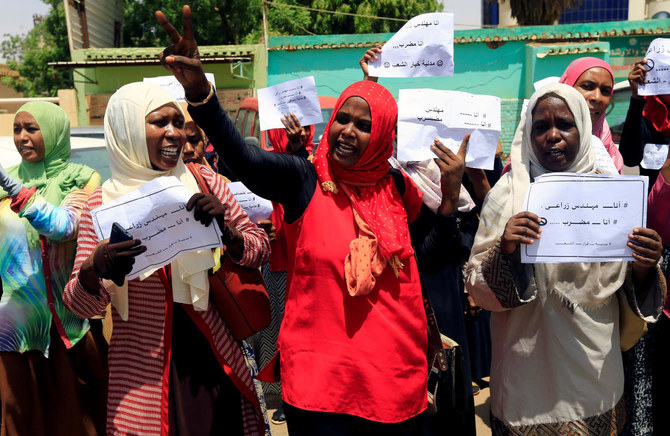
Members of Sudan's alliance of opposition and protest groups chant slogans outside Sudan's Central Bank during the second day of a strike, as tensions mounted with the country's military rulers over the transition to democracy, in Khartoum, Sudan May 29, 2019. (FILE/Reuters)
Updated 13 June 2019
Follow

AU envoy mediates Sudan crisis as protesters slam military

  • Leaders of the country’s protest movement accuse the ruling military of pursuing a brutal crackdown on protestors

KHARTOUM: On Wednesday, the top US diplomat for Africa joined an international effort to press Sudan’s military rulers and the opposition toward a deal on a transition to democracy following the toppling of Bashir.

An African Union (AU) envoy said mediation efforts to ease Sudan’s crisis are making “significant progress.”

Ethiopia and the US have recently stepped up diplomatic efforts to ease Sudan’s growing tensions. 

The AU envoy to Sudan, Mohammed El-Hacen Lebatt, declined to elaborate on where the mediation talks were headed, saying during a news conference in Khartoum that it was up to the two sides to disclose the outcome of the talks.

The head of Sudan’s ruling military council met with US diplomats in Khartoum and the AU envoy to Sudan on Thursday, the council said.

The ruling Transitional Military Council said Lt. Gen. Abdel Fattah Al-Burhan met with Tibor Nagy, the US assistant secretary for Africa, and veteran diplomat Donald Booth, who was appointed US envoy to Sudan on Wednesday.

Ethiopia’s Foreign Ministry said Wednesday the military council and leaders of the protest movement had agreed to resume their talks soon, “in good-faith to iron-out the remaining outstanding points.” 

Those points include setting up a government council to run Sudan during a transition period. 

The ministry said both sides also agreed to refrain from inflammatory rhetoric and de-escalate tensions, and that the military council would undertake confidence-building measures including the release of political prisoners.

However, Tarek Abdel Meguid, a leader of The Forces for Declaration of Freedom and Change (FDFC), said the direct talks with the military had yet to resume. 


Israel orders removal of electricity network, destroys Palestinian houses in West Bank

Updated 16 sec ago
Follow

Israel orders removal of electricity network, destroys Palestinian houses in West Bank

  • The notice demonstrates Israel’s continued efforts to tighten its control over the residents of Idhna, the mayor said
  • Israeli forces demolished two homes belonging to the Qabha family in the Khor Al-Dabaa neighborhood of Bartaa in Jenin

LONDON: Israeli authorities informed Palestinian residents of Idhna village, located west of Hebron, about a plan to remove the electricity network in the area as the Israeli government intends to strengthen control in the occupied West Bank.

Jaber Tmaizi, the mayor of Idhna, said that Israeli troops issued a notice demanding the removal of an electricity network that supplies Bir Al-Balouta area, located west of the town.

He added that this notice demonstrates Israel’s continued efforts to tighten its control over the residents of Idhna, aiming to displace them closer to the separation wall to expand the Adora settlement nearby.

On Tuesday, the Energy Minister Eli Cohen said that recent measures adopted by the government that deepen Israeli control in the occupied West Bank amounted to implementing “de facto sovereignty.”

Cohen said that steps “actually establish a fact on the ground that there will not be a Palestinian state.”

Palestinians, Arab countries, and human rights groups have described the moves announced on Sunday as an annexation of the territory, which is home to approximately 3.4 million Palestinians who aspire to use it for a future state.

On Tuesday, Israeli forces demolished two homes belonging to the Qabha family in the Khor Al-Dabaa neighborhood of Bartaa, which is located in Jenin in the northern West Bank. The demolition was carried out under the pretext that the houses were built without the necessary construction permits.

Earlier this year, Israeli forces also demolished four homes in Bartaa, again citing the absence of permits as the reason for the demolitions.