

Sudan rivals agree to new talks as protest strike ends: mediator

1 / 2
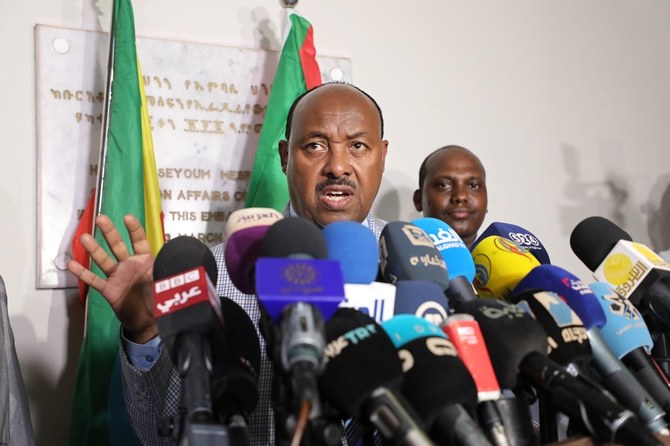
Mahmoud Drir, an envoy of Ethiopian Prime Minister Abiy Ahmed, has been mediating between the two sides since Ahmed visited Khartoum last week. (AP)
2 / 2
Sudanese vendors sell vegetables in the central market of Khartoum on June 10, 2019, as most of the shops and businesses remained shut. (AFP)
Updated 13 June 2019
Follow

Sudan rivals agree to new talks as protest strike ends: mediator

  • Sudan has been led by a military council since it toppled autocratic president Omar Al-Bashir on April 11
  • A top US diplomat planned a mission to press the generals to halt the crackdown on protesters demanding civilian rule

KHARTOUM: Protest leaders have agreed to end a campaign of civil disobedience launched after a deadly crackdown on demonstrators and to resume talks with Sudan’s ruling generals, an Ethiopian mediator said Tuesday.

The apparent breakthrough, which the military rulers had yet to confirm, came as a top US diplomat prepared to embark on a mission to press the generals to halt the crackdown on protesters demanding civilian rule.

Sudan has been led by a military council since it toppled autocratic president Omar Al-Bashir on April 11 after months of nationwide protests against his iron-fisted rule of three decades.

Following Bashir’s removal, protesters camped outside military headquarters in Khartoum for weeks to demand civilian rule, before security and paramilitary forces dispersed them in a June 3 crackdown that killed dozens.

The protest movement launched a campaign of civil disobedience on Sunday, and most businesses stayed closed and residents hunkered indoors for the next three days.

It had threatened to pile even more pressure on the generals by releasing a list of members for a new ruling body — the key point of dispute between the two sides.

But they agreed to end the campaign and return to talks, said an envoy of Ethiopian Prime Minister Abiy Ahmed.

“The Alliance for Freedom and Change agreed to end the civil disobedience (campaign) from today,” Mahmoud Drir, who has been mediating between the two sides since Ahmed visited Khartoum last week.

“Both sides have also agreed to resume talks soon,” he told reporters.

The protest movement itself said in a statement that it was calling on people “to resume work from Wednesday.”

The UN Security Council called on all sides “to continue working together toward a consensual solution to the current crisis” and voiced support for African-led diplomatic efforts.

The council also called for an immediate halt to attacks against civilians and stressed the importance of upholding human rights — a week after Russia and China blocked a similar draft statement on the crisis.

In Khartoum, the protest strike saw most shops and businesses remain closed with some companies extending to the end of the week the Eid Al-Fitr holidays marking the end of Ramadan.

The paramilitary Rapid Support Forces accused of having played the lead role in last week’s crackdown patrolled districts in their trademark pickup trucks fitted with heavy machine guns.

“We are now getting used to living with guns as we are seeing so many of these men walking into restaurants with their weapons,” one resident said as a group of RSF members entered an eatery.


Hundreds mourn in Syria’s Homs after deadly mosque bombing

Updated 27 December 2025
Follow

Hundreds mourn in Syria’s Homs after deadly mosque bombing

  • Officials have said the preliminary investigations indicate explosive devices were planted inside the mosque but have not yet publicly identified a suspect

HOMS: Hundreds of mourners gathered Saturday despite rain and cold outside of a mosque in the Syrian city of Homs where a bombing the day before killed eight people and wounded 18.
The crowd gathered next to the Imam Ali ibn Abi Talib Mosque in the Wadi Al-Dhahab neighborhood, where the population is predominantly from the Alawite minority, before driving in convoys to bury the victims.
Officials have said the preliminary investigations indicate explosive devices were planted inside the mosque but have not yet publicly identified a suspect.
A little-known group calling itself Saraya Ansar Al-Sunna claimed responsibility for the attack in a statement posted on its Telegram channel, in which it indicated that the attack intended to target members of the Alawite sect, an offshoot of Shia Islam whom hard-line Islamists consider to be apostates.
The same group had previously claimed a suicide attack in June in which a gunman opened fire and then detonated an explosive vest inside a Greek Orthodox church in Dweil’a, on the outskirts of Damascus, killing 25 people as worshippers prayed on a Sunday.
A neighbor of the mosque, who asked to be identified only by the honorific Abu Ahmad (“father of Ahmad“) out of security concerns, said he was at home when he heard the sound of a “very very strong explosion.”
He and other neighbors went to the mosque and saw terrified people running out of it, he said. They entered and began trying to help the wounded, amid blood and scattered body parts on the floor.
While the neighborhood is primarily Alawite, he said the mosque had always been open to members of all sects to pray.
“It’s the house of God,” he said. “The mosque’s door is open to everyone. No one ever asked questions. Whoever wants to enter can enter.”
Mourners were unable to enter the mosque to pray Saturday because the crime scene remained cordoned off, so they prayed outside.
Some then marched through the streets chanting “Ya Ali,” in reference to the Prophet Muhammad’s cousin and son-in-law whom Shiite Muslims consider to be his rightful successor.