ISLAMABAD: Pakistan Prime Minister Imran Khan’s government vowed to collect more taxes and make spending cuts in a closely watched budget presented to parliament Tuesday, weeks after reaching a deal with the IMF for a $6 billion bailout.
Before a rowdy parliamentary session, the government announced plans to slash civil expenditure and freeze military spending while promising to substantially raise revenues to stem a yawning fiscal deficit, and pledging to collect 5.5 trillion rupees ($36 billion) in taxes.
Discontent is simmering in Pakistan following repeated devaluations of the rupee, soaring inflation, and increasing utility costs.
“The country is in a difficult situation,” Khan admitted during a televised address into early Wednesday, but he promised the situation would only continue for several months.
Earlier in parliament the opposition shouted slogans and held up signs against an “unacceptable IMF budget.”
“We have slashed the civil budget by five percent while the military budget will remain the same,” Hammad Azhar, Minister of State for Revenue, said as he announced details of the plan.
“The financial year 2019-2020 will be a year for economic stability. We will make some tough decisions and will try to save the poor public from the effects of those tough decisions,” he added.
Azhar went on to highlight a range of new taxes and increases in existing levies in the new budget, saying raising revenue was pivotal to stabilising the country’s economy.
“As long as we do not improve our tax system Pakistan cannot prosper,” said Azhar, who added that government members and the prime minister had agreed to take a 10 percent salary cut.
Pakistan has struggled for decades to collect taxes. Estimates suggest that only around one percent of the 200-million strong population filed a return in 2018.
Ahead of the budget presentation, Khan took to the country’s airways Monday for the second time in recent weeks to plead with Pakistanis to declare their assets in the latest scheme aimed at increasing tax revenues.
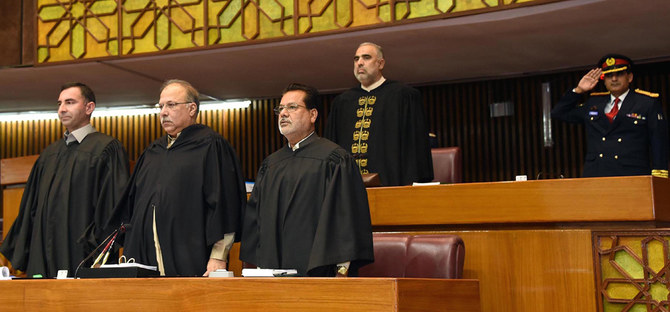
The budget session was dominated by a vocal opposition following a string of arrests of their leaders this week. Members of the PakistanPeople’s Party and Pakistan Muslim League Nawaz chanted throughout the proceedings, drowning out Azhar.
The presentation of Khan’s first budget comes just a day after the government released the latest round of bleak economic figures for the cash-strapped country, showing growth for the current fiscal year falling to 3.3 percent — well below the 6.2 percent target.
Khan’s administration has tried for months but failed to stave off ballooning fiscal and balance of payments deficits, along with low tax yields and mounting debt.
The agreement eked out with the International Monetary Fund still needs final approval by the fund’s board, and it is widely believed the body was waiting to see details of the budget before giving the final sign-off.
Analysts have warned the IMF deal would likely come with myriad restrictions that could thwart Khan’s promises to build an Islamic welfare state, as the country is forced to tighten its purse strings.
He announced the creation of a commission to investigate former leaders and recover money suspected to have been embezzled.
He welcomed the arrest on Monday of former president Asif Ali Zardari, as well as that of legislator Hamza Shahbaz, both in cases of alleged corruption.
Pakistan’s increasing economic woes also come as the country faces possible sanctions from the Financial Action Task Force — a money-laundering monitor based in Paris — for failing to rein in terrorist financing.
The organization will decide soon whether to add Pakistan to a blacklist that would trigger automatic sanctions, further weakening an already faltering economy.
To add to its troubles, the United States has warned it will be watching closely to ensure Pakistan does not use IMF money to repay debts to China, which has poured billions into the country for infrastructure projects under its Belt and Road Initiative.


![]()

With new budget following IMF deal, Pakistan resolves to raise revenues
With new budget following IMF deal, Pakistan resolves to raise revenues
- Plans to slash civil expenditure and freeze military spending
- Pakistan has struggled for decades to collect taxes
Latest updates


Recommended


© 2026 SAUDI RESEARCH & PUBLISHING COMPANY, All Rights Reserved And subject to Terms of Use Agreement.