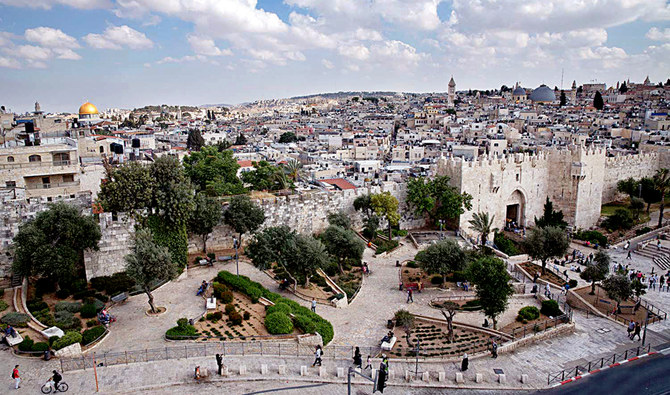
Crisis Group report slams Israeli’s $530m plan for occupied East Jerusalem

There are many Palestinian land owners from East Jerusalem who are living abroad, and this plan is aimed at transferring their properties to the Israeli government, says expert. (AFP)
Updated 12 June 2019
Follow

Crisis Group report slams Israeli’s $530m plan for occupied East Jerusalem

  • ICG calls on allies of both leaderships to press Israeli govt not to carry out these plans
  • The report concludes that these actions ‘would exacerbate the conflict in and over Jerusalem’

AMMAN: The International Crisis Group (ICG) has called on Israel not to implement controversial parts of a $530 million, five-year plan to develop occupied East Jerusalem without any input from the Palestinian community.

In a 40-page report published on Tuesday, the ICG called on Israel not to separate Palestinian communities in parts of East Jerusalem from the city’s municipality, force schools there to adopt Israel’s curricula, and introduce a land registry.

The report, titled “Reversing Israel’s Deepening Annexation of Occupied East Jerusalem,” concludes that these actions “would exacerbate the conflict in and over Jerusalem.”

Ofer Zalzberg, a senior analyst with the ICG and the report’s main author, told Arab News that despite settlement construction in East Jerusalem and severe impediments placed on natural growth in Palestinian neighborhoods, Israel has failed to establish a durable and substantial Jewish majority in that part of the city. 

Zalzberg said a former Israeli minister described the dilemma to him as follows: “East Jerusalem remains stuck in our throat: We can’t swallow it and we can’t spit it out.”

Khaled Abu Arafeh, a former Palestinian minister, said Israel is moving fast to Judaize East Jerusalem. 

“It’s very worrisome what’s happening. This large amount of money is being set aside to tackle Palestinian aspirations, especially in the educational field,” he told Arab News. 

Abu Arafeh said the report shows how Israeli authorities operate in East Jerusalem with impunity. 

“This is very dangerous, and requires more than ever (Palestinian) national unity and a position from the Arab and Islamic world,” he added. 

Khalil Assali, a member of the Waqf, which manages Al-Aqsa Mosque, said Israel has been targeting education in East Jerusalem for some time. 

“The Israelis have placed obstacles, closed schools and forced (Palestinian) students to attend Israeli municipal schools,” he told Arab News.

“We have at least 30,000 students whose names aren’t in any registry because they have no school seats.”

Khalil Tufakji, head of the map department at the Arab Studies Center, expressed opposition to the idea of a land registry for East Jerusalem. 

“There are many Palestinian land owners from East Jerusalem who are living abroad, and this idea is aimed at transferring their properties to the Israeli government by means of putting them in the hands of the custodian of absentee properties,” he told Arab News.

The ICG called on Palestinians, Israelis, and allies of both leaderships to press Israel’s government not to carry out these plans. 

“If it wants to reduce poverty and crime in East Jerusalem, Israel should allow Palestinians to establish civic leadership bodies in the city and end its ban on Palestinian Authority activities there,” the ICG wrote.

It urged outside powers “to allocate funds to help Palestinian Jerusalemites establish civic leadership bodies in East Jerusalem to operate both east and west of the separation barrier, in coordination with Israel.”


Virtual museum preserves Sudan’s plundered heritage

Updated 6 sec ago
Follow

Virtual museum preserves Sudan’s plundered heritage

CAIRO: Destroyed and looted in the early months of Sudan’s war, the national museum in Khartoum is now welcoming visitors virtually after months of painstaking effort to digitally recreate its collection.
At the museum itself, almost nothing remains of the 100,000 artefacts it had stored since its construction in the 1950s. Only the pieces too heavy for looters to haul off, like the massive granite statue of the Kush Pharaoh Taharqa and frescoes relocated from temples during the building of the Aswan Dam, are still present on site.
“The virtual museum is the only viable option to ensure continuity,” government antiquities official Ikhlass Abdel Latif said during a recent presentation of the project, carried out by the French Archaeological Unit for Sudanese Antiquities (SFDAS) with support from the Louvre and Britain’s Durham University.
When the museum was plundered following the outbreak of the war between the regular army and the paramilitary Rapid Support Forces (RSF) in April 2023, satellite images showed trucks loaded with relics heading toward Darfur, the western region now totally controlled by the RSF.
Since then, searches for the missing artefacts aided by Interpol have only yielded meagre results.
“The Khartoum museum was the cornerstone of Sudanese cultural preservation — the damage is astronomical,” said SFDAS researcher Faiza Drici, but “the virtual version lets us recreate the lost collections and keep a clear record.”
Drici worked for more than a year to reconstruct the lost holdings in a database, working from fragments of official lists, studies published by researchers and photos taken during excavation missions.
Then graphic designer Marcel Perrin created a computer model that mimicked the museum’s atmosphere — its architecture, its lighting and the arrangement of its displays.
Online since January 1, the virtual museum now gives visitors a facsimile of the experience of walking through the institution’s galleries — reconstructed from photographs and the original plans — and viewing more than 1,000 pieces inherited from the ancient Kingdom of Kush.
It will take until the end of 2026, however, for the project to upload its recreation of the museum’s famed “Gold Room,” which had housed solid-gold royal jewelry, figurines and ceremonial objects stolen by looters.
In addition to the virtual museum’s documentary value, the catalogue reconstructed by SFDAS is expected to bolster Interpol’s efforts to thwart the trafficking of Sudan’s stolen heritage.