UK economy close to stagnation due to Brexit, weak global demand: PMI

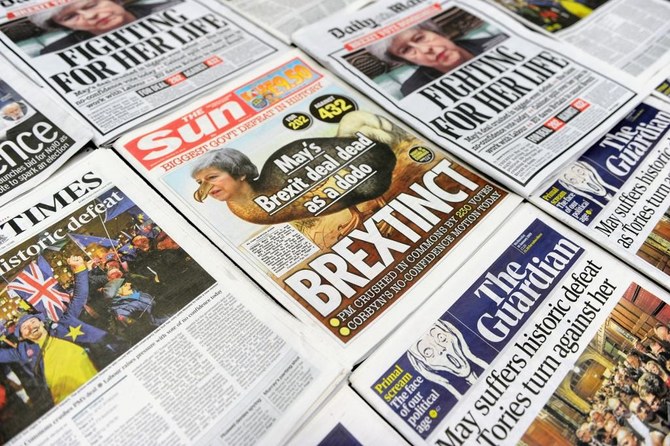
Brexit worries continued to hurt sales in Europe, echoing a concern voiced by manufacturers on Monday. (AFP)
Updated 05 June 2019
Follow

UK economy close to stagnation due to Brexit, weak global demand: PMI

  • The Bank of England forecasts Britain’s quarterly economic growth rate will fall to 0.2 percent for the three months to June
  • Many services firms said Brexit worries continued to hurt sales in Europe

LONDON: British economic growth almost halted last month as a modest expansion in the services sector barely offset weakness among manufacturers and construction firms caused by the Brexit crisis and weaker global growth, a business survey showed.
The IHS Markit/CIPS services Purchasing Managers’ Index (PMI) edged up to 51.0 from 50.4 in April, its strongest reading in three months and slightly above economists’ average forecast in a Reuters poll.
Equivalent PMI surveys for manufacturing and construction published earlier this week unexpectedly fell deep into contractionary territory, however, and taken together, the three PMIs gave one of their weakest readings since 2012.
“The PMI surveys collectively indicated that the UK economy remained close to stagnation midway through the second quarter,” IHS Markit economist Chris Williamson said.
Official data showed Britain’s economy grew a robust 0.5 percent in the first quarter of the year, though much of that was driven by firms stockpiling ahead of a Brexit deadline of March 29, which has since been postponed until Oct. 31.
The Bank of England forecasts Britain’s quarterly economic growth rate will fall to 0.2 percent for the three months to June.
Many services firms said Brexit worries continued to hurt sales in Europe, echoing a concern voiced by manufacturers on Monday.
“Domestic political uncertainty remained a key factor holding back their growth expectations for the year ahead,” IHS Markit said, adding that Brexit concerns were weighing on business investment and consumer spending.
Prime Minister Theresa May announced her resignation in May ahead of a heavy defeat for her Conservative Party in European Parliament elections, triggering a leadership contest that could open the way for a successor with a tougher line on Brexit.
Nonetheless, the survey found optimism among services firms rose to its highest since September 2017 and hiring was the strongest since November.
BoE officials have said that in an uncertain business environment, British firms tend to meet expansion needs by hiring staff — who can be easily sacked in a downturn — rather than make long-term investments that are costly to reverse.


Saudi Arabia’s cultural sector is a new economic engine between Riyadh and Paris, says ambassador

Updated 25 January 2026
Follow

Saudi Arabia’s cultural sector is a new economic engine between Riyadh and Paris, says ambassador

RIYADH: Culture has become a fundamental pillar in bilateral relations between France and Saudi Arabia, according to the French Ambassador to the Kingdom, Patrick Maisonnave.

Maisonnave noted its connection to the entertainment and tourism sectors, which makes it a new engine for economic cooperation between Riyadh and Paris.

He told Al-Eqtisadiah during the opening ceremony of La Fabrique in the Jax district of Diriyah that cultural cooperation with Saudi Arabia is an important element for its attractiveness in the coming decades.

La Fabrique is a space dedicated to artistic creativity and cultural exchange, launched as part of a partnership between the Riyadh Art program and the French Institute in Riyadh. 

Running from Jan. 22 until Feb 14, the initiative will provide an open workspace that allows artists to develop and work on their ideas within a collaborative framework.

Launching La Fabrique as a space dedicated to artistic creativity

The ambassador highlighted that the transformation journey in the Kingdom under Vision 2030 has contributed to the emergence of a new generation of young artists and creators, alongside a growing desire in Saudi society to connect with culture and to embrace what is happening globally. 

He affirmed that the relationship between the two countries is “profound, even cultural par excellence,” with interest from the Saudi side in French culture, matched by increasing interest from the French public and cultural institutions unfolding in the Kingdom.

Latest estimates indicate that the culture-based economy represents about 2.3 percent of France’s gross domestic product, equivalent to more than 90 billion euros ($106.4 billion) in annual revenues, according to government data. The sector directly employs more than 600,000 people, making it one of the largest job-creating sectors in the fields of creativity, publishing, cinema, and visual arts.

Saudi Arabia benefiting from French experience in the cultural field

Maisonnave explained that France possesses established cultural institutions, while Saudi Arabia is building a strong cultural sector, which opens the door for cooperation opportunities.

This comes as an extension of the signing of 10 major cultural agreements a year ago between French and Saudi institutions, aiming to enhance cooperation and transfer French expertise and knowledge to contribute to the development of the cultural system in the Kingdom.

He added that experiences like La Fabrique provide an opportunity to meet the new generation of Saudi creators, who have expressed interest in connecting with French institutions and artists in Paris and France.

La Fabrique encompasses a space for multiple contemporary artistic practices, including performance arts, digital and interactive arts, photography, music, and cinema, while providing the public with an opportunity to witness the stages of producing artistic works and interact with the creative process.