Donald Trump tells Britain to ‘walk away’ if EU does not yield on Brexit

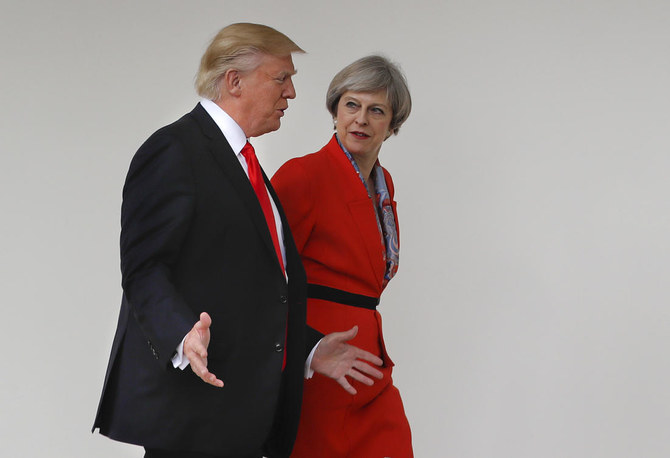
In this file photo from Jan. 27 2017, President Donald Trump and British Prime Minister Theresa May walk along the colonnades of the White House in Washington. (AP)
Updated 02 June 2019
Follow

Donald Trump tells Britain to ‘walk away’ if EU does not yield on Brexit

  • Trump says “no deal” Brexit should be an option
  • Says could work very quickly on a US-UK trade deal

LONDON: US President Donald Trump said Britain should refuse to pay a $50 billion European Union divorce bill and “walk away” from Brexit talks if Brussels does not give ground.
Trump told the Sunday Times newspaper ahead of a state visit to Britain, which starts on Monday, that Britain’s next leader should send arch-Brexiteer Nigel Farage to conduct EU talks.
Once Britain leaves the EU, which Trump said must happen this year, then he would go “all out” to agree a trade deal.
“They’ve got to get it done,” he said in the Sunday Times interview. “They have got to get the deal closed.”
British Prime Minister Theresa May will step down shortly after this week’s Trump visit, having failed to win backing for the Brexit divorce deal she negotiated with the EU.
Trump said her successor should pursue a “no-deal” Brexit if he or she could not get more concessions from Europe by the end of October, when Britain is due to leave.
“If they don’t get what they want, I would walk away,” he said. “If you don’t get a fair deal, you walk away.”
The 13 candidates already in the leadership race are split between those willing to accept a “no-deal” and those opposed.
In the “no deal” camp are former foreign secretary Boris Johnson, whom Trump praised in an interview with the Sun newspaper on Friday, along with former Brexit minister Dominic Raab and interior minister Sajid Javid.
Trump said the United States could work “very, very quickly” on a trade deal if Britain was not constrained by a transition period agreed with Brussels.

All on the table
The US Ambassador to Britain, Woody Johnson, said any such trade deal would include agriculture and health care.
“In a trade deal, all things that are traded will be on the table,” he told the BBC on Sunday. Asked if that included health care, he replied: “I would think so.”
Concerns have been raised in Britain about accepting US agricultural standards, notably chlorine-washed chicken, and about opening up its state-funded health care system to US companies as the price of a trade deal.
“American products would come over, and be allowed to come over,” Johnson told the BBC’s Andrew Marr Show. “You give the British people a choice, if they like it they can buy it, if they don’t want it, they do not have to buy it.”

Farage

Trump said it was a mistake for the Conservatives not to involve Farage, the Brexit Party leader, in negotiations with Brussels after his success in European Parliament elections.
“I like Nigel a lot. He has a lot to offer — he is a very smart person,” Trump said. “They won’t bring him in but think how well they would do if they did. They just haven’t figured that out yet.”
Farage, who led the unofficial campaign to leave the EU in the 2016 Brexit referendum, wants to leave the bloc without any agreement.
His new Brexit party swept to victory in the United Kingdom’s European parliament election last month, prompting him to demand a seat at Brexit negotiations.
However, none of the candidates seeking to replace May are expected to offer an olive branch to a longstanding rival who has the potential to split the right-wing vote in Britain.
Trump also said he would have “to know” Labour opposition leader Jeremy Corbyn before authorizing US intelligence to share its most sensitive secrets with a hard-left government.
He said Britain must be careful not to jeopardize intelligence-sharing by letting Chinese firm Huawei Technologies Co. Ltd. into its 5G mobile phone network.


Immigration raids in Minnesota fuel grassroots Somali activism

Updated 5 sec ago
Follow

Immigration raids in Minnesota fuel grassroots Somali activism

  • “You would never fathom that people would just pluck you off the streets ... and say, ‘Prove to me that you’re a citizen,’” Mohamed said
  • Trump, who ‌has described Somalis as “garbage” who should be thrown out of the country, has said the operations are necessary to combat crime

MINNEAPOLIS: When immigration agents began aggressive operations in Minneapolis last month, Kowsar Mohamed started knocking on doors, fielding late-night calls and mobilizing other Somali Americans into an ad-hoc response team.
Many feared they were being singled out, a worry that revived memories of the state surveillance and arbitrary authority they thought they had left behind when they resettled in the United States.
More than 100 volunteers now patrol south Minneapolis, distribute “Know Your Rights” guides and escort frightened elders — part of a sweeping grassroots effort to counter what many describe as constitutionally suspect raids that are destabilizing Minnesota’s roughly 80,000-strong Somali community, one of the country’s largest refugee populations.
“You would never fathom that people would just pluck you off the streets ... and say, ‘Prove to me that you’re a citizen,’” Mohamed said, referring to reports of aggressive tactics by the agents. “It’s not that we never thought it was impossible. We just believed the Constitution was going to protect us from this level of interrogation.”

TRUMP’S 3,000-AGENT PUSH SPARKS VOTER-INTIMIDATION FEARS
The deployment of 3,000 federal agents — ordered by Republican President Donald Trump — has intensified accusations from Democrats and local leaders that he is targeting ‌a politically influential community ‌ahead of the 2026 midterm elections, deepening fears that the operations amount to intimidation aimed at suppressing ‌Somali ⁠voter turnout.
Trump, who ‌has described Somalis as “garbage” who should be thrown out of the country, has said the operations are necessary to combat crime, though many of those arrested have no criminal charges or convictions. He has also cited a fraud scandal around the theft of federal funds for social-welfare programs in Minnesota to justify sending agents into the state, many of them from US Immigration and Customs Enforcement.
Democrats and community leaders accuse the agents of harassing peaceful protesters, racial profiling and searching houses without warrants. Minneapolis has been on edge since the fatal shooting of 37-year-old Renee Good by an immigration agent on January 7.
“A lot of community members escaped war and this administration is triggering another war zone,” said Abdulahi Farah, co-chair of the Somali American Leadership Table, an advocacy group formed in response ⁠to hate crimes and political attacks on Somalis. He said Trump’s history of racist rhetoric against Black and other immigrants of color has emboldened far-right activists and had a destabilizing effect on ‌small businesses and citizens’ general sense of safety.
Department of Homeland Security spokesperson Tricia McLaughlin said in ‍a statement to Reuters that immigrants who are served administrative warrants or ‍I-205 removal orders “have had full due process and a final order of removal from an immigration judge.”

PUSHING BACK AGAINST IMMIGRATION RAIDS
In Cedar-Riverside, a ‍normally bustling Somali neighborhood lined with restaurants, boutique shops and convenience stores, business owners say activity is noticeably quieter since immigration agents arrived there last month.
“It’s been really slow,” said Rashid Jama, a grocery store manager in the neighborhood, also known as the West Bank. “A lot of our suppliers are Latino and they’re scared to come to work.”
The efforts of Mohamed, a third-year doctoral student at the University of Minnesota, are part of a broader wave of grassroots initiatives to push back by filming arrests, planning peaceful protests and accelerating voter outreach.
Some Somali Americans fear the raids are a bid to suppress voter turnout before midterm elections in November, according to over a dozen grassroots organizers, local officials and residents interviewed by ⁠Reuters.
“It’s signaling that if we get rid of them, if we scare them, they’re not going to come out to vote in the 2026 midterm election. We know that’s the target,” said Farah, whose group is partnering with other grassroots organizations to train people on priorities like opposing ICE raids as well as broader issues like affordability.
Mosques and neighboring community centers are now turning into political education hubs in Minnesota, local leaders said.
Civil rights advocates and scholars say the Minneapolis immigration operations echo past crackdowns in Black and Latino neighborhoods, fueling fears of political scapegoating, said political science professor Christina Greer at Fordham University.
Somali American voters have largely supported Democrats since refugees began resettling in the US in the 1990s, before becoming more politically active in the 2000s. US Representative Ilhan Omar is the community’s most high-profile member and a frequent target of racist attacks from Trump.
Asked about that and tactics of agents decried by residents, White House spokeswoman Abigail Jackson said in a statement to Reuters that immigrants “who fail to contribute to our economy, rip off Americans and refuse to assimilate into our society should not be here.”
Minnesota Republican Party Chairman Alex Plechash denied the raids were politically driven, calling the charge “categorically false” but said complaints about aggressive tactics ‌warrant review.
Some Somali community leaders say mobilizing voters will be a priority in the months ahead.
“The power we have is to vote,” said Abdullahi Kahiye, 37, who said he became a naturalized US citizen in 2024. “ICE and whoever is trying to terrorize the Somali community will not succeed.”