PARIS: An Iraqi court on Tuesday sentenced two high-profile French members of Daesh to death, bringing the total number of French former militants condemned to death this week to six.
France said it would do all it can to spare the group from execution in Iraq. Although it has made no effort to bring back the captured fighters, France is outspoken against the death penalty globally.
The sentencings in Iraq come amid a controversy about the legal treatment of thousands of foreign fighters who had joined Daesh at the height of its power in Syria and Iraq when the militant group declared its self-styled caliphate.
The men sentenced to death Tuesday were identified as Karam Salam Mohammed El-Harchaoui and Brahim Ali Mansour Nejara. They are among a group of 12 French citizens who were detained by the US-backed Syrian Democratic Forces in neighboring Syria and handed over to Iraq in January. The Kurdish-led group spearheaded the fight against Daesh in Syria and has handed over to Iraq hundreds of suspected Daesh members in recent months.
Nejara, 32, helped run one of the networks that sent Europeans to join Daesh and appeared in a video a week after the November 2015 attacks in Paris. The video was titled "Paris has collapsed" and shows a fictitious destruction of the Eiffel Tower, according to Jean-Charles Brisard of the Center of the Analysis of Terrorism.
Nejara is originally from a suburb of the French city of Lyon called Meyzieu, long known to be a training ground for militants, even before the appearance of Daesh. He is believed to have encouraged one of his brothers back home to carry out an attack in France, possibly on the stadium there. Two brothers were arrested in France.
The video he appeared in, praising the Paris attacks that killed 130 people and wounded more than 400, was played in court Tuesday.
Nejara, speaking before the judge, said that he was forced to make the video because the group was looking for someone who speaks French. He said he was threatened with prison when he requested to appear masked in the video, before they agreed to his request.
The other militant, El-Harchaoui, 33, lived in Belgium before he left for Syria in 2014. He was wounded in one of the battles he fought for Daesh in Syria. His second wife told The Associated Press he joined Daesh in Syria in 2014, was sent to Iraq to fight, escaped and traveled back to Syria's Shaddadeh, then to Raqqa where he was wounded in an airstrike in 2016. He was jailed for fleeing, then released. The two then met and married in October 2015, after which he was arrested again.
"I know he will not have a fair trial," Samira told the AP in an interview in March at camp Roj in northern Syria, where thousands of foreign women and children are languishing.
El-Harchaoui showed off his wound to the court on Tuesday, pulling off the top of his yellow prison uniform to reveal a hole in his right shoulder where he was wounded from a shell that hit a nearby house.
Three other French Daesh fighters had already been sentenced to death on Sunday, and a fourth on Monday. Those convicted can appeal their sentences within a month.
Human rights groups have criticized Iraq's handling of Daesh trials, accusing authorities of relying on circumstantial evidence and often extracting confessions under torture.
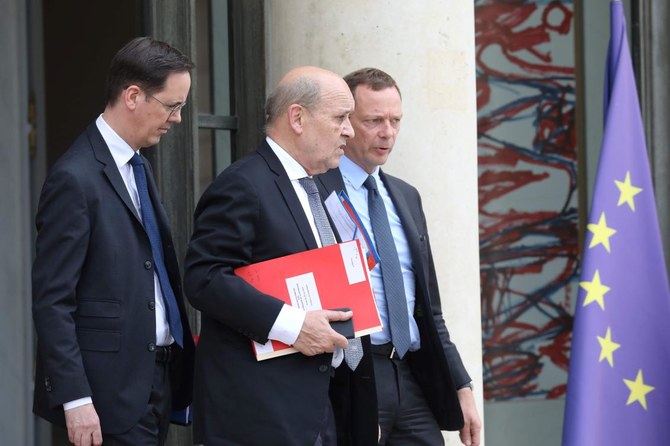
France's foreign minister said earlier Tuesday that his government is working to spare the group of condemned Frenchmen from execution after Iraq sentenced them to death.
Foreign Minister Jean-Yves Le Drian also reiterated France's position but said the Daesh militants should be tried where they committed their crimes.
"We are multiplying efforts to avoid the death penalty for these ... French people," he said on France-Inter radio. He didn't elaborate, but said he spoke to Iraq's president about the case.


![]()

Iraq sentences 2 more French Daesh members to death as France seeks to prevent execution
Iraq sentences 2 more French Daesh members to death as France seeks to prevent execution
- France has made no effort to bring back captured French Daesh fighters
- Controversy surrounds the legal treatment of thousands of foreign fighters who joined Daesh


Latest updates


Recommended


© 2026 SAUDI RESEARCH & PUBLISHING COMPANY, All Rights Reserved And subject to Terms of Use Agreement.