ISLAMABAD: Prime minister’s special assistant on accountability Mirza Shahzad Akbar announced on Monday that his country had signed a memorandum of understanding (MoU) with the United Kingdom to extradite wanted individuals to Pakistan, adding the development would also make it possible for his government to bring back the country’s former finance minister Ishaq Dar who currently resides in England.
Faced with serious corruption charges, Dar left Pakistan in October 2017 to attend a regional economic conference but did not return to his country. In a letter sent to an accountability court, he said that he was suffering from diffuse coronary heart disease and needed medical treatment abroad.
In December 2017, the court declared him an absconder and in October 2018 it ordered the government to auction Dar’s movable and immovable properties.
On Monday, Shahzad Akbar announced in a tweet that he had had productive meetings with UK Home Secretary Sajid Javid and Minister of State for Asia and the Pacific at the Foreign and Commonwealth Office Mark Field.
“UK signs first ever MoU for extradition to Pakistan, setting legal basis for extradition of Ishaq Dar in absence of a treaty,” he said in a twitter post.

Pakistan and United Kingdom sign first-ever MoU for extradition
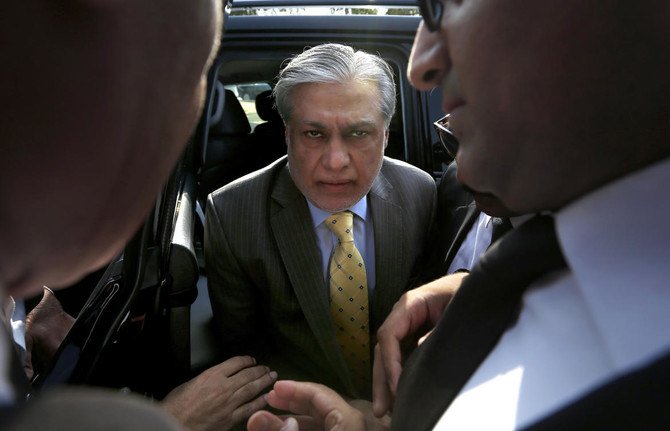
- The development may help the government bring Ishaq Dar back to Pakistan
- Prime minister’s adviser on accountability says his meeting with British home secretary was fruitful
Pakistan says Afghan forces opened ‘unprovoked’ border fire, warns of retaliation
- Incident follows Pakistan’s weekend strikes on TTP and Daesh targets inside Afghanistan
- Escalation threatens fragile ceasefire along 2,600-km frontier linking South and Central Asia
ISLAMABAD: Pakistan on Tuesday accused Afghan Taliban forces of opening “unprovoked” fire along their shared border and warned that any further aggression would draw a swift response.
The latest exchange comes amid sharply rising tensions between the two neighbors following Pakistan’s weekend strikes targeting what it described as Tehreek-e-Taliban Pakistan (TTP) and Daesh militant camps inside Afghanistan. Kabul said the strikes killed civilians and condemned them as violations of its sovereignty, vowing to respond.
Cross-border violence has intensified since Pakistan blamed recent suicide bombings in Islamabad, Bajaur and Bannu on militants it says are based in Afghanistan. Islamabad maintains that militant safe havens across the border are driving a surge in attacks inside Pakistan, a charge Kabul denies.
Mosharraf Zaidi, Prime Minister Shehbaz Sharif’s spokesperson for foreign media, said Afghan forces opened fire near the Torkham border crossing and Tirah Valley in Pakistan’s northwest.
“Pakistan’s security forces responded immediately and effectively silencing the Taliban aggression,” he told Arab News. “Any further provocation will be responded to immediately and severely, god willing. Pakistan will continue to protect its citizens and guard its territorial integrity.”
The incident marks the second major escalation in less than a year. Similar Pakistani strikes last year triggered weeklong clashes before Qatar, Turkiye and other regional actors mediated a tenuous ceasefire in October.
The 2,600-kilometer (1,600-mile) frontier, a key trade and transit corridor linking Pakistan to landlocked Afghanistan and onward to Central Asia, has faced repeated closures amid tensions, disrupting commerce and humanitarian movement. Trade between the two nations has remained closed since October.
Analysts warn that sustained military exchanges risk undermining diplomatic efforts to stabilize ties, including a Saudi-mediated initiative earlier this month that secured the release of three Pakistani soldiers.
Separately on Tuesday, Prime Minister Sharif discussed the situation in Afghanistan with Qatar’s Deputy Prime Minister Sheikh Saoud Al-Thani during talks in Doha, according to a statement from Sharif’s office. Both sides emphasized dialogue and de-escalation to promote regional stability.