



DUBAI: In the natural scheme of things, sports and environment are not easy to combine. But a group of eight Saudi women are attempting just that through their football team, the Greens.
The team’s members want to use their passion for sport to raise environmental awareness and bring about a mindset change across the Kingdom.
The Greens were established by the Saudi Sports for All Federation two months ago — specifically to promote environmental causes. The federation focuses on sports as a social, rather than professional, activity for women, men, adults, children, the elderly and people with special needs.
Leading the Greens is Rawh Alarfaj, 34, who played football for 12 years before deciding to become a coach.
“I am very passionate about sports overall, but my speciality is football and I feel I am good at it,” Alarfaj, who lives in Riyadh, told Arab News. “One of the things that keeps me going is that I am one of the founders of the Challenge Sports Club, which I manage right now.
FASTFACT
• The Global Goals World Cup is an alternative sports tournament that creates a community and inspires and engages women from all over the world.
• A one-day football celebration was created for 30 teams in Copenhagen.
• All teams qualify by choosing and creating an action plan on how to work with one of the UN’s 17 Sustainable Development Goals.
“We were focused at first only on football. But from the beginning of 2017, we have also had a basketball team for women in Riyadh.”
“We run programs for everyone in society because our goal is to increase the level of public participation in sports in Saudi Arabia from 13 percent in 2015 to 40 percent by 2030, based on a study we did at the federation,” said Alarfaj.
“Today, we’re at 18 percent. The programs focus on all kinds of sports. Just days ago, in the Danish capital Copenhagen, we took part in the Global Goals World Cup, which promotes causes such as environmental ones.”
The tournament, better known as GGWC, frames the UN’s 17 Sustainable Development Goals (SDGs) as a sport, with 30 teams worldwide competing to create the kind of world they would like to see. Each team creates an action plan with a particular global goal and strives to achieve it in their own country.
For the Greens, the focus was SDG 15: “Life on Land.” “We thought it would be a good global goal to choose right now because the issue has many sides,” Alarfaj said. “Awareness of the state of the environment is a very important topic now. So we organized a number of campaigns across the Kingdom.”
During a male professional football league game in Riyadh, Greens players distributed reusable bags as they educated the crowds about the benefits of using them instead of plastic bags.
After the event, the team — with the help of a number of young Saudis — cleaned up the stadium. They collected plastic bottles for use in building a “plastic art work” — due for completion in June — which highlights the harm they do to the planet.
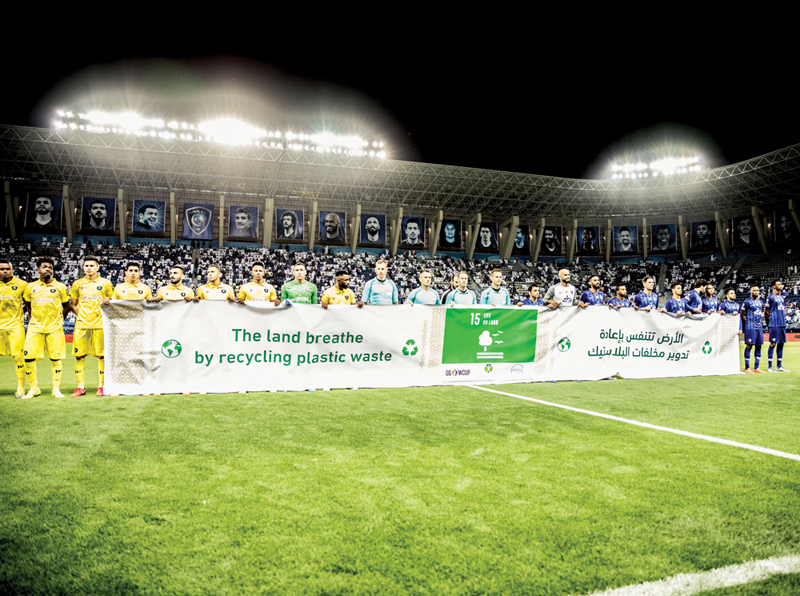
The Greens promoted their cause at a football match. (Supplied photo)
The environmental protection campaign was not confined to Riyadh alone. A clean-up drive was undertaken by the Greens at a public park in Alkhobar, in Saudi Arabia’s Eastern Province, while awareness talks were held in Jeddah about how plastic harms marine life.
“These campaigns are really important,” Alarfaj said. “A lot of young people volunteered to help us and it’s something that needs to be a part of the culture.”
Such campaigns gain the team points toward their final tournament score. “Global Goals isn’t just about football,” she said. “It’s about the SDGs and how to achieve them through sports, specifically female football. It’s very good to take part in sports for a cause and to have this culture in Saudi Arabia.”
Having taken part in the GGWC this year, the Greens hope to host the tournament in the Kingdom in a couple of years. “To win, you can’t just go out and play,” Alarfaj said. “You have to organize these campaigns and engage society in the goal you choose.
“Sports is the most peaceful activity which people can use to espouse a cause,” she said. “So I recommend that people get more engaged with sport and use it as a tool to spread awareness about different causes.”
Lujain Kashgari, 28, discovered she loved football when she was only 8 years old. She used to play the sport with her relatives as children.
As she grew older, so did her passion for the beautiful game. “It’s my favorite hobby and biggest passion today,” said Kashgari, who was originally from Jeddah but lives in Alkhobar at present.
“My mission was to come up with an initiative that engaged the people of Eastern Province and also made a big impact on Life on Land through plastic recycling.”
A lot of young people volunteered to help – it’s something that needs to be a part of the culture.
Greens coach Rawh Alarfaj
To this end, Kashgari asked residents and communities to donate 10,000 plastic bottles to a recycling center. She also targeted children by organizing a fun learning day in the Altamimi public park, while teaching others in schools about the importance of recycling through playing a game.
“What I really liked about the GGWC is that it combines sports with humanities and a good cause,” Kashgari told Arab News. “I have learnt a lot about sustainability and simplicity, while enjoying every moment of the football tournament and scoring three goals. It was an amazing opportunity and an unforgettable experience.”
She said many Saudis lack awareness of ways to implement the specific goal of Life on Land.
“When I read about the Life on Land global goal, especially the concept of the three Rs (recycle, reuse and reduce), and looked around, even at myself, I realized that we might have known about it, but we needed a reminder,” Kashgari said.

their clean-up campaigns have attracted the interest of young Saudi volunteers. (Supplied photo)
“Even when we reached out to recycling centers, we found that they don’t really take plastic bottles unless it’s a massive amount. They don’t support communities or individuals, so I realized it’s very important that we do something about it and give it more attention.”
As a football club, the Greens were able to collect plastic bottles over a period of two weeks to recycle them. It also collaborated with five schools and two sports clubs in Alkhobar to collect 100 tons of plastic bottles, utensils and plates — the minimum required for recycling at the center.
According to Alyah Aboalola, a Greens player from Jeddah, more needs to be done for environmental protection in the Kingdom.
“I was focused more on raising awareness about the sea because local residents in Jeddah are into scuba diving as part of their interest in life under water,” Aboalola, 24, said. “There’s a lot of plastic being thrown into the sea, which affects the quality of marine life and coral life.”
Currently involved full time with a sports academy, Aboalola said she was thrilled as a Greens player to have reached the semifinals in Copenhagen.
“I’d like to do this professionally later on,” she said. “When you take part in sports, you build a community and, through it, we can do more for society. I’d like to always keep sports and environmental
causes connected.”


