

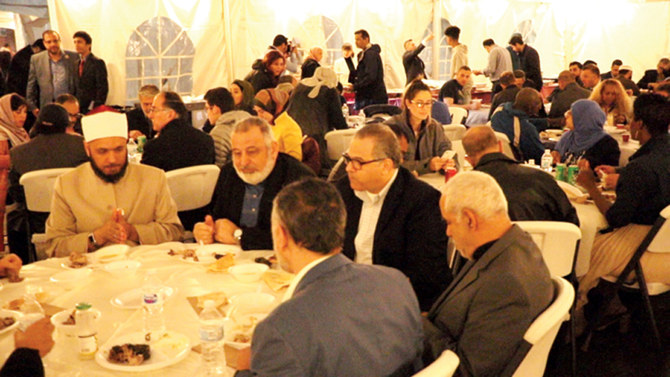

DETROIT, US: For many American Muslims, iftar is more than just the breaking of the fast at sunset each evening during the holy month of Ramadan. It is an opportunity for them to build bonds by gathering with non-Muslims to convey a better understanding of Islam.
Throughout the country, Muslims are inviting non-Muslims, including public officials, to join them during iftar. The non-Muslims are leaving the gathering with stronger ties and a better understanding of Islam and America’s growing Muslim community.
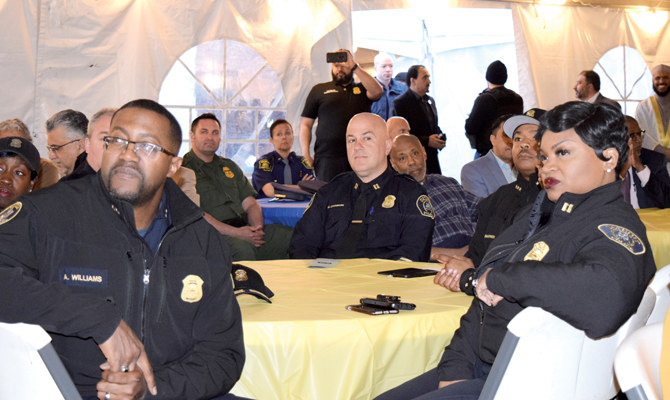
The Islamic Center in Detroit (ICD), the largest mosque in the Midwest, launched an initiative to establish the “Ramadan tent,” which provides free iftar meals for Muslims and non-Muslims, as well as offering free sahoor during the last 10 days of the holy month. The mosque has also organized breakfast events for a variety of public figures in the American community to strengthen cooperation between the ICD and American institutions.
“As the holy month of Ramadan is taking place, Muslims all over the world use this month to focus on their spirituality,” ICD Executive Director Sufian Nabhan said.
“We find many ways to increase our service to God. One of the most satisfying rewards is feeding the less fortunate in our community. Each night during Ramadan, over 200 families are our guests at this most worthy demonstration of man’s love and caring for other fellow human beings.”
Special hours
Often in communities with sizable Muslim populations within Greater Detroit, such as Dearborn, Hamtramck, and increasingly suburbs like Canton and Troy, you will see restaurants set up special Ramadan hours to accommodate their practicing customers, with some staying open 24/7. Dearborn, which is one of the largest communities of American Muslims, is sometimes known as the Muslims’ Plymouth Rock, a reference to the spot where European explorers on the Mayflower first set foot in the “New World” in 1620.
The ICD invited several major mainstream news media representatives to share iftar in recognition of the role they play in educating the community on important issues, including on the Muslim community.
Veteran journalist Walter Middlebrook, a former assistant manager at Detroit News, said the gathering was “an important step to learn about the cultures and issues of Arab communities” as part of American society.
“Every media outlet in the city has an open door for your concerns, and it is up to you to come and make us accountable,” Middlebrook said. “You are who make us responsible, so we need you as much as we hopefully wish you realize that you need us. We can all work together to make our city a better place.”
Journalist Priya Mann of Detroit’s Channel 4 TV news station also spoke, adding that the iftar allows the mainstream news media to convey accurate images and understandings of Islam to non-Muslims in America.
“This event is a great opportunity to connect the components of American society and to identify unique stories from the community and to express them through the media,” Mann said.
“It is so important that we build bridges and to talk to one another and discuss how to cover certain stories. I think the more all of us get around the table together, the greater the opportunity to deliver fair and valuable journalism.”
Having people from various parts of community attend is important. But to have a dialogue is what makes the gathering more valuable.
Khalil Hachem, a host on the US Arab Radio morning program in Michigan, said that the focus on news media personalities and the media is important.
“We want our community to understand what is going on,” he said. “There are two kinds of media: Streaming media and community news which is very important these days because most newspapers and TV stations do not have the staff to focus on every community as well as they should. We need to tell our story because no one knows it better than us and we are going to tell it to everybody.”
He also highlighted the role of journalism in supporting members of the community to render achievements, whether they are in the form of appointments or people who won elections.
Mark Hawkes, a Detroit News columnist and religious affairs writer, also expressed his desire to get in touch with Islamic religious centers to learn more about the Muslim community’s culture.
Madeleine Moytuzu, a documentary filmmaker and freelance journalist, is working on a documentary series that focuses on Muslim immigrants in America.
“I am learning so much about your community this evening, there is so much misunderstanding, so having this kind of conversation would change our community.”
One of the ICD iftars was attended by Detroit Mayor Mike Duggan and various key officials. The mayor of Detroit said he has been attending iftar banquets with Muslims for three years.
He added that despite the attacks led by some politicians against the Muslim community, the community is continuing to build bridges of communication with other parts of American society.
Michigan Congresswoman Debbie Dingell also hosted an iftar reception, preserving a tradition started by her late husband, former Congressman John Dingell. He was one of the first non-Muslims to host iftars to bring Muslims and non-Muslims together to recognize the issues, concerns and traits they all shared.
She stressed the importance of standing up to the discourse of fear, hatred and discrimination. She said it was important to hold such an event annually, both to honor the holy month of Ramadan and to commemorate her husband, who died earlier this year.
In his speech, Sam Beydoun, a member of the provincial financial committee, highlighted the philosophy behind fasting.
Dr. James Zogby, the president of the Arab American Institute, joined from Washington to talk to audiences about the problems Arabs and Muslims face in confronting Islamophobia in the West.
“We are witnessing a leap in the community members holding governmental, executive and legislative positions through the nomination and election process,” Zogby said, stressing that time is the most appropriate to work and protect the community’s rights.
The observance of Ramadan traditions, along with the gathering of Muslims and non-Muslims, will culminate after the last day of Ramadan in the celebration of Eid Al-Fitr.
The final three-day commemoration will underscore many of the understandings that have been shared during the past month of Ramadan.


