

Ramadan in Saudi Arabia: The Musaharati tradition

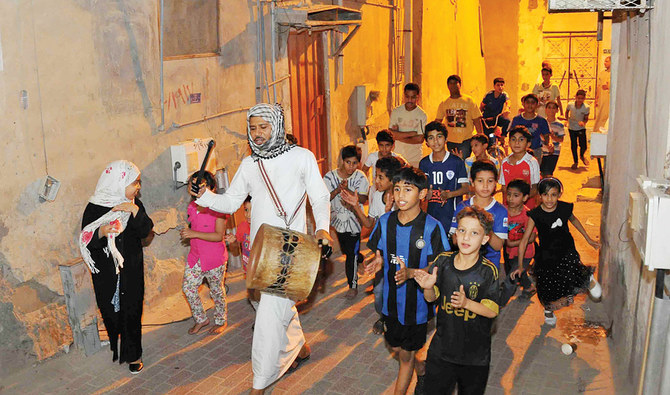
Musaharati’s job is to wake worshippers for their suhoor meal. (SPA)
Updated 24 May 2019
Follow

Ramadan in Saudi Arabia: The Musaharati tradition

  • The Musaharati profession is one of the oldest Ramadan traditions in Al-Ahsa in the Kingdom’s east

Despite the march of modern technology, old Ramadan traditions continue to die hard for Muslims in the Kingdom’s largest province.

The job of Musaharati is the name given to the person who walks and beats a drum in residential areas to wake worshippers for their suhoor meal. In the Eastern Province, where the custom remains a deep-rooted part of the holy month, the drummer is known as Abu Tabila.

The fasting month is not complete in Al-Ahsa governorate without him roaming the streets before dawn prayers. Adults and children often come out of their homes or peer from windows to watch Abu Tabila pass by beating his small drum while reciting prayers.

The Musaharati profession is one of the oldest Ramadan traditions in Al-Ahsa, and every town has its own Abu Tabila. He goes about his business until the end of Ramadan and people offer him money, gifts, sweets, and best wishes for Eid.

Although modern phone apps can alert worshippers, Al-Ahsa communities continue to adhere to time-honored ways.

Omar Al-Faridi, director of the Saudi Commission for Tourism and National Heritage (SCTH) in Al-Ahsa, said that Abu Tabila was known for his traditional folk clothes and boisterous voice.

Former director of the Al-Ahsa Archaeological and Heritage Museum, Walid Al-Hussein, described the beat of Abu Tabila’s drum as “unique and splendid,” and a sound that evoked the true spirit of Ramadan. 


Separation of Somali conjoined twins Rahma and Ramla begins in Riyadh

Updated 14 sec ago
Follow

Separation of Somali conjoined twins Rahma and Ramla begins in Riyadh

  • Surgery to take 14 hours in 8 stages with 37-member team
  • Initiative is led by leading surgeon Dr. Abdullah Al-Rabeeah

RIYADH: Surgery to separate Somali conjoined twins Rahma and Ramla is underway at the King Abdullah Specialized Children’s Hospital of the Ministry of the National Guard in Riyadh.

The children came with their parents to Saudi Arabia upon King Salman’s directives in May last year and were transferred to the hospital for tests to determine whether the operation would be safe.

An official of the Saudi Conjoined Twins Program told Arab News that in addition to the complexity of the intervention, there was also a waiting list of other children.

Dr. Abdullah Al-Rabeeah, who heads the SCTP’s teams and is also supervisor-general of the Saudi aid agency KSrelief, said the 13-month-old girls who arrived on May 6 were joined at the lower abdomen and pelvis. 

“Each twin has two complete lower limbs, and they share a pelvic bone, colon and rectum, with overlaps in the urinary and reproductive systems,” said Al-Rabeeah.

He explained that Ramla suffers from complete atrophy of both kidneys and would need immediate dialysis after separation.

Rahma suffers from complete atrophy of her left kidney, and there are cysts in her right kidney, which is currently functioning adequately but would require close monitoring following surgery to ensure its continued function, he added. 

Al-Rabeeah said the risk was 40 percent due to the case’s medical challenges. The situation was explained in detail to the twins’ parents, who accepted the plan to separate the girls, he added.

He said the procedure is expected to take about 14 hours in eight stages, and would involve 37 consultants, specialists, nurses and staff in the fields of anesthesia, pediatrics, orthopedics and plastic surgery.

He said Rahma and Ramla will be the 68th pair of conjoined twins to be separated under the program, which began 35 years ago. 

Al-Rabeeah thanked the Saudi leadership for supporting the initiative over the years. He prayed for the success of the separation, which he said would give the girls the best chance to live happy and healthy lives.