

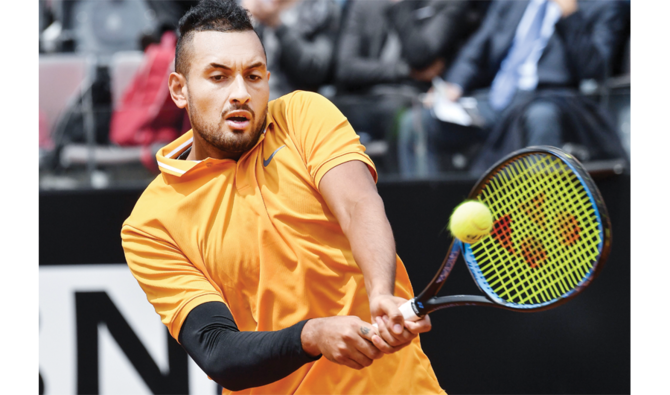

PARIS: After a tantrum in Italy last week, Nick Kyrgios withdrew from the French Open on Friday.
The ATP said the Australian player cited illness as the reason.
Last week at the Italian Open, the 36th-ranked Kyrgios was defaulted and fined during his second-round match after an outburst of rage. Trailing against Norwegian qualifier Casper Ruud, Kyrgios slammed his racket to the clay and kicked a water bottle. Then he picked up a white chair and flung it onto the court.
Kyrgios was fined and lost ATP points but escaped suspension and was expected to play in Paris.
His withdrawal came only days after Kyrgios posted a video online in which he said the French Open “sucks” when compared to Wimbledon, where he trained recently.
In 2015, Kyrgios insulted Stan Wawrinka with crude remarks during a match in Montreal. He was fined $12,500 and given a suspended 28-day ban. He also attracted criticism for deciding not to play at the Olympics because of a spat with an Australian team official, and for firing back at retired players who have offered advice.
Also on Friday, Roger Federer played down his chances of winning the French Open on his first appearance at Roland Garros since 2015, saying that title-winning form might not be “in his racquet.”
The 20-time Grand Slam champion missed the French Open in 2016 through injury before sitting out the next two clay-court seasons in order to focus on Wimbledon.
But he will make his Roland Garros return on Sunday with a first-round tie against unheralded Italian Lorenzo Sonego.
Federer admitted that he is unsure of his title chances, but did compare his current situation with when he ended a five-year Grand Slam drought at the Australian Open in 2017.
“(I) don’t know (if I can win the tournament). A bit of a question mark for me. Some ways I feel similar to maybe the Australian Open in ‘17,” the 2009 French Open winner said.
“A bit of the unknown. I feel like I’m playing good tennis, but is it enough against the absolute top guys when it really comes to the crunch? I’m not sure if it’s in my racquet.
“But I hope I can get myself in that position deep down in the tournament against the top guys. But first I need to get there and I know that’s a challenge in itself.”
Despite being the third seed, Federer faces a tricky draw, with a possible quarter-final against Greek youngster Stefanos Tsitsipas — who beat him in the Australian Open last 16 — and a potential last-four clash with 11-time champion and old adversary Rafael Nadal.
Meanwhile, Nadal said on Friday that he “doesn’t care” if he is the red-hot favorite to lift a record-extending 12th French Open title, insisting that there are a host of players in contention for the trophy.
The world number two holds an incredible French Open win-loss record of 86-2, and hit top form by winning his ninth Italian Open last week with a final victory over old rival Novak Djokovic.


