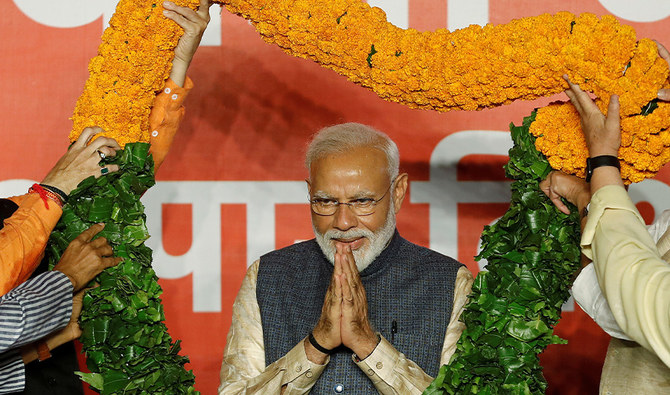
ISLAMABAD: Pakistani Prime Minister Imran Khan took to Twitter on Thursday to congratulate India’s Narendra Modi on the runaway election win of his Hindu-nationalist Bharatiya Janata Party (BJP), a gesture the newly elected two-time Indian prime minister reciprocated with his own conciliatory message.
The messages of peace come after Narendra Modi returned to power in New Delhi in an election fought in the wake of confrontation between the nuclear-armed enemies. Modi’s victory is also widely believed to have been achieved on the plank of a tougher stand on national security, including ties with arch-rival Islamabad.
The two nations have had tense relations in recent months following a confrontation that saw them carry out an aerial bombing mission against each other earlier this year, and even fight a brief dogfight, before tensions subsided.
“I congratulate Prime Minister Modi on the electoral victory of BJP and allies,” Khan said in a Twitter post. “Look forward to working with him for peace, progress and prosperity in South Asia.”
Shortly after a victory speech before thousands of supporters gathered outside the BJP’s headquarters on Thursday evening, Modi thanked Khan: “I warmly express my gratitude for your good wishes. I have always given primacy to peace and development in our region.”
Official data from India’s Election Commission showed Modi’s BJP on course to increase its majority in India’s parliament, the first back-to-back majority for a single party since 1984.
While tackling economic problems at home, Modi will also keep a close eye on relations with Pakistan during his second term as prime minister.
Pakistan on Wednesday signaled a willingness to open talks, with Foreign Minister Shah Mehmud Qureshi saying after briefly meeting his Indian counterpart Shushma Swaraj at the sidelines of a meeting of the Shanghai Cooperation Organization member states in the Kyrgyz capital, Bishkek: “We never speak bitterly, we want to live like good neighbors and settle our outstanding issues.”
“I told Sushma that we are still firm on the statement of Prime Minister Imran Khan that if India takes one step forward, Pakistan would reciprocate with two,” Qureshi added.
Despite the foreign minister’s reconciliatory tone, as it became clear on Thursday that Modi was set to win the massive, multi-stage poll, Pakistan’s army test fired a surface-to-surface ballistic missile capable of delivering conventional and nuclear weapons in what was seen as a veiled warning to India.
The dispute over the former princely state of Kashmir, which both countries claim in full but rule in part, sparked the first two of three wars between India and Pakistan after independence in 1947.
On Thursday, a Pakistani foreign ministry spokesman said the Kashmir dispute could only be resolved through implementation of UN Security Council resolutions that call for an end to hostilities and a plebiscite in the region.
“Dialogue is hence essential. We remain committed to the same, irrespective of whoever forms the new government in India,” he told reporters in Islamabad.
Khan has repeatedly offered to start talks with India to resolve the Kashmir issue, which has been the cause of two of three wars between the countries, and officials have said that they hoped the process could start once the election is concluded.
Last month he said he believed there was more prospect of peace talks with Indian if the BJP won the election.
“Pakistan will be in a position to present the new Indian government with a historic opportunity to frame a new deal for this region and its prosperity,” Mosharraf Zaidi, columnist and foreign policy analyst, told Arab News, commenting on prospects for peace between India and Pakistan following India’s landmark poll.
Zaidi said all issues including Kashmir could be resolved through dialogue and urged political consensus within Pakistan before proceeding with negotiations with India.
“None of these issues are unresolvable,” he added. “But at least within Pakistan, a serious effort at detente and normalization with India demands a wide spectrum of political ownership.”


![]()

Pakistan, India make conciliatory overtures as Modi clinches second term as PM
Pakistan, India make conciliatory overtures as Modi clinches second term as PM
- Khan says looking forward to working with Modi for “peace, progress and prosperity in South Asia”
- Modi says has always given "primacy" to peace and development in the region
Latest updates


© 2026 SAUDI RESEARCH & PUBLISHING COMPANY, All Rights Reserved And subject to Terms of Use Agreement.